Quick Summary
- Selene is the Greek goddess of the moon, daughter of the Titans Hyperion and Theia, sister of Helios the sun and Eos the dawn.
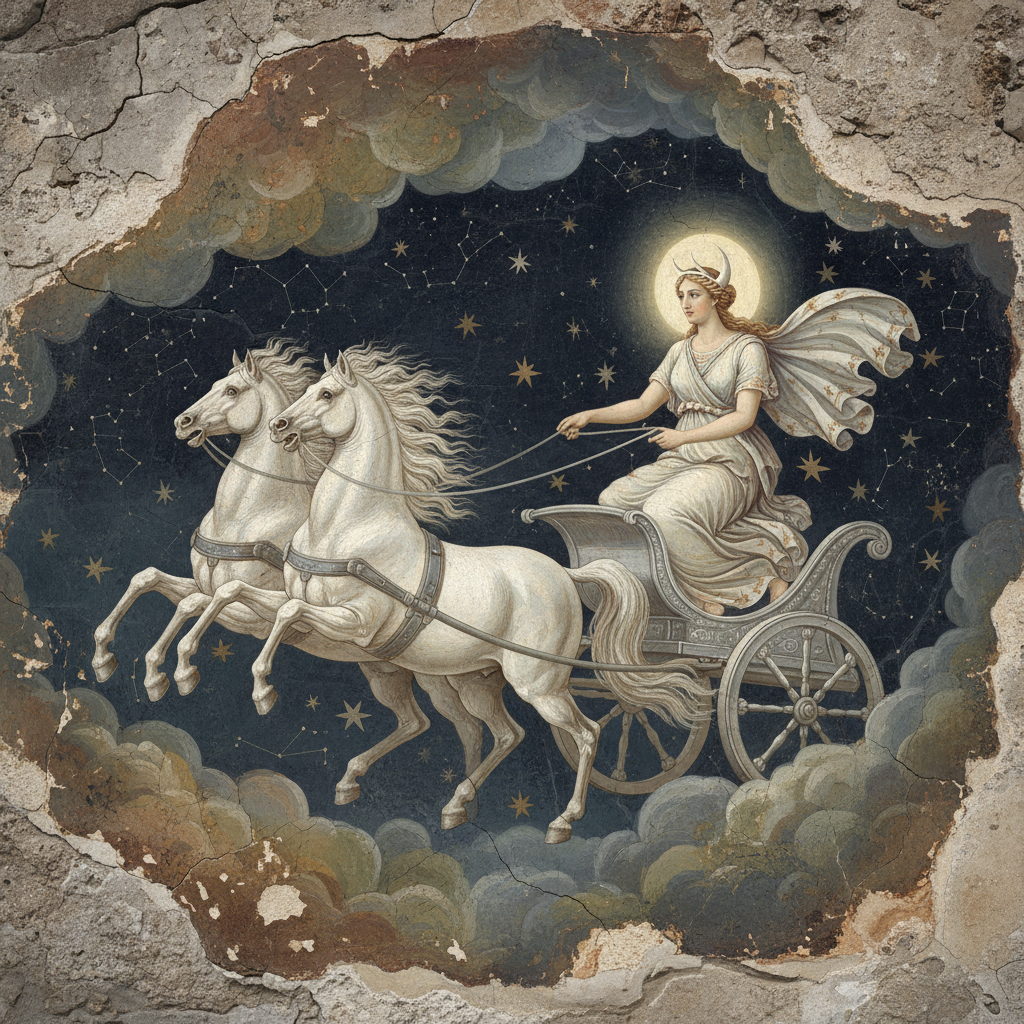
- She drives a silver chariot drawn by white horses or oxen across the night sky each night.
- Her most famous myth is her love for the mortal shepherd Endymion, whom Zeus placed in eternal sleep so that Selene could visit him each night.
- In later Greek tradition she was conflated with Artemis and with Hecate, becoming part of a triple goddess of moon, hunt, and underworld magic.
- Her name gives science the elements selenium and the prefix seleno- for everything related to the moon.
The full moon rises over the Aegean. The white light spreads across the water. Somewhere on a quiet hillside in Caria, a shepherd lies asleep, eternally young, eternally still. The moon goddess descends from her chariot, leaves the sky for an hour, and bends over him to kiss his lips. He does not wake. He never wakes. Each night she returns, finds him sleeping, kisses him again, and rides on. He is hers, and she is the moon, and the bargain has lasted longer than any human marriage.
This is Selene, the Greek goddess of the moon. She drives a silver chariot through the night sky every night while the world below sleeps. Her myth is quieter than her brother Helios’s, less melodramatic than her sister Eos’s, but among the most haunting in the entire Greek pantheon.
Origins and Cultural Roots
Selene (Σελήνη) is the daughter of the Titans Hyperion and Theia, sister of Helios the sun and Eos the dawn. She belongs to the older generation of Greek gods, the Titans, who preceded the Olympians. Each of the three siblings governs a celestial domain. Helios drives the sun. Eos brings the rosy fingered dawn. Selene drives the moon.
Her name comes from the Greek selas, light or brightness, and is etymologically related to a wide family of Indo-European words for shining and gleaming. She is the bright one. Her chariot is drawn by white horses, oxen, or in some sources by mules. She wears a crown shaped like a crescent moon. She is depicted in Greek art on coins, pottery, and reliefs from at least the 6th century BCE.
Like her brother Helios, Selene was eventually partly absorbed by another Olympian, in her case Artemis. The two remain distinct in the early sources, but by the Hellenistic period they were often treated as aspects of the same goddess. The triple-form Hecate-Artemis-Selene, ruling underworld, earth, and sky aspects of moon-magic, became a powerful figure in late Greek and Roman religion.

Selene and Endymion
The most famous Selene myth is her love for Endymion, a mortal shepherd or king of Elis, depending on the version. Selene saw him asleep on Mount Latmus in Caria, in what is now western Turkey, and fell in love with his beauty. Knowing that mortals must age and die, she begged Zeus to grant Endymion eternal youth. Zeus agreed, on the condition that Endymion be eternally asleep. Selene accepted. Endymion sleeps forever in his cave on Latmus, eternally young, while Selene visits him each night.
Different ancient sources give different details. Some say Endymion is the king of Elis. Some say he is a hunter. Some that he asked for eternal sleep himself. In the most haunting versions, Selene bears him fifty daughters during his eternal slumber, the fifty Menai who personify the fifty months of the four-year Olympic cycle. The image of the moon goddess loving a sleeping man, leaning over him each night, is one of the most intimate scenes in Greek mythology.
The story has been adapted by countless Greek and Roman poets, by Renaissance artists, and by Romantic poets including John Keats, whose long poem Endymion (1818) reworks the myth around a young man searching for an unattainable lover.
The Conflation with Artemis and Hecate
By the late classical and Hellenistic periods, Selene was increasingly identified with Artemis, the Olympian goddess of the hunt, and with Hecate, the goddess of crossroads and witchcraft. The three came to be understood as aspects of a single triple goddess, with Selene ruling the moon in the sky, Artemis the moon-as-huntress on earth, and Hecate the dark moon and the underworld magic. The triple form became central to Greco-Roman magical practice.
This kind of theological consolidation is typical of late Greek religion, where the boundaries between deities became increasingly fluid. Helios merged with Apollo. Selene merged with Artemis. The original distinct figures continued to be invoked separately in some contexts, but the merged forms also took hold. The modern reader meets all three: Selene the original moon goddess, Selene-Artemis the hunting moon, and Selene-Artemis-Hecate the triple goddess.

Symbolism and Meaning
Selene is the Greek personification of the night sky’s most striking object. Where the sun is the engine of the day, the moon is the slow companion of the night, the lamp that watches over sleep. To the Greeks, the moon was a goddess driving a chariot, just as the sun was a god driving a chariot. Both were active beings, not natural phenomena. Both were watched, named, and worshipped.
What makes Selene distinctive among Greek deities is her quietness. She does not have epic cycles of betrayal, wars, or grand intervention in mortal affairs. Her great myth is a love story that involves no war, no death, no scandal, only an eternal kiss. The moon is associated with quiet, with night, with rest, and Selene reflects all three. She is the goddess of the small hours.
Cross-cultural connections are striking. The Roman Luna is Selene under another name. The Egyptian Khonsu and Thoth share lunar associations. The Vedic Chandra is the male Hindu moon god. The Norse Mani is the male moon, brother of Sol the sun. The Greek imagination of the moon as feminine is one cultural choice among many: in some traditions the moon is male, in some female, in some genderless. The Greeks chose a goddess.

Legacy and Modern Influence
Selene’s name has had a wide afterlife. The chemical element selenium, discovered in 1817, was named after her because it was found in association with tellurium (named after Earth). Everything related to the moon in scientific naming uses the prefix seleno-: selenology, selenotopography, selenocentric. The first crewed lunar landings of NASA’s Apollo program ironically borrowed her brother’s name, but the moon itself is still hers in scientific Latin.
In modern fiction, Selene is a frequent character. Rick Riordan’s The Olympians series includes her. The 2009 anime Soul Eater features a Selene-derived character. Various novels, video games, and films draw on her image. Her place in modern paganism, especially within the broader Hecate-Artemis-Selene triad, remains active. The Endymion myth continues to inspire Romantic literature, opera, and ballet.
For modern readers, Selene offers a quieter mythology than the loud dramas of Olympus. She does what she does. She drives the moon across the sky every night. She visits her sleeping lover. She has done this for three thousand years. She will, in some sense, continue.
More From Greek Mythology
Continue exploring the gods, monsters, and heroes of ancient Greece. New encyclopedia entries published every week.
Explore MoreFrequently Asked Questions
Who is Selene in Greek mythology?
Selene is the Greek goddess of the moon, daughter of the Titans Hyperion and Theia. Her brother is Helios the sun and her sister is Eos the dawn. She drives a silver chariot drawn by white horses across the night sky.
What is the Selene and Endymion myth?
Selene fell in love with Endymion, a mortal shepherd of Caria. To preserve his beauty forever, Zeus placed him in eternal sleep at her request. Selene visits him each night in his cave on Mount Latmus, kisses him, and rides on with her chariot.
Is Selene the same as Artemis?
In early Greek religion they are distinct: Selene is the literal moon goddess, Artemis is the Olympian goddess of the hunt. By the Hellenistic period they were often conflated, alongside Hecate, into a triple moon-and-magic goddess. The original distinction is preserved in many sources.
Does the element selenium come from her name?
Yes. Selenium, discovered in 1817, was named after Selene because it was found in association with tellurium, named after Earth. The same root provides the scientific prefix seleno- for everything related to the moon.
How is Selene shown in art?
Greek art shows her as a young woman in a flowing robe, often crowned with a crescent moon, driving a silver chariot drawn by white horses or oxen. She appears on coins, pottery, and temple reliefs from at least the 6th century BCE onward.
How does Selene compare to other moon deities?
The Roman Luna is Selene under another name. The Egyptian Khonsu and Thoth have lunar associations. The Vedic Chandra is the male Hindu moon god. The Norse Mani is the male moon. Different cultures choose different genders and characters for the moon, but all recognise it as worth personifying.