Quick Summary
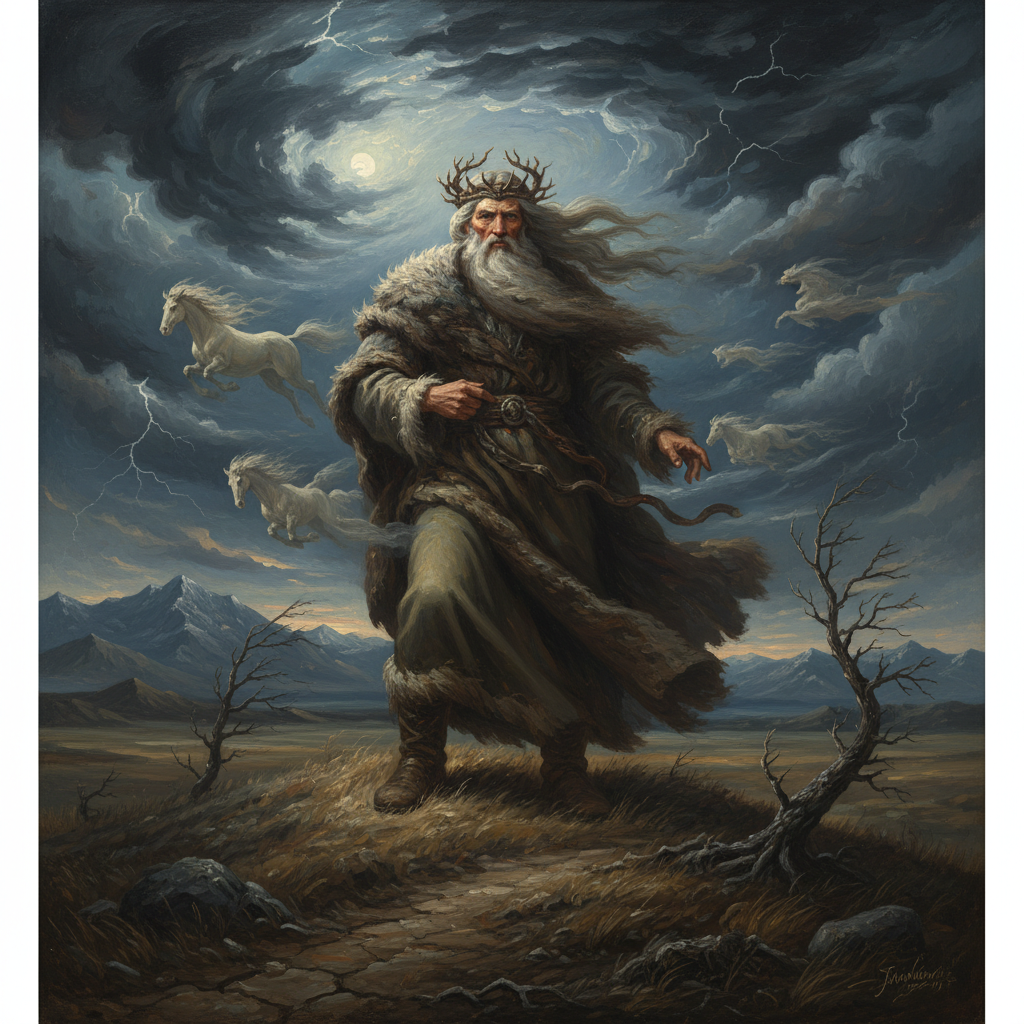
- Stribog is the Slavic god of wind, air, and storms, called “wind grandfather” in some traditions for his ancient and patriarchal role.
- He is mentioned by name in the 12th-century Russian epic Tale of Igor’s Campaign and in the Primary Chronicle of Kievan Rus.
- The winds are sometimes called the “grandsons of Stribog” in surviving Slavic poetry, suggesting a family of subordinate wind spirits.
- His worship was suppressed at the Christian conversion of Kievan Rus in 988 CE, but his name survives in folk tradition and in modern Slavic neopaganism.
- Stribog belongs to the cross-cultural family of wind deities that includes the Greek Anemoi, the Japanese Fujin, and the Hindu Vayu.
The wind comes off the steppes of Eastern Europe with no obstacle in its way. It rises in the cold north and runs across the open grasslands for hundreds of miles before it reaches the towns. The Slavs who lived under that wind gave it a name. They called the wind grandfather. They called him Stribog. The wind, in the old Slavic understanding, had children, the gusts and breezes, and Stribog was the patriarch of them all.
Stribog is one of the more shadowy figures in Slavic mythology. The conversion of the Slavs to Christianity in the 9th and 10th centuries swept away most of the systematic theology that the pre-Christian Slavs had built. What survives are fragments: a name in a chronicle, a phrase in an epic, a folk custom that may or may not preserve an older meaning. Stribog is one of those names that survived, mentioned twice in the most important Old Russian sources, and folklorists and reconstructors have been working from those mentions ever since.
Origins and Cultural Roots
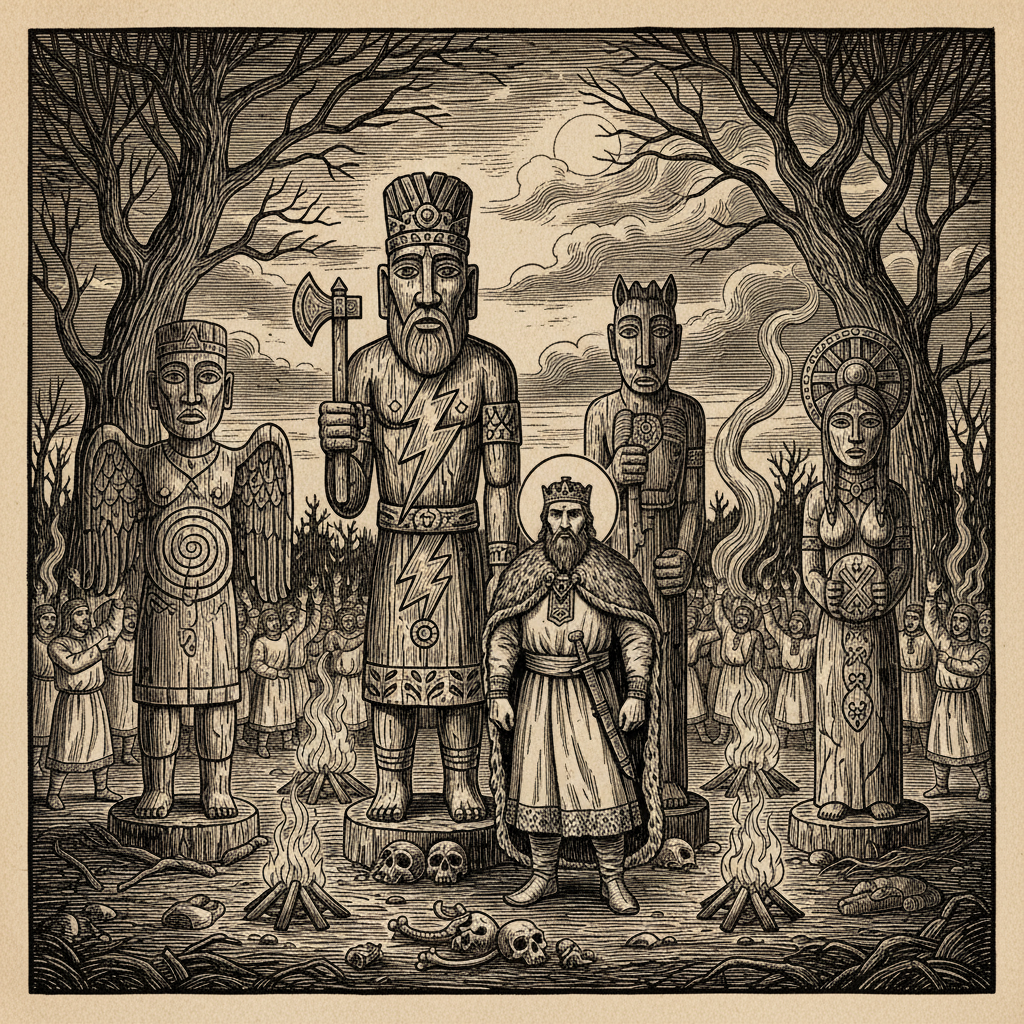
Stribog’s name appears in the Primary Chronicle (also called Nestor’s Chronicle), a 12th-century Old East Slavic text compiled in Kiev around 1113, in a list of pagan idols set up by Prince Vladimir of Kievan Rus in 980 CE. The chronicle records that Vladimir, who later converted to Christianity in 988, set up six idols in Kiev: Perun the thunder god, Khors the sun god, Dazhbog the giving god, Stribog, Simargl, and Mokosh. The list is one of our most important documents of pre-Christian Slavic religion.
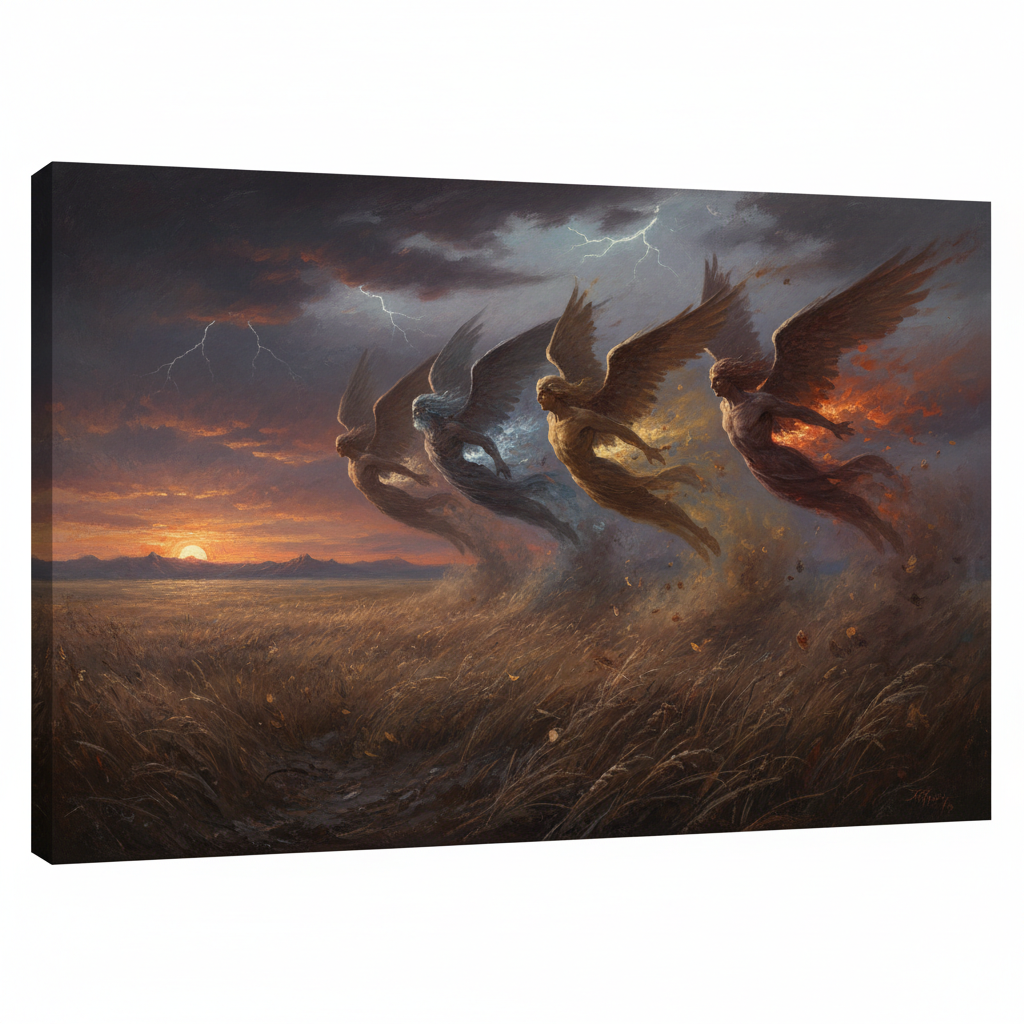
The second major mention is in the late 12th-century Russian epic The Tale of Igor’s Campaign, where the winds blowing across the battlefield are called “the grandsons of Stribog”. The phrase is significant. It tells us that Stribog was understood as the source or progenitor of the winds, with subordinate wind spirits descending from him.
His name has been variously interpreted. Some scholars derive it from a Proto-Slavic root *stri-, perhaps meaning “father” or “elder”. Others connect it to a verb meaning “to spread” or “to disperse”, which would suggest the wind’s role in scattering. The modern Slavic linguistic root strib- appears in some words related to wind and dispersal. Whatever the precise origin, the name carries an air of antiquity and patriarchy.
The Wind Grandsons
The phrase “grandsons of Stribog” in The Tale of Igor’s Campaign has been the subject of considerable scholarly speculation. The phrase suggests a family of subordinate winds descended from the older Stribog, a structure parallel to the Greek Anemoi, who descend from Astraeus and Eos. The Slavic system, like the Greek, may have personified the winds as a family rather than as a single figure.
Folk traditions in Russia, Ukraine, and other Slavic regions preserve a number of subordinate wind spirits, sometimes named for directions, sometimes for seasons. The midday wind, the night wind, the wind from the east: each appears in some folk tradition with its own personality and customs. The fragmented evidence suggests that pre-Christian Slavic religion had a developed system of wind deities, with Stribog at the head, but the full structure is now beyond reconstruction.
Stribog in the Slavic Pantheon
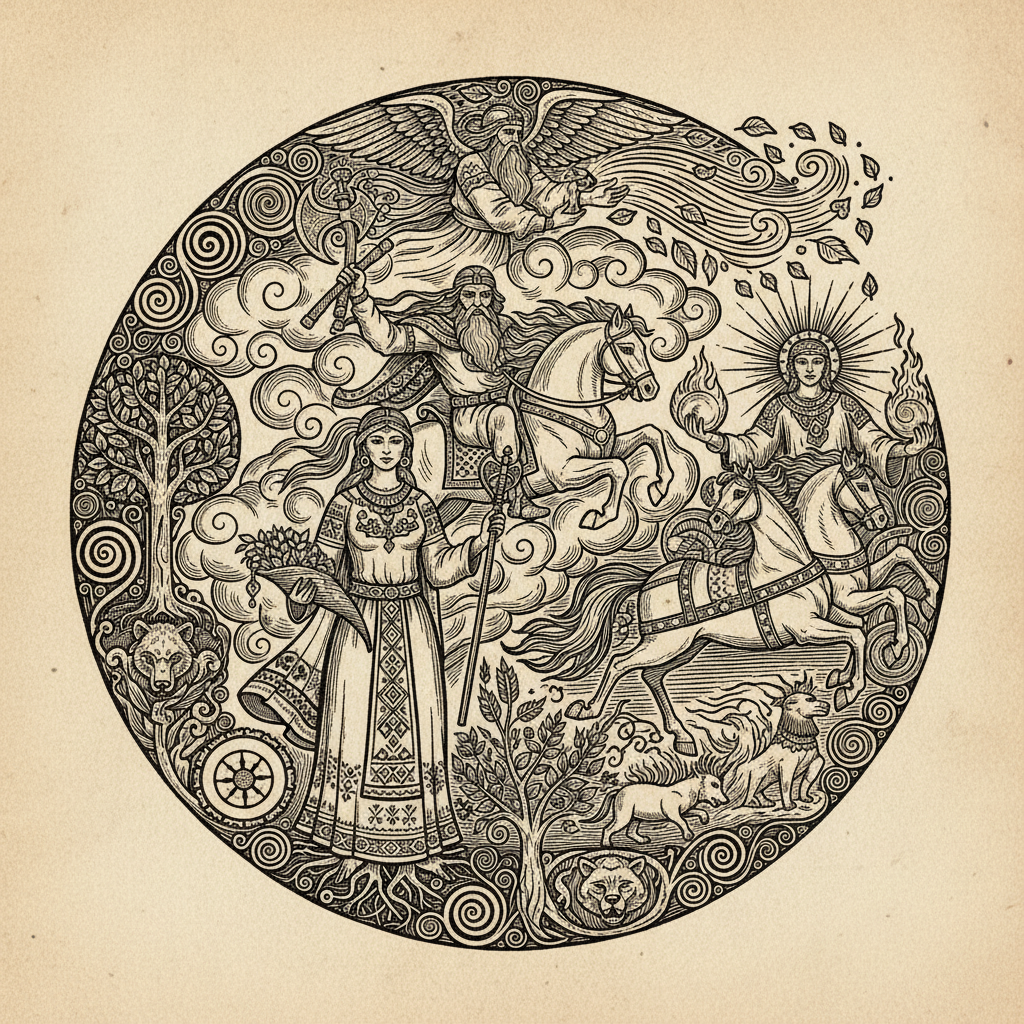
The Slavic pantheon as preserved by Vladimir’s idol-list and by later folkloric reconstructions includes a small group of major gods. Perun, the thunder god, is the most attested, with Indo-European cognates including the Hindu Indra and the Norse Thor. Dazhbog is a sun and giving god. Mokosh is a mother goddess associated with weaving and the earth. Marzanna, the winter goddess, comes from the same mythological world though her name is not on Vladimir’s list.
Stribog occupies a quieter position in this pantheon. He is not the most attested. He is not the focus of the surviving folk customs to the same degree as Marzanna or Mokosh. But his place in the official idol-list of Vladimir’s Kiev tells us he was significant enough to be among the six gods chosen for state-level worship. The wind grandfather mattered.
Symbolism and Meaning
Stribog embodies the Slavic understanding of wind as a patriarchal, ancestral force. Where the Greek Anemoi divide the wind into four directional brothers, where the Japanese Fujin compresses it into a single demon, the Slavs gave it a grandfather and a family of grandsons. The choice reflects something about the social structure of the early Slavs, where extended kinship was the basic unit of identity. The wind, like everything else, came in lineages.
His character is largely lost to us. We do not have stories of Stribog. We do not have his myths. We have his name in two important sources and a few folk fragments. Yet even these fragments tell us something. The wind was personified. The wind had ancestors. The Slavs lived under a sky populated by spirits.
Cross-cultural connections are important precisely because the surviving Slavic evidence is thin. The Greek Anemoi, the Vedic Vayu, the Japanese Fujin, the Iroquois Dagwanoenyent, the Aztec Ehecatl: all give us frameworks for thinking about what a wind god is and does. Stribog fits comfortably into this family even though we know less about him than about most of his cousins.
Legacy and Modern Influence
Stribog has had a vigorous second life in modern Slavic neopaganism, particularly within the rodnovery (native faith) movement that has grown across Russia, Ukraine, Poland, and other Slavic countries since the late 20th century. Practitioners honour him as part of the reconstructed Slavic pantheon, often pairing him with other deities from the Vladimir list.
His name appears in modern Slavic fantasy literature, in video games (notably Stribog figures as a Slavic warship name and as a character in some role-playing games), in heavy metal music, and in academic study of Slavic mythology. Polish, Russian, and Ukrainian folkloric studies continue to investigate the surviving fragments and propose reconstructions of his cult.
For modern readers, Stribog is a useful reminder of what mythology looks like when most of it has been lost. We have a name. We have a few phrases. We have a place in a list. From these we reconstruct as best we can. The fragmentary nature of the evidence is itself a kind of fact about Slavic religion: the sweep of Christianisation was thorough, and what survived survived in fragments. The wind grandfather is one of those fragments, blowing through the cracks in the historical record.
More From Slavic Mythology
Continue exploring the gods, spirits, and folk traditions of Eastern and Central Europe. New encyclopedia entries published every week.
Explore MoreFrequently Asked Questions
Who is Stribog in Slavic mythology?
Stribog is the Slavic god of wind, air, and storms, sometimes called “wind grandfather”. He is mentioned in the Primary Chronicle of Kievan Rus among the six idols set up by Prince Vladimir in 980 CE, and in the 12th-century epic Tale of Igor’s Campaign, where the winds are called his grandsons.
Why are the winds called grandsons of Stribog?
The phrase comes from The Tale of Igor’s Campaign, a Russian epic of the late 12th century. It suggests that Slavic mythology personified the winds as a family of subordinate spirits descended from the older Stribog, parallel to the Greek Anemoi who descend from Astraeus and Eos.
What does the name Stribog mean?
The etymology is debated. Some scholars derive the name from a Proto-Slavic root meaning “father” or “elder”, consistent with his role as a patriarchal wind grandfather. Others connect it to a verb meaning “to spread” or “to disperse”, reflecting the wind’s role.
Where was Stribog worshipped?
The Primary Chronicle records that an idol of Stribog stood in Kiev among the six pagan idols set up by Prince Vladimir in 980 CE. He was likely worshipped across the broader Slavic world before the Christian conversion of Kievan Rus in 988 CE. Active worship was suppressed thereafter, surviving only in folk fragments.
Is Stribog related to other wind gods?
Yes. He belongs to the wider Indo-European and cross-cultural family of wind deities, alongside the Greek Anemoi, the Vedic Vayu, the Japanese Fujin, the Iroquois Dagwanoenyent, and the Aztec Ehecatl. Like several of these, he heads a family of subordinate wind spirits.
Is Stribog still worshipped today?
Active religious worship of Stribog ended with the Christian conversion of Kievan Rus in 988 CE. He has been revived in modern Slavic neopaganism, particularly the rodnovery movement, alongside other reconstructed gods of the Vladimir list. He also appears in modern Slavic fantasy literature and gaming.