Quick Summary
- Khepri is the ancient Egyptian god of the rising sun, depicted as a scarab beetle or as a man with a scarab for a head.
- His name comes from the Egyptian verb kheper, meaning “to come into being”, and he is the god of becoming and self-creation.
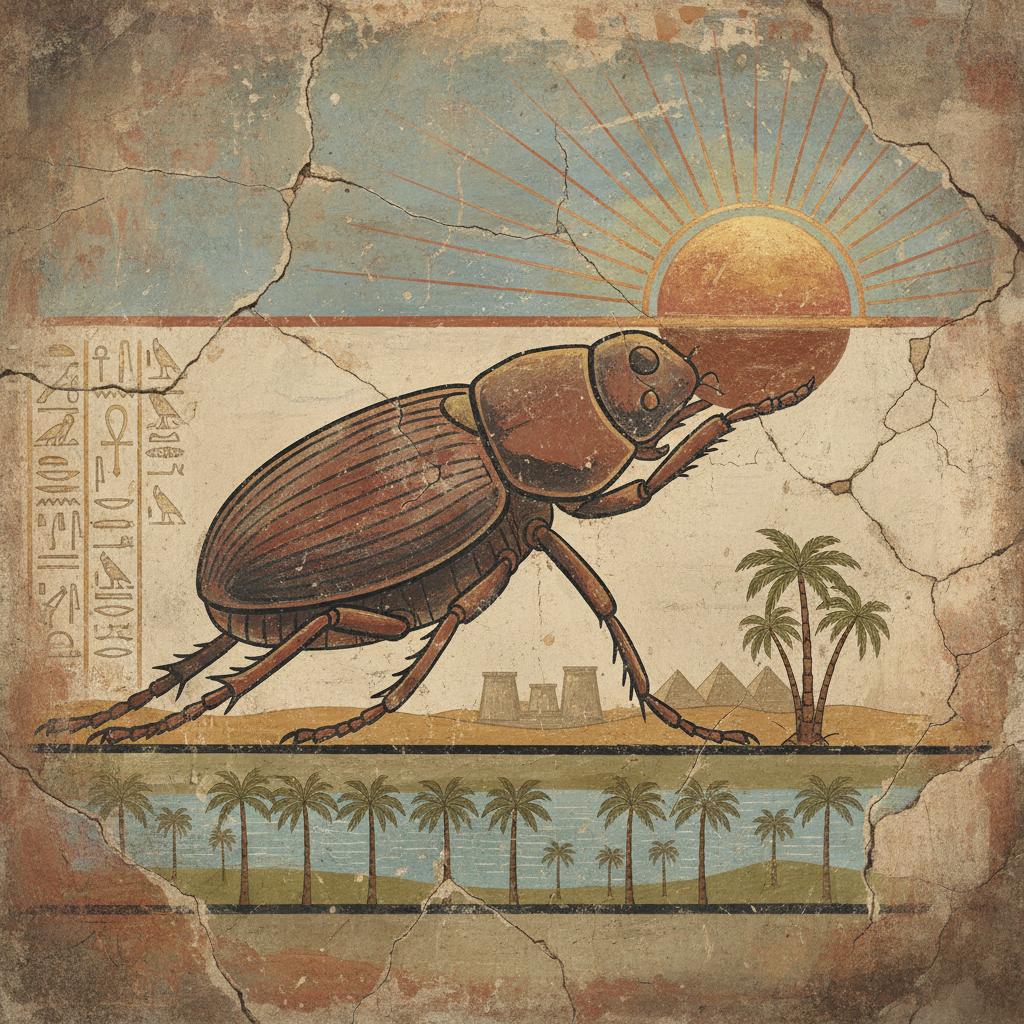
- The Egyptians observed scarab beetles rolling balls of dung across the desert and saw in them an image of the sun being pushed across the sky.
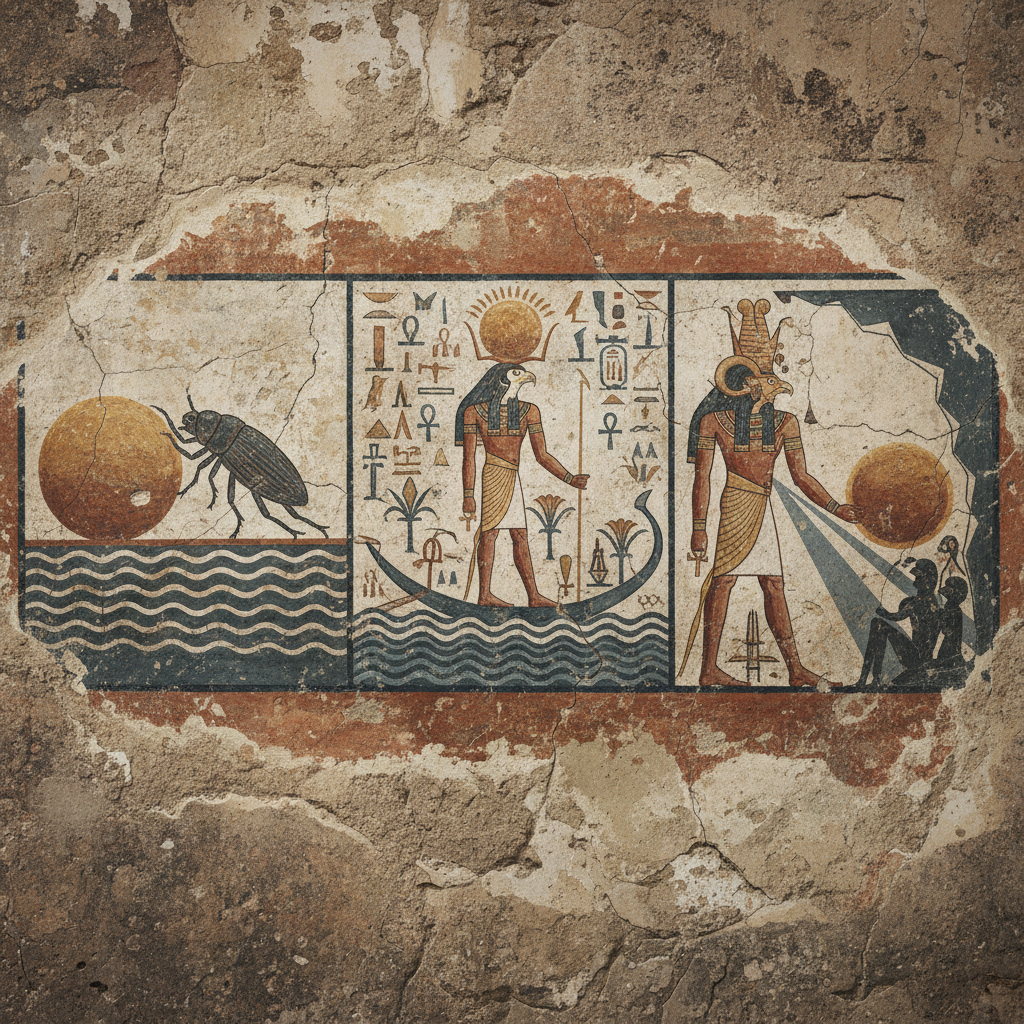
- Khepri represents the morning sun, complementing Ra (the midday sun) and Atum (the evening sun) in a tripartite division of solar deity.
- The scarab amulet, carved with Khepri’s image, was one of the most widely worn protective objects in ancient Egypt and remains the most recognisable Egyptian motif today.
The first light of dawn comes over the eastern horizon. The sky goes from black to grey to gold. The sun lifts above the desert. The Egyptians watching from their fields knew exactly what was happening. A great scarab beetle, vast as the world, was pushing the sun up out of the underworld, the way an ordinary scarab pushes a ball of dung across the sand. The image was strange and beautiful and, to the Egyptians, completely natural. The morning sun had a face, and that face was a beetle.
Khepri (Kheper, Khepera) is one of the most distinctive figures in Egyptian religion. He is a god whose form is an insect. He is the morning sun, the principle of becoming, the act of self-creation. To meet him is to enter a theology where the smallest creature on the desert floor was understood as an image of the largest mystery in the sky.

Origins and Cultural Roots
Khepri is attested from at least the Old Kingdom (around 2700-2200 BCE) and remained an important figure throughout the three thousand years of Egyptian religion. His name comes from the verb kheper (“to come into being”, “to develop”, “to be transformed”), one of the most theologically loaded words in the Egyptian language. Khepri is “He Who Comes Into Being” or “The Self-Created One”.
His connection to the scarab beetle (Scarabaeus sacer) is rooted in observation. The Egyptians watched these beetles roll balls of dung across the desert, lay their eggs inside, and the new beetles emerging from the ball seemed to come from nothing. The Egyptians, who did not have the modern understanding of insect lifecycles, took this as an image of self-creation: a creature emerging out of itself. They projected this onto the sky. The sun rises each morning out of nothing. A great scarab pushes it up.
Khepri is closely connected to two other solar gods. Ra is the midday sun. Atum is the evening sun, the setting sun, the old sun who descends into the underworld each night. Khepri is the morning sun, the new sun, the renewing sun. Sometimes the three are treated as aspects of a single solar deity passing through phases. Sometimes they are distinct gods with their own personalities. Egyptian theology was layered enough to allow both readings.

The Scarab Amulet
The scarab is one of the most recognisable images in all of ancient Egyptian art. Carved scarabs in stone, faience, gold, and other materials were produced in vast quantities from the Middle Kingdom onward and worn as amulets, used as seals, placed in tombs, and offered as votives. The British Museum, the Egyptian Museum in Cairo, and museums worldwide hold tens of thousands of surviving scarab amulets, ranging from tiny stone pieces to large carved figures.
The largest and most famous scarab in the world is the colossal granite scarab beside the sacred lake at the Karnak temple complex in Luxor. Visitors to Karnak today still walk around it for luck. The scarab on a tomb wall, on a chest, on a finger, was a constant invocation of Khepri’s protection.
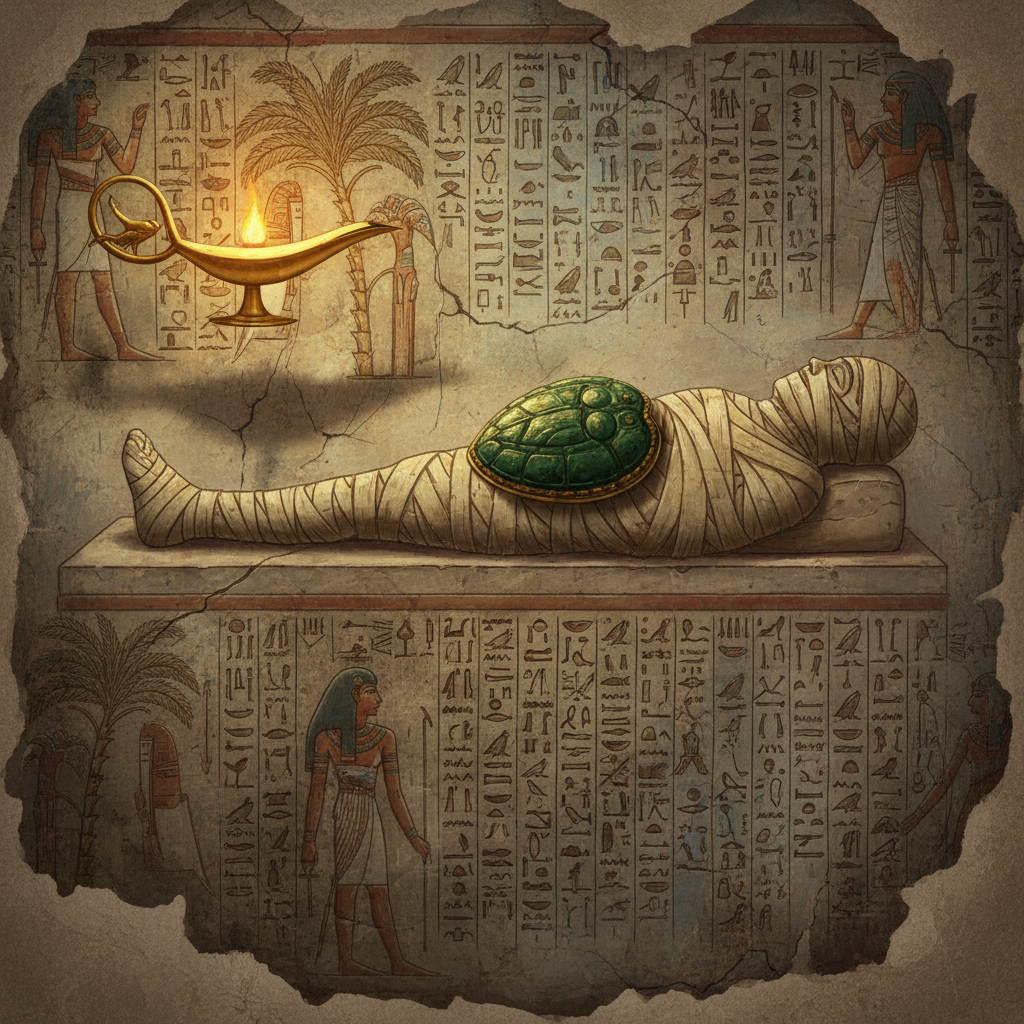
Particularly important was the heart scarab, a large carved scarab placed on the chest of the deceased and inscribed with a passage from the Book of the Dead asking the heart not to testify against its owner during the judgment of the dead. Khepri, the god of becoming, was the appropriate divine witness for the moment of becoming whatever the next world held.
Khepri in the Solar Cycle
Egyptian theology divided the daily journey of the sun into stages, each ruled by a different aspect of the solar god. The dawn was Khepri’s. The midday was Ra’s. The evening was Atum’s. The night was the journey through the underworld, where the sun took on forms including the ram-headed Aten of the night barque and other names. The full cycle of the sun was the full cycle of becoming, ageing, dying, and being reborn.
This division mapped the daily journey of the sun onto the human life cycle. Khepri was the child sun, the becoming sun. Ra was the adult sun. Atum was the old sun. The night journey through the underworld was the death and the eventual rebirth. To worship the sun in Egyptian religion was to worship one’s own arc through life.
Symbolism and Meaning
Khepri embodies the Egyptian principle of kheper, becoming. This is one of the most important concepts in Egyptian theology and hieroglyphic writing. The scarab hieroglyph is the verb “to become”. To use the word is to invoke the god. Every text that uses the verb kheper, and there are many, is in a small way a hymn to Khepri.
His self-creation is theologically distinctive. Most cosmologies have one or more creator gods who make the world from outside. Khepri is the principle of self-arising. He is the verb of coming-to-be. The Egyptian universe, in this conception, did not need a creator from outside. It came into being itself, as Khepri rolls the sun up over the horizon each morning.
The choice of an insect for a divine form is also worth noting. The Greeks gave their sun god a chariot. The Norse gave theirs horses. The Egyptians gave their morning sun a beetle. The choice reflects the Egyptian habit of finding the divine in the small. The scarab is humble. It does its work in the dust. It is, the Egyptians decided, the right image for the god of becoming. The sun is not something distant and removed. It is something pushed into being, day after day, by patient labour.
Legacy and Modern Influence
The scarab is one of the most universally recognisable Egyptian images, more widely known than the ankh, the eye of Horus, or the ibis. Modern jewellery brands use it. Modern tattoos depict it. Egyptian-themed films and games include it constantly. Khepri himself appears occasionally in fiction, including Rick Riordan’s The Kane Chronicles, but his image, the scarab, is everywhere.
Modern Egyptology continues to study the layered theology behind Khepri’s role. The relationship between Khepri, Ra, Atum, and the lesser solar manifestations remains a subject of scholarly investigation. The scarab itself has become a model organism in entomology, where its dung-rolling behaviour is now understood through the lens of evolution rather than solar theology, but the link between insect and sun remains a beautiful example of how observation can become theology.
For modern readers, Khepri offers a way of thinking about creation that is unusual in Western traditions. The world is not made. It comes into being. Each morning is its own coming-into-being. The scarab on the desert floor and the sun in the sky are doing the same thing in different scales. To live in such a world is to participate in becoming, every day, with every breath.
More From Egyptian Mythology
Continue exploring the gods, kings, and afterlife of ancient Egypt. New encyclopedia entries published every week.
Explore MoreFrequently Asked Questions
Who is Khepri?
Khepri is the ancient Egyptian god of the rising sun, depicted as a scarab beetle or as a man with a scarab for a head. His name comes from the Egyptian verb kheper, “to come into being”, and he is the god of becoming, self-creation, and the morning.
Why is Khepri shown as a scarab beetle?
The Egyptians observed scarab beetles rolling balls of dung across the desert. They saw this as an image of the sun being pushed across the sky. The beetles’ young, emerging from the dung balls, seemed to come from nothing, suggesting self-creation. Khepri’s scarab form combines all these observations.
What is the difference between Khepri, Ra, and Atum?
The three are aspects of the solar god in different phases of the day. Khepri is the morning sun, the becoming sun. Ra is the midday sun at full strength. Atum is the evening sun descending toward the underworld. Together they map the daily journey of the sun onto the human lifecycle.
What is a heart scarab?
A heart scarab is a large carved scarab placed on the chest of the deceased in Egyptian funerary practice. It was inscribed with a passage from the Book of the Dead asking the heart not to testify against its owner during the judgment of the dead. Khepri, the god of becoming, presided over this moment of transition.
Where is the famous Karnak scarab?
The colossal granite scarab beside the sacred lake at Karnak in Luxor is one of the largest surviving Egyptian scarabs. Visitors today still walk around it for luck. It dates from the New Kingdom and remains one of the iconic objects of the Karnak temple complex.
Why is the scarab so widely worn as an amulet?
The scarab carries the protective power of Khepri, the god of becoming and self-creation. As an amulet it offered protection, fortune, and the power of transformation. Carved scarabs in stone, faience, gold, and other materials were produced in vast quantities from the Middle Kingdom onward and remain the most widely recognised Egyptian motif.