Quick Summary
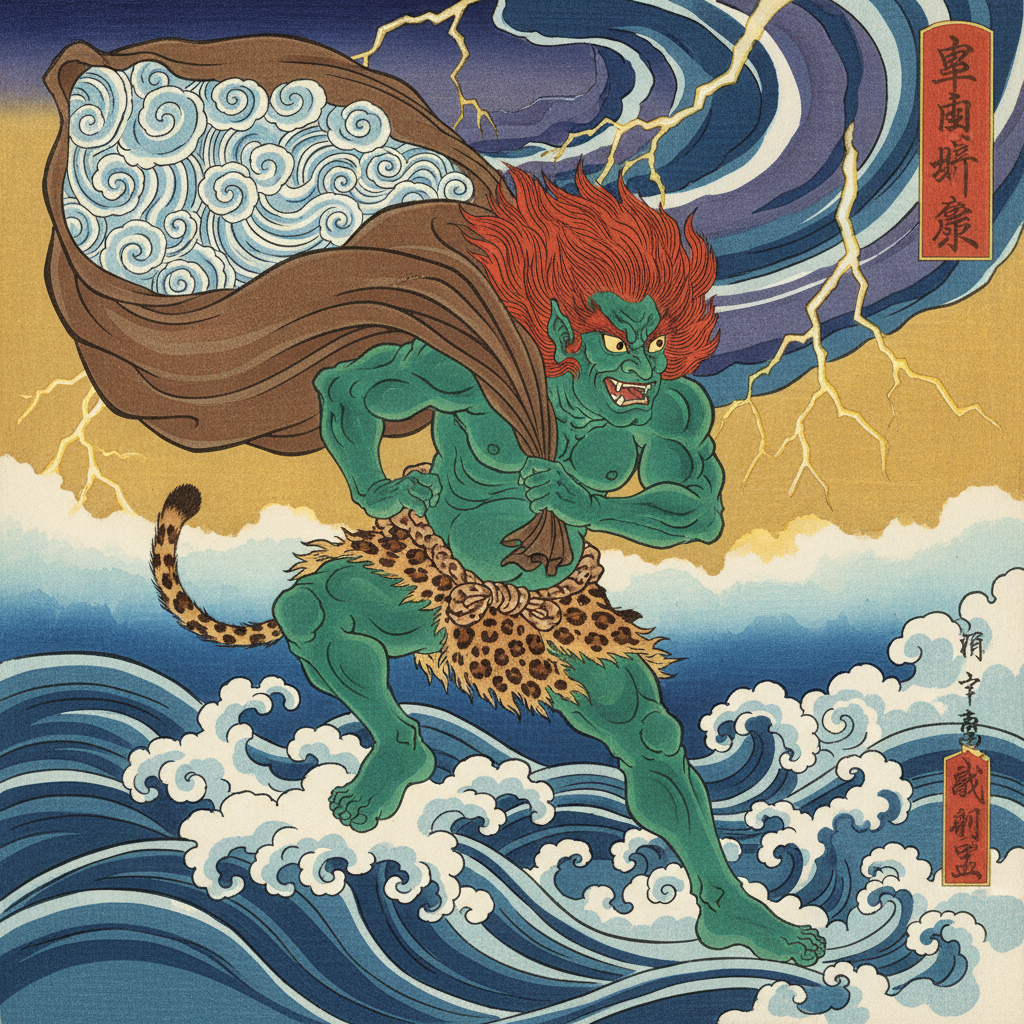
- Fujin (風神) is the Japanese wind kami, typically depicted as a green-skinned demon carrying a great bag of winds across his shoulders.
- He is one of the oldest deities in the Shinto pantheon, said to have emerged from the corpse of the creator goddess Izanami in the underworld of Yomi.
- Fujin is almost always paired with Raijin, the thunder god, and the two are often shown together as celestial twins ruling weather between them.
- His most famous portrayal appears in Tawaraya Sotatsu’s 17th-century folding screen Fujin Raijin-zu byobu, now a National Treasure of Japan.
- Japanese tradition holds that Fujin sent the kamikaze (divine winds) that destroyed two Mongol invasion fleets in 1274 and 1281.
A storm gathers over the eastern sea. The clouds boil with green light. From the heart of the gale, a figure leans forward, muscles taut, fanged mouth twisted into a grin. Across his shoulders he carries a vast leather sack, and from its open ends pour the four winds of the world. He laughs as he runs across the sky, and entire fleets vanish beneath the waves below.
This is Fujin (風神), the Japanese wind demon. He is older than the imperial throne, older than the written word in Japan, older than the Buddhist monasteries that would eventually adopt him into their gallery of guardian spirits. To call him a god feels imprecise. To call him a demon misses the reverence in which he is held. Fujin is something stranger and more ancient: a kami of raw elemental force, bound to the breath of the world itself.
You will find him at temple gates and on folding screens, on woodblock prints and in the back of family shrines. Wherever Japanese culture has depicted the weather, Fujin has been there, sack open, hair streaming, leopard-skin loincloth billowing. He is the kami who reminds you that the sky is alive.

Origins and Cultural Roots
Fujin sits at the deepest layer of Japanese myth. The earliest written sources of Shinto belief, the Kojiki (Records of Ancient Matters, 712 CE) and the Nihon Shoki (Chronicles of Japan, 720 CE), describe how the wind kami came into being at the dawn of the cosmos. In one tradition, he is born of Izanagi and Izanami, the divine couple who created the islands of Japan. In another, more striking version, he springs from the corpse of Izanami herself, after she has descended into Yomi (the land of the dead). The wind, in this telling, is the breath that escapes a dying god.
The name Fujin is built from two characters: 風 (fu or kaze, meaning wind) and 神 (jin or kami, meaning god or spirit). Some sources call him Futen, a name borrowed from Buddhist iconography that travelled from India through China before reaching Japan. In that older lineage, Fujin shares ancestry with the Hindu wind god Vayu, who carries a similar bag and rules the same elemental domain. By the time Buddhism reached the Japanese archipelago in the 6th century, the wind kami of native Shinto and the wind deva of imported Buddhism had begun to merge into the figure that Japanese art would later make famous.
What you see when you look at a classical image of Fujin is a layered being. His green skin and demonic features come from Buddhist oni iconography. His wind bag descends from Central Asian traditions of personified winds. His role as a kami of agricultural and maritime weather is rooted in the Shinto reverence for the natural forces that shaped life on a chain of typhoon-prone islands. He is a creature of cultural fusion, but the fusion took place so long ago that he now feels singular.
The Wind Bag and the Demon Form
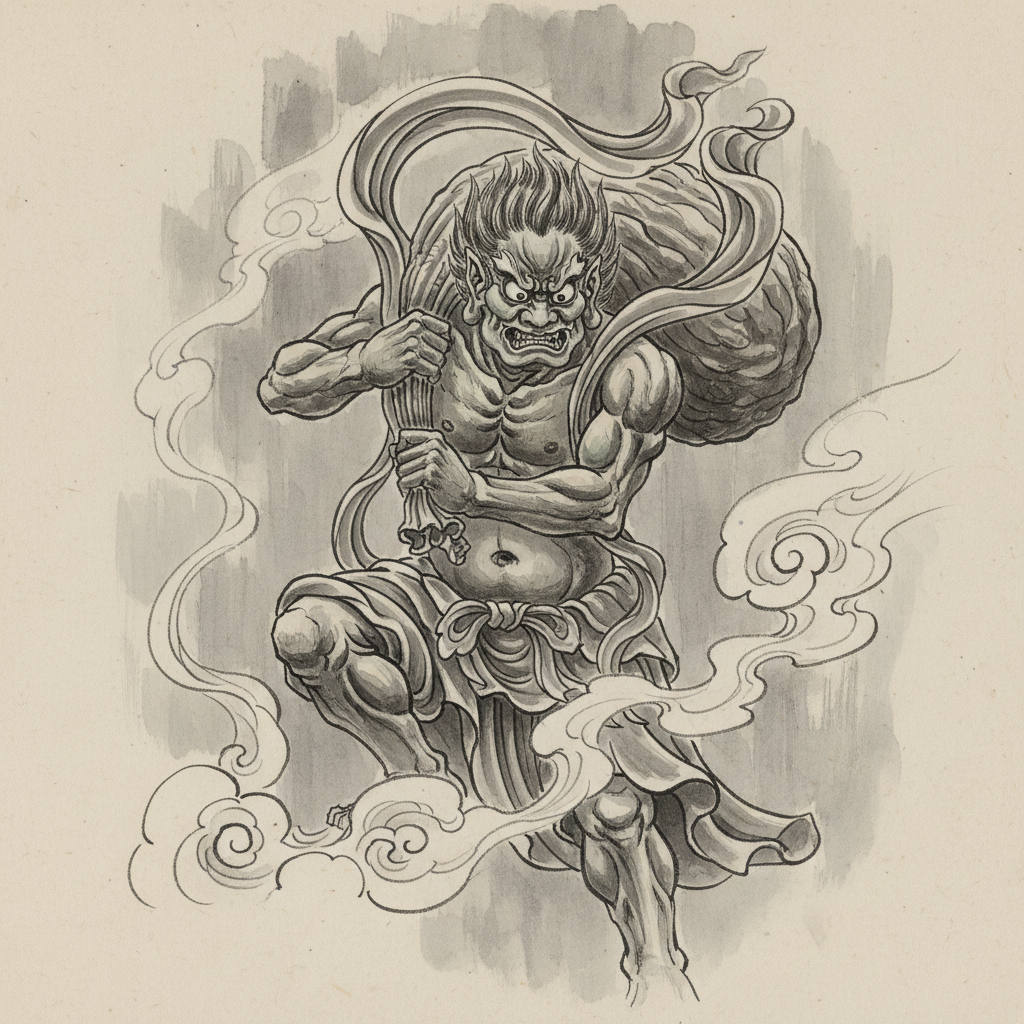
Almost every depiction of Fujin shares a few unmistakable features. His skin is green, sometimes verging on blue. His hair is wild, lifted by his own gales. He wears a leopard-skin loincloth and is barefoot. Most importantly, he carries a long sack across his shoulders, gripping each open end in a fist. From this sack, the winds of the world flow out as he runs.
The wind sack is the symbol that fixes him in the imagination. It is a closed system of weather, a container that can be opened or shut at the kami’s will. When Fujin loosens his grip, breezes drift across the rice fields. When he opens the bag wide, typhoons tear roofs from temples. This image of the wind as something carried, something held, something released by a personal hand, appears across many traditions. The Greek Aeolus kept the winds in a leather pouch and gave them to Odysseus. Inuit folklore tells of wind kept inside skins until released. The motif of bound wind is one of mythology’s quiet universals.
Fujin’s body language matters too. He is shown mid-run, mid-leap, never still. His face is twisted into a wide grin or a fierce snarl, depending on the artist, but it is always animated. The wind, in Japanese imagination, is not abstract. It is a being with appetites, moods, and a sense of humour.
Fujin and Raijin: The Twin Kami of Sky and Storm
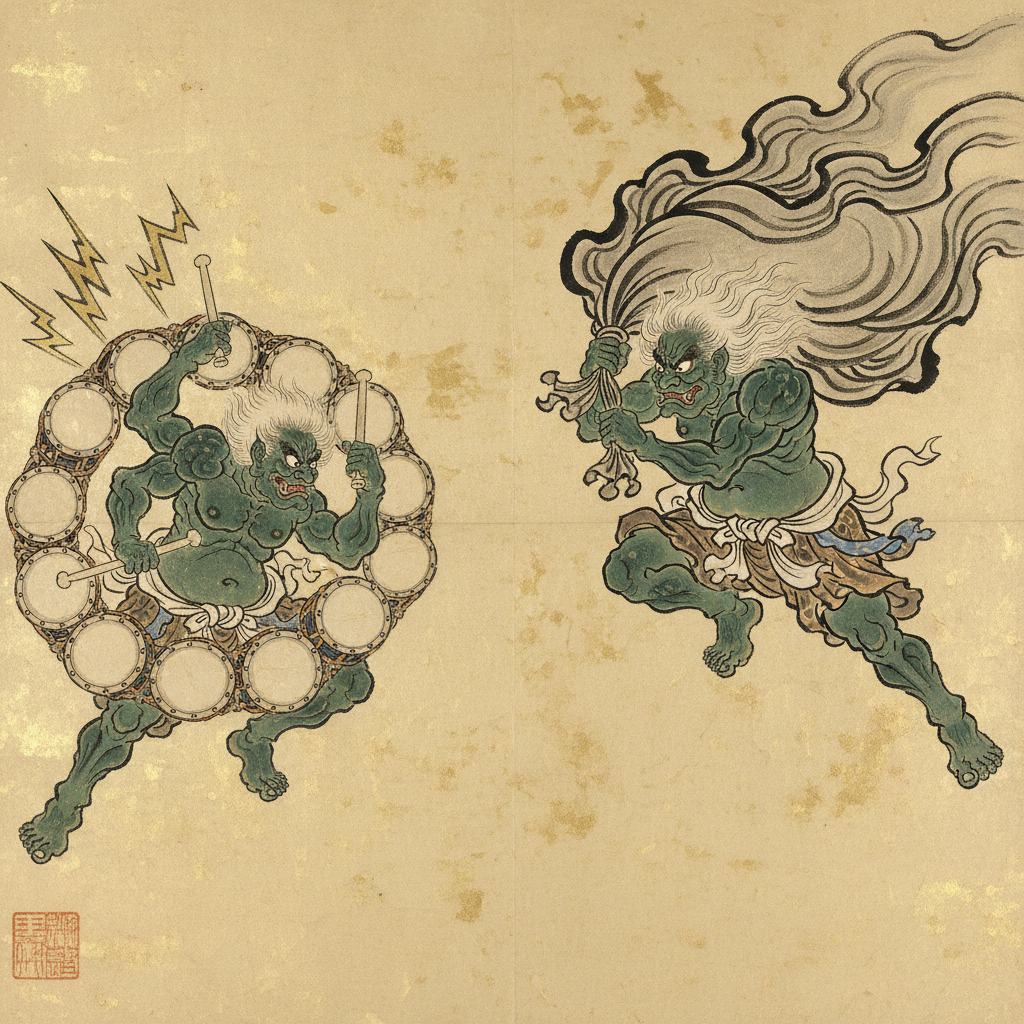
You almost never meet Fujin alone. He travels with Raijin (雷神), the thunder kami. Where Fujin carries his bag of winds, Raijin carries a ring of drums. Where Fujin’s face is contorted by gales, Raijin’s is contorted by the percussion of his own thunder. Together they govern the storm.
The pairing is so persistent in Japanese art that it has its own name: Fujin Raijin-zu, paintings of the wind and thunder gods. Both are oni-like in form, green or red, fanged and barefoot, with the same wild hair and loincloths. Both carry the tools of their trade. Both inhabit the same sky. They are not exactly brothers in the Shinto genealogies, but they function as inseparable companions, two halves of a single weather event. When you hear thunder cracking and feel the air shift before the rain, you are witnessing the work of these two kami together.
The most celebrated image of the pair is the folding screen painted by Tawaraya Sotatsu in the early 17th century. It now resides at Kennin-ji temple in Kyoto and has been designated a National Treasure of Japan. On a gold-leaf background, Fujin charges from the right, sack billowing, while Raijin laughs from the left within his ring of drums. Between them stretches an empty expanse of gold. The negative space is the storm itself, the moment before the wind hits and the thunder breaks. Centuries of Japanese painters, including Ogata Korin and Sakai Hoitsu, have produced their own versions of this scene, each treating the original as both reference and rite.
The Kamikaze: Divine Winds That Saved Japan
In the autumn of 1274, the Mongol fleet of Kublai Khan arrived off the coast of Kyushu. It was the largest naval invasion the world had yet seen, carrying tens of thousands of soldiers from across the Mongol Empire. Japan, fragmented under feudal lords, had no fleet capable of stopping it. The samurai on the beaches of Hakata Bay prepared to die.
A typhoon swept in from the sea. The Mongol ships were torn apart on the rocks. The invasion collapsed before it had truly begun. Seven years later, in 1281, Kublai Khan tried again with an even larger force. Again, a typhoon arrived at the precise moment of attack and shattered the fleet against the coast. Two invasions, two miraculous storms, two Mongol disasters.

The Japanese called these storms kamikaze, the divine winds. The credit went to Fujin. He had emptied his bag at the moment Japan needed him most, and the kami of wind had defended the islands when the samurai could not. The story passed into national mythology and became one of the central narratives of medieval Japanese identity. It also gave the islands a sense, however fragile, that their gods watched over them. Centuries later, in the closing months of the Second World War, the same word would be revived for the suicide pilots of the Imperial Navy, an attempt to invoke the same divine protection that had saved Japan in the 13th century. The history is heavy, but the original meaning belongs to Fujin and his sack of winds.
Symbolism and Meaning
Fujin embodies a particular Japanese understanding of natural force. The wind, in this worldview, is not impersonal. It is willed. It is alive. It can be wrathful or generous, and the difference often depends on how the kami has been treated. To plant rice, to fish, to sail, to live on a typhoon-swept archipelago is to live in a relationship with Fujin, whether or not you ever speak his name.
His demonic appearance carries its own meaning. In Buddhist iconography, fearsome figures often guard sacred thresholds. The grimacing, fanged kami at the temple gate is not evil. He is powerful enough to repel evil. Fujin’s monstrous form belongs to this tradition of guardian ferocity. He looks the way he does because the wind itself is dangerous, and a god who could not frighten you would not be a true god of wind.
Across world mythology, the same pattern repeats. The Greeks gave their winds personalities through the Anemoi: Boreas the cold north wind, Notus the wet south, Eurus the unlucky east, Zephyrus the gentle west. The Hindus had Vayu, who carries a banner and rides a deer or antelope across the sky. The Maya knew Hurakan, the one-legged storm god from whose name the word hurricane descends. The Aztecs worshipped Ehecatl, the wind aspect of Quetzalcoatl, who breathed life into the world. Iroquois tradition tells of Dagwanoenyent, the whirlwind witch whose flying head spins through the forests. Every culture that has lived under a sky has needed to give the wind a face.
What is striking is how often that face is fierce. The wind tends to be personified as someone you must respect, not someone you can simply love. Fujin fits this pattern perfectly. He is not malevolent, but he is not safe. He is the kami you petition before a sea voyage, not the one you sing lullabies to.
Fujin in Temple, Shrine, and Art
Fujin’s images survive in some of Japan’s most sacred spaces. At Sanjusangen-do in Kyoto, a Buddhist temple housing 1,001 statues of the bodhisattva Kannon, you will find a wooden statue of Fujin standing at the temple’s eastern end. His twin, Raijin, stands at the western end. Between them stretch the rows of golden Kannon, watched over by these two storm kami. The statues were carved in the 13th century, around the time of the Mongol invasions, and they remain among the most striking sculptures of Japanese religious art.
The Sotatsu screen at Kennin-ji is the painting that most people picture when they imagine Fujin. The composition has been so widely reproduced that it has become a kind of national icon. It appears on stamps, currency design proposals, museum posters, and countless reproductions sold to tourists. Yet the original itself, when you stand before it, has a quality that no reproduction conveys. The gold leaf catches the temple light. The two kami leap toward each other across an empty sky. It is a painting of a storm in which the storm is mostly absent, and that absence is the point. The wind and thunder are felt more than seen.
Smaller shrines across Japan dedicate themselves to Fujin or to storm kami more broadly. Tatsuta Shrine in Nara prefecture is one of the oldest, dating back over a thousand years and dedicated to wind deities including Shinatobe-no-mikoto and Shinatsuhiko-no-mikoto, regional wind kami sometimes identified with Fujin. Farmers and sailors visit such shrines to pray for favourable weather, or to thank the kami after a typhoon has spared them.
Legacy and Modern Influence
Fujin has crossed into modern culture with surprising ease. He appears in manga, anime, video games, and literature, often as a character whose visual design is lifted directly from the classical paintings. The Studio Ghibli film Pom Poko features tanuki shapeshifting into Fujin and Raijin during a parade scene. Fighting games like Mortal Kombat, Tekken, and Street Fighter have included characters drawing on his iconography. The card game Yu-Gi-Oh! features cards explicitly named after him. In Hayao Miyazaki’s The Wind Rises, the wind itself becomes a quiet, omnipresent character, and although Fujin is never named, his spirit moves through every frame.
Outside Japan, the figure has become recognisable enough that the green wind demon with the bag is now part of a global mythological vocabulary. He turns up in tabletop role-playing games, in graphic novels, in concept art for storm scenes. The image is too vivid not to travel.
What endures, though, is the older meaning. Even now, when a typhoon makes landfall in Japan, news reports use the word kamikaze to describe the strongest winds. Even now, you can find small wooden votive plaques (ema) hung at shrines with prayers to the wind kami written in careful kanji. The form of the practice has changed, but the recognition has not. Fujin is still understood as the kami who carries the storm.
Mythology Delivered to Your Inbox
Join 25,000 readers exploring world myth, ancient legends, and the cosmic questions that have shaped human storytelling. New encyclopedia entries delivered every week.
SubscribeFrequently Asked Questions
What is Fujin in Japanese mythology?
Fujin is the Japanese kami of wind, one of the oldest deities in the Shinto pantheon. He is depicted as a green-skinned demon carrying a large bag of winds across his shoulders, from which he releases gales, breezes, and typhoons. He is almost always paired with Raijin, the thunder god.
Why is Fujin shown as a demon?
Fujin’s demonic form draws on Buddhist oni iconography, where fearsome figures often serve as powerful guardians rather than evil beings. His green skin, fangs, and wild expression reflect the raw, dangerous nature of the wind itself. A kami of storms must look powerful enough to wield them.
What is the wind bag Fujin carries?
The wind sack is the defining symbol of Fujin. It is a long leather bag held over both shoulders, with each end gripped in a fist. By opening or closing the ends, Fujin controls the strength and direction of the winds released into the world. The motif of wind kept in a sack appears in other traditions too, including the Greek myth of Aeolus.
Who is Fujin’s twin?
Fujin is paired with Raijin, the kami of thunder and lightning. The two appear together in countless Japanese paintings and sculptures, including Tawaraya Sotatsu’s famous 17th-century folding screen at Kennin-ji temple in Kyoto and the wooden statues at Sanjusangen-do. They function as inseparable companions ruling the storm together.
What is the kamikaze and how is it linked to Fujin?
The kamikaze, or divine wind, refers to the typhoons that destroyed two Mongol invasion fleets attacking Japan in 1274 and 1281. Japanese tradition credited Fujin with sending these storms to defend the islands. The word later took on a different meaning during the Second World War, but in its original sense it belongs to Fujin and the Mongol invasions.
How is Fujin connected to other wind gods around the world?
Fujin shares features with wind deities across many cultures. The Hindu Vayu also carries a banner and rules the wind, and the iconographic link likely passed into Japan through Buddhism. The Greek Anemoi (Boreas, Notus, Eurus, Zephyrus) personified four directional winds. The Maya Hurakan, the Aztec Ehecatl, the Slavic Stribog, and the Iroquois whirlwind spirit Dagwanoenyent all share the role of giving the wind a face.
Where can Fujin’s image be seen today?
The most famous depiction is Tawaraya Sotatsu’s Fujin Raijin-zu byobu at Kennin-ji temple in Kyoto, a designated National Treasure of Japan. Wooden statues of Fujin and Raijin also stand at Sanjusangen-do temple, and smaller wind shrines including Tatsuta Shrine in Nara prefecture continue to honour wind kami. Fujin also appears widely in modern manga, anime, and video games.
Is Fujin worshipped today?
Active worship of Fujin as a singular deity is uncommon, but he remains part of broader Shinto practice. Wind shrines across Japan continue to receive offerings from farmers, fishermen, and travellers seeking favourable weather. His image, especially in the form of the Sotatsu screen, has become a national icon recognised even by those who do not practise Shinto.