Quick Summary
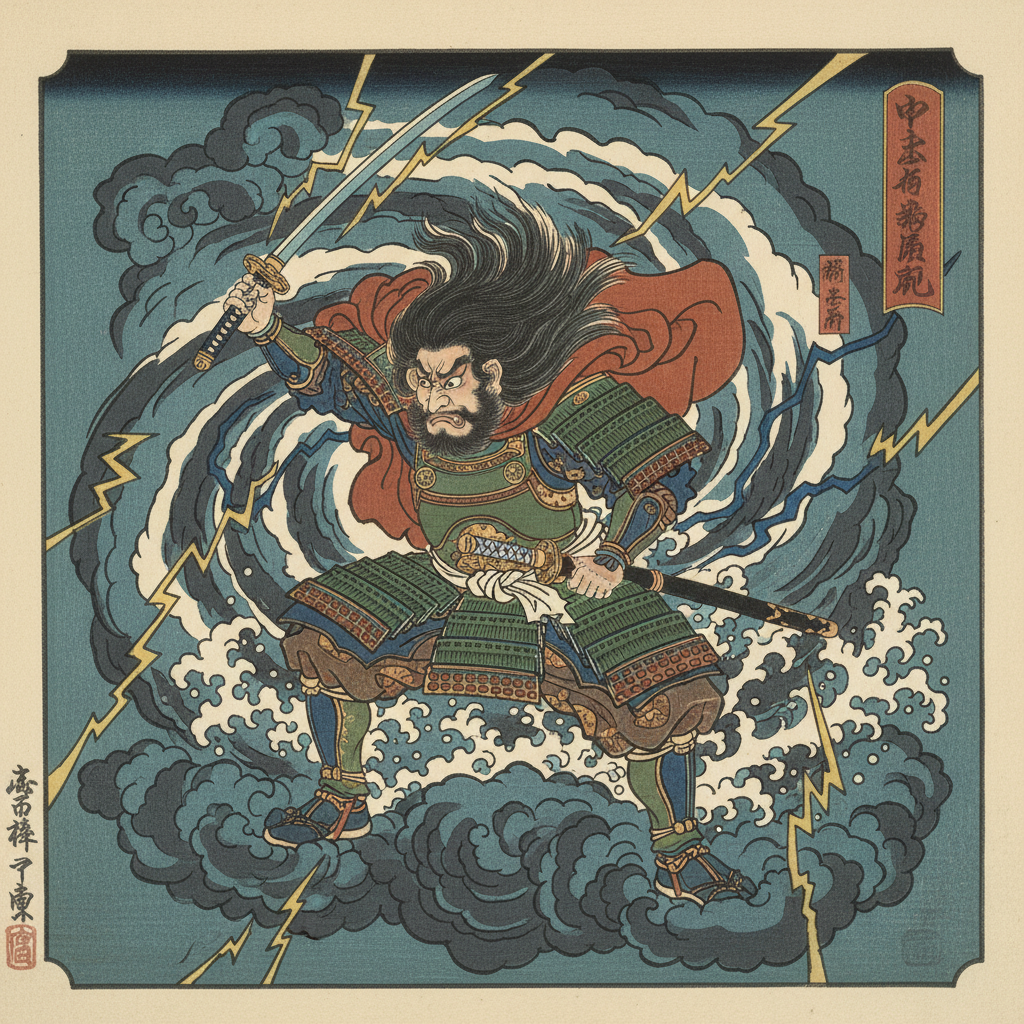
- Susanoo is the Japanese kami of storms, the sea, and chaotic forces, brother of the sun goddess Amaterasu and the moon god Tsukuyomi.
- He was born from the nose of the creator god Izanagi during his ritual purification after returning from the underworld of Yomi.
- His most famous deed is the slaying of the eight-headed dragon Yamata-no-Orochi, from whose tail he drew the sword Kusanagi.
- Kusanagi later became one of the three sacred imperial regalia of Japan, alongside the mirror Yata-no-Kagami and the jewel Yasakani-no-Magatama.
- Susanoo’s complex character spans both terrible storm violence and unexpected gentleness, making him one of the most layered figures in Shinto myth.
A boy stands in the courtyard of his father’s house and weeps. His tears flatten the grass. His sobs send the clouds racing across the sky. He has been told to take his place ruling one of the great realms of the world, and he refuses. He wants only to go to his mother in the land of the dead. His father, the creator god Izanagi, has lost patience. The boy’s name is Susanoo, and his refusal is the first storm.
Susanoo (須佐之男命) is one of the most contradictory figures in Japanese mythology. He is the kami of storm and sea, the brother of the sun, the slayer of the eight-headed dragon, the bringer of the imperial sword. He is also a wailing child, a banished exile, a vandal of his sister’s fields. To meet him in the early Shinto chronicles is to meet a god who refuses to fit neatly into any single role. He is exactly as complicated as a storm.
Origins and Cultural Roots
The earliest written sources for Susanoo are the same two foundational Japanese texts that preserve so much of Shinto myth: the Kojiki (Records of Ancient Matters, 712 CE) and the Nihon Shoki (Chronicles of Japan, 720 CE). Both texts tell the story of his birth, his banishment from the high heavens, and his great deeds in the land of Izumo. The two accounts differ in detail but agree on the broad outlines.
Susanoo is born when his father Izanagi performs a ritual purification after returning from Yomi, the land of the dead, where he had failed to retrieve his beloved wife Izanami. As Izanagi washes his face in a river, three children come into being: Amaterasu the sun goddess, born from his left eye; Tsukuyomi the moon god, born from his right eye; and Susanoo, born from his nose. Each of the three is given a domain. Amaterasu rules the sun and the high plain of heaven. Tsukuyomi rules the night. Susanoo is given dominion over the seas.
His name is often interpreted as containing the element susa, meaning “raging” or “impetuous”. He is the violent child of the three. From the start, he is associated with intensity, with weather that breaks, with feelings that overflow.
The Banishment from Heaven
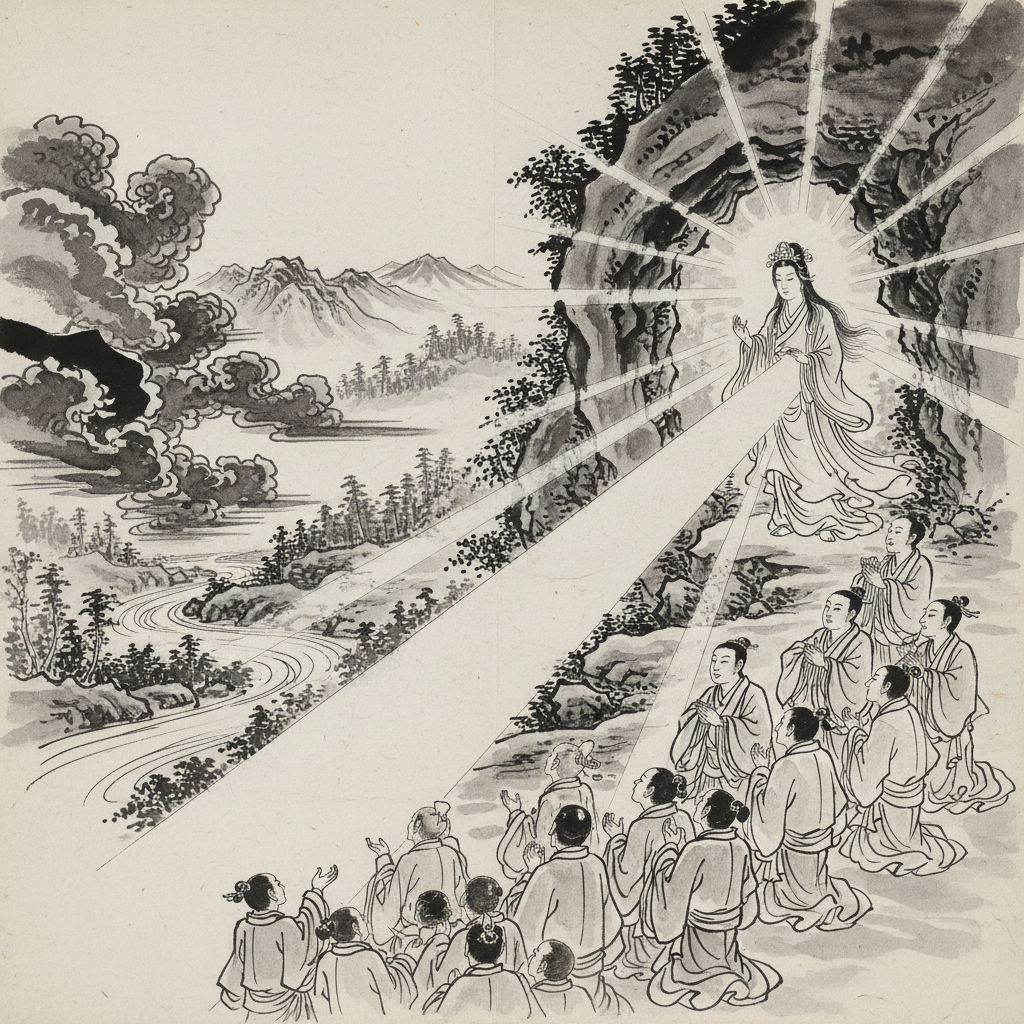
Susanoo refuses his given role. He weeps for his mother. His weeping is not gentle: it withers fields, dries rivers, and drives the people to despair. Izanagi, exasperated, demands an explanation. When Susanoo says he wants only to be with his mother in the underworld, Izanagi banishes him from heaven altogether.
Before he leaves, Susanoo asks to say farewell to his sister Amaterasu. He climbs to her palace in such force that the very earth shakes. Amaterasu, fearing her wild brother has come to take her realm, prepares for battle. They meet in tense ceremony at the bridge between heaven and earth. Susanoo proposes a contest of children: each will produce divine offspring from items belonging to the other, and the result will prove his good intentions. Amaterasu produces five male kami from his sword. Susanoo produces three female kami from her jewels.
Susanoo claims victory and grows wild with celebration. He breaks down the borders of his sister’s rice paddies. He fills in her irrigation ditches. He flings the body of a flayed pony into her sacred weaving hall, killing one of her attendants. Amaterasu, terrified and grief-stricken, retreats into a cave and seals the entrance with a great stone. The world goes dark.
This is one of the most famous moments in Japanese mythology. The other gods must coax Amaterasu out of the cave with feasting, music, and a clever stratagem involving a mirror. When she finally emerges, light returns to the world. Susanoo is held responsible. His beard and fingernails are cut as a kind of ritual humiliation, and he is expelled to the earth.
The Slaying of Yamata-no-Orochi
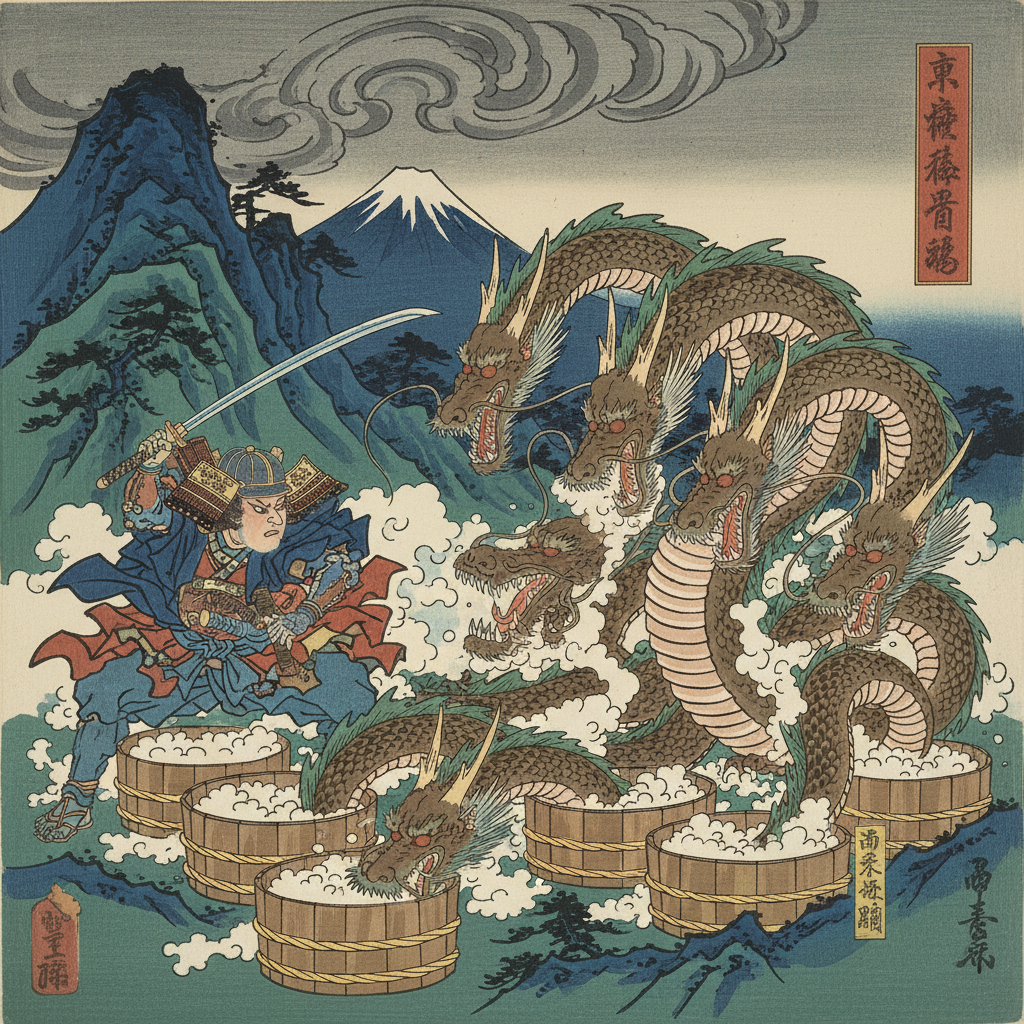
Banished from heaven, Susanoo descends to the land of Izumo on the shore of the Sea of Japan. There he meets an elderly couple in tears beside a river. They explain that they had eight daughters, and a great eight-headed serpent named Yamata-no-Orochi has devoured seven of them. The eighth, Kushinada-hime, is to be taken next.
Susanoo offers to kill the serpent if the couple will give him their daughter as wife. They agree. He instructs them to brew eight tubs of strong sake and place them in eight enclosures. When Yamata-no-Orochi arrives, each of his eight heads dips into a different tub. The serpent grows drunk and falls asleep. Susanoo draws his sword and cuts the dragon to pieces. Inside the tail of the serpent, he finds an extraordinary blade. He pulls it out and presents it to his sister Amaterasu as a gift of reconciliation. The sword’s name is Kusanagi-no-Tsurugi, the Grass-Cutting Sword.
Kusanagi becomes one of the three Sacred Treasures of Japan, the imperial regalia of the Japanese royal house. The mirror that lured Amaterasu from the cave is another. The jewel that figured in the contest of children is the third. These three objects, mirror, sword, and jewel, are still considered the symbols of imperial legitimacy in Japan today, though the originals are kept secret and even reigning emperors are said to have never seen them.
Susanoo in Izumo
Susanoo settles in Izumo and marries Kushinada-hime. Their descendants include Okuninushi, one of the great culture heroes of Japanese myth, who is associated with the founding of the Izumo Taisha shrine. Susanoo’s transformation from raging exile to settled patriarch is one of the most striking arcs in the Kojiki. The kami of storms becomes the founder of a divine lineage. The boy who weeps for his mother grows into a god who builds a household.
Izumo Taisha, on the western coast of Honshu, remains one of the most ancient and important Shinto shrines in Japan. Its main deity is Okuninushi, but Susanoo is honoured throughout the region. The shrines of the Izumo region preserve a slightly different mythology from the more famous Ise tradition associated with Amaterasu, and Susanoo plays a larger role in Izumo than in many other parts of Japan.
Symbolism and Meaning
Susanoo is the Shinto god of paradox. He represents the storm, but he also represents the longing for the dead. He is the disrupter of his sister’s order, but also the giver of the imperial sword that gives that order its symbol. He is wild, but he is capable of love. He is banished, but he becomes a founding ancestor.
This complexity reflects the Shinto understanding of natural forces. The storm is destructive, but it is also necessary. Without the rain that comes with violent weather, the rice cannot grow. Without the sea that is sometimes monstrous, there is no fishing. Susanoo is not a villain. He is the divine face of a world that includes both fertility and destruction in the same breath.
His relationship with his brother Raijin, the kami of thunder, is more peripheral than is sometimes suggested. The two are not part of the same divine triad in the early texts, but in popular tradition both are associated with violent weather, and Susanoo’s storms and Raijin’s thunder often appear together in folk imagination. The Japanese imagination of weather has many faces, and the Anemoi-style strict division of the Greeks gives way here to a more fluid, overlapping system.

Legacy and Modern Influence
Susanoo is one of the most visible Shinto kami in modern Japanese popular culture. He appears in countless anime and manga, from the long-running Naruto series, where his name is given to a manifestation of an ocular technique, to Inuyasha, Noragami, and dozens of others. The slaying of Yamata-no-Orochi has been adapted into video games, films, and folk theatre kabuki performances, where the eight-headed serpent provides spectacular staging opportunities.
Real Shinto worship of Susanoo continues today. Yasaka Shrine in Kyoto, one of the most prominent shrines in the city, is dedicated to him, and its annual Gion Matsuri festival is among the largest in Japan. The shrines of the Izumo region honour him as a founding ancestor of the local divine lineage. The image of the storm kami who slays the serpent and gives Japan its sacred sword has remained alive for fourteen hundred years.
For modern readers, Susanoo offers something the more orderly Greek and Norse pantheons sometimes miss: the recognition that a god can be wrathful, foolish, and tender all at once, and that even the gods grieve for their mothers. He weeps. He destroys. He kills the dragon. He marries. He becomes an ancestor. The Kojiki does not flatten him into a moral lesson. It lets him be all of those things.
More From Japanese Folklore
Continue exploring the kami, yokai, and legends of Japan. New encyclopedia entries published every week.
Explore MoreFrequently Asked Questions
Who is Susanoo in Japanese mythology?
Susanoo is the Japanese kami of storms, the sea, and chaotic forces. He is the brother of the sun goddess Amaterasu and the moon god Tsukuyomi, and the son of the creator god Izanagi. He is famous for slaying the eight-headed dragon Yamata-no-Orochi and finding the sword Kusanagi in its tail.
How was Susanoo born?
Susanoo was born from the nose of the creator god Izanagi when Izanagi performed a ritual purification after returning from Yomi, the land of the dead. At the same moment, Amaterasu was born from his left eye and Tsukuyomi from his right eye, forming the three great kami of sun, moon, and storm.
What is Yamata-no-Orochi?
Yamata-no-Orochi is the eight-headed dragon of Japanese mythology, slain by Susanoo in the land of Izumo. The dragon had devoured seven daughters of an elderly couple and was about to take the eighth. Susanoo got the dragon drunk on eight tubs of sake and cut him to pieces while he slept.
What is the Kusanagi sword?
Kusanagi-no-Tsurugi, the Grass-Cutting Sword, is the legendary sword Susanoo found in the tail of Yamata-no-Orochi. He gave it to his sister Amaterasu as a gift of reconciliation, and it became one of the three Sacred Treasures of the Japanese imperial line, along with a mirror and a jewel.
Why was Susanoo banished from heaven?
Susanoo was first banished by his father Izanagi for refusing his given role and weeping uncontrollably for his mother. Later, after destroying his sister Amaterasu’s rice paddies and weaving hall, he was expelled to earth a second time. His banishment to Izumo led directly to the events of the Yamata-no-Orochi story.
Where is Susanoo worshipped today?
Yasaka Shrine in Kyoto is one of the most famous shrines dedicated to Susanoo, and its annual Gion Matsuri festival is among the largest in Japan. The shrines of the Izumo region also honour him as a founding ancestor, and shrines across Japan continue to recognise him as kami of storms and the sea.