Quick Summary
- The Anemoi are the four directional wind gods of Greek mythology: Boreas (north), Notus (south), Eurus (east), and Zephyrus (west).
- They are sons of Astraeus, god of dusk, and Eos, goddess of dawn, and they answer to Aeolus, the king who keeps the winds in a bag.
- Each wind carries its own personality and weather: Boreas is fierce and cold, Zephyrus is gentle and warm, Notus is humid and stormy, Eurus is the unlucky storm-bringer.
- The Anemoi appear in Homer’s Odyssey, Hesiod’s Theogony, and across countless Greek artistic depictions including the Tower of the Winds in Athens.
- Their cross-cultural parallels include the Japanese Fujin, the Hindu Vayu, the Aztec Ehecatl, and the Iroquois whirlwind spirit Dagwanoenyent.
A Greek ship leaves harbour on a still summer morning. The sail hangs slack. The captain mutters a prayer to a god the crew cannot see, and somewhere on a distant peak, a winged figure stirs. The wind rises. The sail catches. The voyage begins. To sail in the ancient Mediterranean was to live by the temper of the Anemoi, the wind gods who could carry you to safe harbour or scatter your ships across the sea.
The Greeks gave the wind four faces. Each face had a name, a direction, and a personality. Together, the four Anemoi ruled the sky, and behind them stood the strange figure of Aeolus, who kept the winds bound in a great leather bag and released them at the will of the gods. To understand the Anemoi is to step into a worldview where weather was not random. It was personal. It had intention.

Origins and Cultural Roots
The Anemoi appear in the earliest layers of Greek myth. Hesiod’s Theogony (around 700 BCE) names them as the children of Astraeus, the Titan god of dusk and stars, and Eos, the rosy-fingered goddess of dawn. From this celestial union came the four winds, born of the place where night and day touch. Their parentage matters. The Greeks understood the wind as something between the sky and the earth, a force connected to the turning of the heavens themselves.
The name Anemoi (ἄνεμοι) simply means “winds”. Each individual wind has its own name, drawn from a directional root. By Hesiod’s time, only three of the four were considered fully divine: Boreas, Notus, and Zephyrus. Eurus, the east wind, was always somewhat marginal in the literary tradition, often described but rarely worshipped. Later Greek and Roman writers fixed the canon at four, mapping each wind to a cardinal direction.
The Anemoi were not the only wind spirits in Greek thought. There were also lesser winds, sometimes called the Aellai or the Anemoi Thuellai, storm spirits who served Hades and brought sudden gales out of nowhere. Above all of them stood Aeolus, the keeper of the winds, whose island home features in one of the most famous wind stories in all of Greek literature.
The Four Winds
Boreas: The Cold North Wind
Boreas (Βορέας) is the wind of winter and the most powerful of the four. He blows from the mountains of Thrace, where the Greeks imagined a frigid land beyond civilisation. Boreas is fierce, ill-tempered, and impatient. He carries snow, frost, and the bitter winds that close down the sailing season. Greek artists depict him as a bearded, winged man with shaggy hair, often shown grasping the unwilling figure of Oreithyia, the Athenian princess he abducted to be his wife.
The Boreas-Oreithyia myth gave Athens a particular relationship with the north wind. When the Persian fleet bore down on the Greek coast in 480 BCE, the Athenians prayed to Boreas as a kind of son-in-law, and a sudden storm scattered the Persian ships. The story is preserved in Herodotus and treated as a real instance of divine intervention. Like the Japanese kamikaze, it became one of the great moments when a wind god turned the tide of history.
Notus: The Wet South Wind
Notus (Νότος) blows from the south, carrying the heavy, humid air of late summer. He is the wind of the sirocco, the dust-laden gusts that rise from Africa and bring oppressive heat to the Aegean. Notus brings rains in autumn and the storms that ruin harvests if they come at the wrong time. Greek farmers feared him for the same reason they feared any unpredictable weather: a single bad season could mean famine.
In art, Notus is often shown as a dripping figure, water streaming from his beard or robes, sometimes with an inverted urn from which rain pours. He is the wettest of the Anemoi.
Eurus: The Unlucky East Wind
Eurus (Εὖρος) is the wind from the east, and of all the Anemoi he has the thinnest mythology. The Greeks regarded him as the wind of bad weather and ill omens, the one that drove ships off course and brought storms in the middle of an otherwise calm passage. He has no major myths of his own, no abduction stories, no cult sites. He is the wind that arrives unexpectedly and leaves you sailing in the wrong direction.
This understated quality is itself revealing. Not every direction needed a legend. Eurus was real to anyone who had been at sea, and his role in mythology was simply to be the wind you did not want.
Zephyrus: The Gentle West Wind
Zephyrus (Ζέφυρος) is the favourite of poets. He is the wind of spring, of soft breezes that thaw the last snow and coax the first blossoms from the trees. Greek writers from Homer onward associate him with new growth, with sweetness, with the season of love. He is the gentlest of the Anemoi, but he is not without temper. In one famous myth, Zephyrus loved the beautiful youth Hyacinthus and grew jealous when Apollo turned his attention to the boy. In a fit of envy, Zephyrus blew Apollo’s discus off course and killed Hyacinthus, from whose blood the hyacinth flower bloomed.
Zephyrus also fathered two famous immortal horses, Xanthus and Balius, who pulled the chariot of Achilles. In Roman tradition, he became Favonius, “the favourable”, and his association with springtime entered Western literary tradition through Latin poetry. When Sandro Botticelli painted The Birth of Venus in the 1480s, he placed Zephyrus in the upper left corner, blowing the goddess to shore. The wind of spring carries Aphrodite into the world.
Aeolus and the Bag of Winds
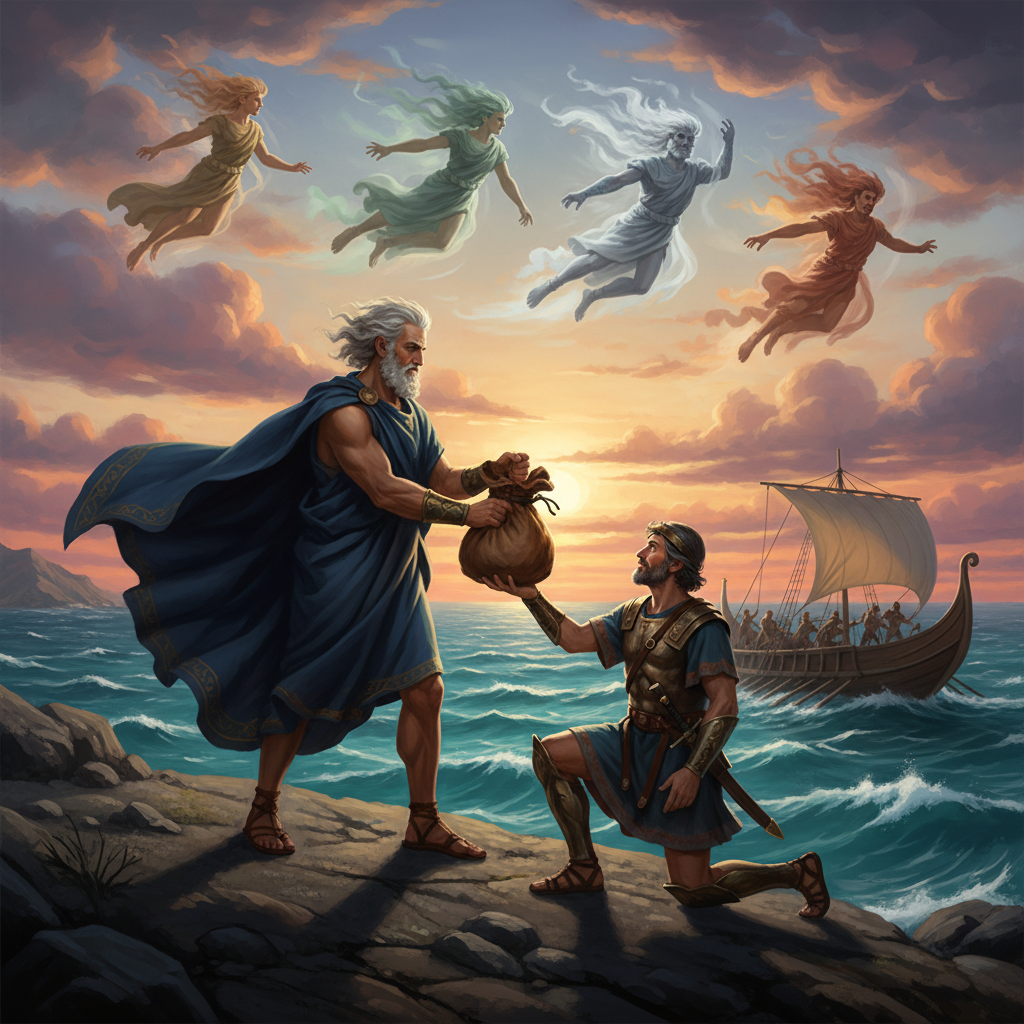
Above the four Anemoi stood Aeolus, the keeper of the winds. The most famous Aeolus story comes from Homer’s Odyssey. Odysseus, returning from Troy, lands on the floating island of Aeolia. Aeolus welcomes him as a guest and, when Odysseus is ready to leave, makes him a parting gift: a leather bag containing every wind except the gentle Zephyrus, which alone is left free to blow Odysseus home.
Within sight of the Greek coast, Odysseus falls asleep. His crew, suspecting the bag holds treasure he is keeping for himself, opens it. The four winds rush out at once, and the ships are blown all the way back to Aeolia. When Odysseus returns and asks for help again, Aeolus refuses. A man so cursed by the gods, he says, is not someone you offer a second favour.
The image of the wind bag is one of the most enduring in world mythology. The same motif appears in Japanese folklore with Fujin, who carries his own sack of winds across his shoulders. Inuit traditions tell of wind kept inside skins. The story of bound wind, contained in something that can be opened, repeats across cultures separated by oceans and centuries.
The Tower of the Winds
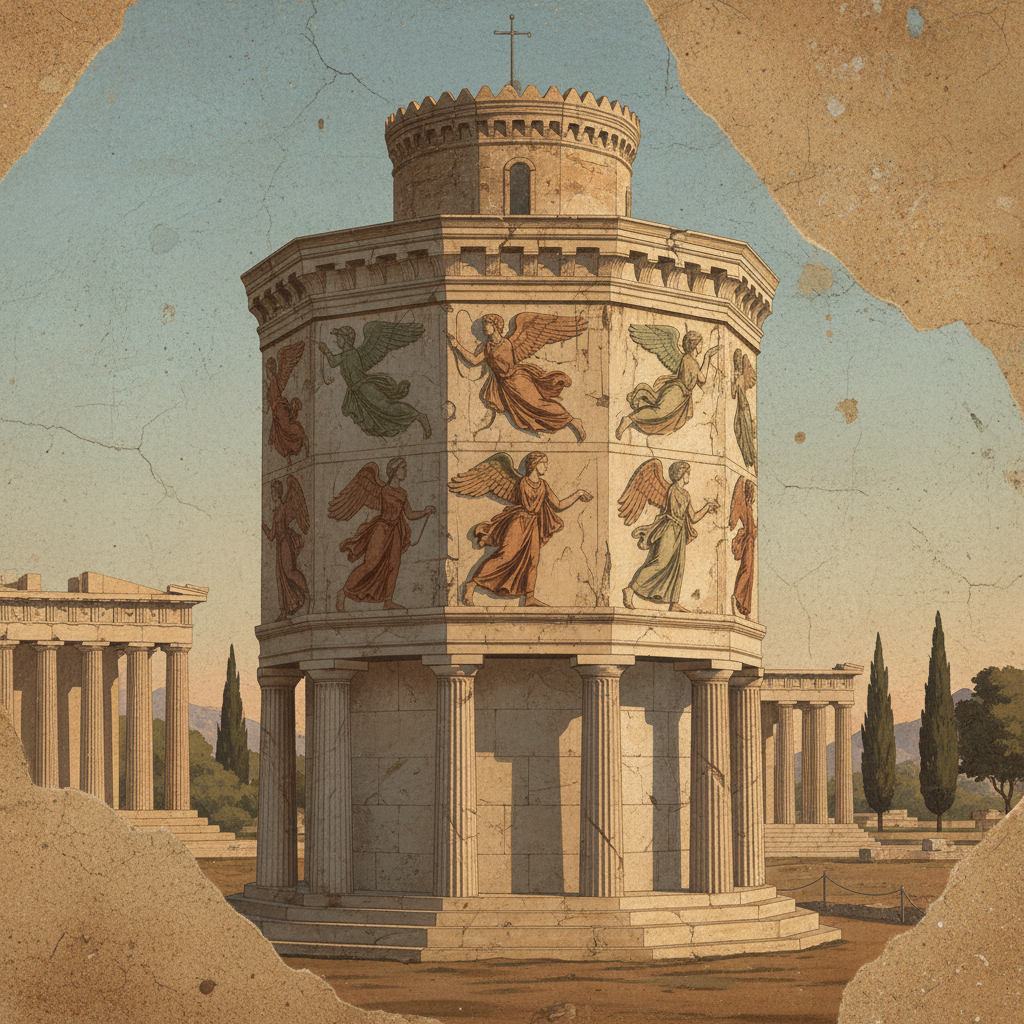
One of the most remarkable surviving monuments of Greek wind worship is the Tower of the Winds in Athens, built in the 1st century BCE. The octagonal marble tower carries a relief on each of its eight sides, depicting the wind from that direction as a winged human figure. The eight winds shown are an expansion of the original four, adding four intermediate compass points: Kaikias (NE), Apeliotes (E), Lips (SW), and Skiron (NW), alongside the classical Anemoi.
Each figure carries an attribute that signals the wind’s character. Boreas wears heavy boots and carries a conch shell to summon storms. Zephyrus is barefoot and scatters flowers from his cloak. Notus pours water from an urn. The tower also functioned as a sundial, water clock, and weather vane. To stand before it now, in the Roman Agora of Athens, is to see the Greek imagination of weather sculpted into stone.
Symbolism and Meaning
The Anemoi reveal something important about Greek thought. The Greeks did not see the wind as an abstract phenomenon. They saw it as four distinct beings with personalities, preferences, and stories. This was not a poetic decoration. It was a way of organising experience. A north wind is not the same as a south wind. A wet wind is not the same as a dry wind. To name them, to give them faces, was to make sense of a world in which weather could decide whether you ate that winter.
The pattern repeats across world mythology. Wherever a culture has lived under a sky, it has needed to give the wind a face. The Japanese gave the wind to Fujin. The Hindus gave it to Vayu. The Aztecs gave it to Ehecatl. The Maya gave the storms to Hurakan. The Iroquois told stories of whirlwind spirits in the forests. The Greeks were unusual only in giving the wind four faces instead of one. Their habit of personification was systematic, almost scientific. The four Anemoi are the wind reorganised by direction, like a compass made of myth.

Legacy and Modern Influence
The Anemoi have left a long shadow in Western culture. The word zephyr, meaning a soft breeze, comes directly from Zephyrus. The word boreal, meaning northern, comes from Boreas. The Aurora Borealis takes its name from the same root, the dawn lights of the north wind’s land. The horse breed known as the Boreal pony, the Notus class of weather satellites, the countless ships and submarines named Zephyr: each one carries an echo of the old Greek winds.
In modern fantasy, the Anemoi appear in everything from Rick Riordan’s Heroes of Olympus series to video games like God of War. Botticelli’s Zephyrus is reproduced on coffee cups and museum posters around the world. The Tower of the Winds, with its eight personified breezes, has been rebuilt in miniature on countless old weather vanes. The figure of the wind as a human face, cheeks puffed, blowing across an antique map, is a direct inheritance from the Anemoi.
What endures is the recognition that the wind is worth naming. Modern meteorology has its own vocabulary, but the older intuition lingers. When you say the wind is “bitter”, “fair”, or “favourable”, you are speaking, however distantly, in the language of the Anemoi.
Mythology Delivered to Your Inbox
Join 25,000 readers exploring world myth, ancient legends, and the cosmic questions that have shaped human storytelling. New encyclopedia entries delivered every week.
SubscribeFrequently Asked Questions
Who are the Anemoi in Greek mythology?
The Anemoi are the four directional wind gods of Greek mythology: Boreas (north), Notus (south), Eurus (east), and Zephyrus (west). They are sons of Astraeus, god of dusk, and Eos, goddess of dawn, and they answer to Aeolus, the keeper of the winds.
Who is the strongest of the Anemoi?
Boreas, the cold north wind, is generally regarded as the most powerful of the four winds. He brings winter storms, frost, and the bitter weather that closed down ancient sailing seasons. Greek tradition credits him with destroying part of the Persian fleet in 480 BCE.
What is the story of Aeolus and the bag of winds?
In Homer’s Odyssey, Aeolus gives Odysseus a leather bag containing all the winds except Zephyrus, which alone blows him home. Within sight of Ithaca, Odysseus falls asleep and his crew, thinking the bag holds treasure, opens it. The released winds drive the ships back to Aeolia and Odysseus’s homecoming is delayed by years.
Why is Zephyrus the most beloved of the winds?
Zephyrus is the gentle west wind associated with spring, new growth, and warm breezes. Greek and Roman poets celebrated him as the bringer of flowers and the ally of lovers. Botticelli’s painting The Birth of Venus famously depicts Zephyrus blowing Aphrodite to shore.
What is the Tower of the Winds in Athens?
The Tower of the Winds is a 1st-century BCE octagonal marble tower in the Roman Agora of Athens. Each of its eight sides carries a relief depicting a wind from that direction as a winged human figure. The tower also functioned as a sundial, water clock, and weather vane.
Are the Anemoi connected to wind gods in other cultures?
Yes, the Anemoi share the role of personified wind with deities across many traditions: the Japanese Fujin, the Hindu Vayu, the Aztec Ehecatl, the Maya Hurakan, the Slavic Stribog, and the Iroquois whirlwind spirit Dagwanoenyent. The motif of the wind bag also appears in Japanese, Inuit, and other traditions.
Why does Eurus have so few myths?
Eurus, the east wind, was regarded by the Greeks as a bringer of bad weather and ill omens, but he had no major mythological cycle of his own. His role in literature was largely functional, the wind that drove ships off course or brought unexpected storms. Not every wind needed a story to be feared.