Quick Summary
- Ehecatl is the Aztec god of wind, often considered an aspect of Quetzalcoatl, the Plumed Serpent.
- His name in Nahuatl means “wind”, and he is the breath that brings the world to life and moves the rain clouds across the sky.
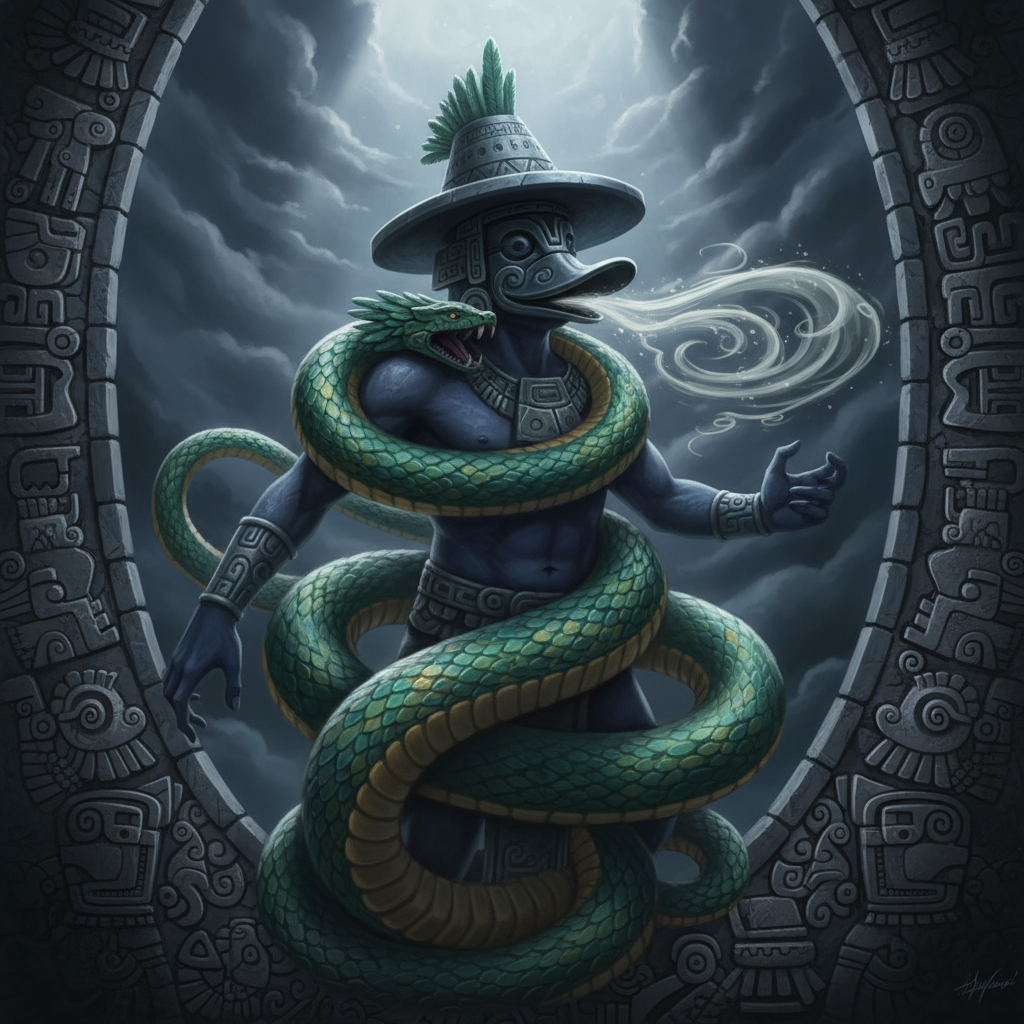
- He is depicted with a distinctive duckbill mask and a conical hat, and his temples were uniquely round to allow the wind to pass through unimpeded.
- According to the creation cycle of the Five Suns, Ehecatl-Quetzalcoatl ruled the second sun, the Sun of Wind, before it was destroyed in great hurricanes.
- Ehecatl participates in the creation of the present world by descending into Mictlan to retrieve the bones of the previous humanity, and by giving the breath of life.
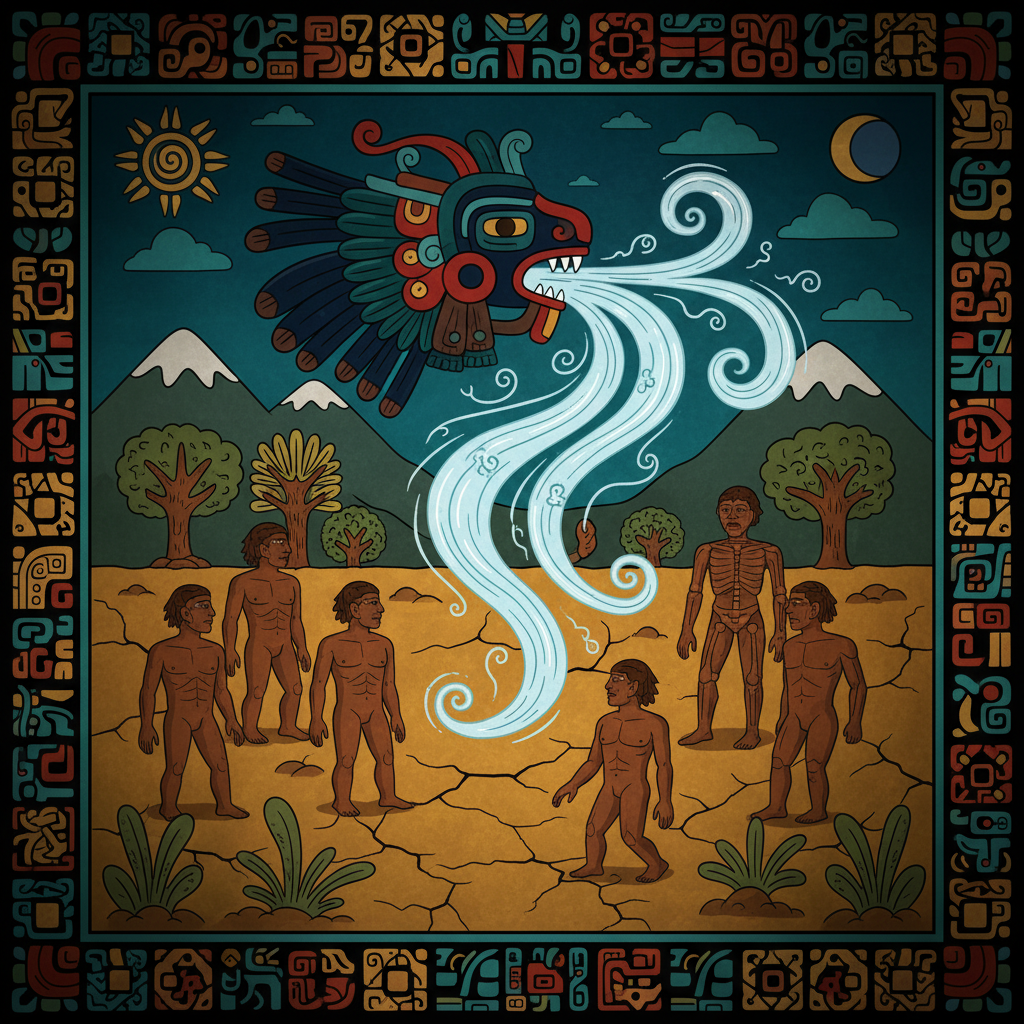
The world has just been remade. The gods have ground the bones of the previous humanity with the blood of their own bodies and shaped a new people from the dough. The bodies lie still on the ground. They are not yet alive. From his shrine in the sky, the wind god Ehecatl descends. He places his lips against the lips of each new human and breathes. The chests rise. Eyes open. The world has people again, and they are alive because the wind chose to give them his breath.
Ehecatl is one of the most distinctive figures in Aztec religion. He is wind given the form of a god, and a god given the function of breath. He is also one face of Quetzalcoatl, the great Plumed Serpent, the god whose worship spans Mesoamerica from the Olmec to the Aztec. To meet Ehecatl is to meet the breath of the cosmos given a duckbill mask, a conical hat, and a round temple where the wind can pass without breaking.
Origins and Cultural Roots
Ehecatl belongs to the religion of the Aztec or Mexica, the people who built the great city of Tenochtitlan in the Valley of Mexico from the 14th to the early 16th centuries. His full name in Nahuatl is often given as Ehecatl-Quetzalcoatl, marking him as an aspect of the more famous Plumed Serpent god. In some sources he is treated as a distinct deity. In others he is one of the four directional Quetzalcoatls, with Ehecatl associated specifically with the wind aspect of the larger god.
The name ehecatl simply means “wind” in Nahuatl. Aztec religion frequently took the natural phenomenon and gave it a personal face. Tlaloc is rain. Tonatiuh is the sun. Ehecatl is wind. The pattern is consistent: the basic forces of weather and time receive divine identity, with cult, image, and story.
Iconographically, Ehecatl is unmistakable. He wears a buccal mask shaped like a bird’s beak, often called a duckbill mask, through which he blows the wind. His head is crowned by a conical hat or pointed cap. He is sometimes shown with the body of Quetzalcoatl wrapped around him, the feathered serpent and the wind god as two facets of the same divine person. The mask is one of the most recognisable images in all of Mesoamerican art.
The Sun of Wind
Aztec cosmology divides time into a sequence of “Suns”, each a complete world ruled by a particular god and ended in a particular catastrophe. There have been four suns before the present one, and each ended in destruction. The second sun, the Sun of Wind, was ruled by Ehecatl-Quetzalcoatl. The people of that world were turned into monkeys and scattered when the world ended in hurricanes. This is recorded in several Aztec sources, including the Codex Chimalpopoca and the Florentine Codex.
The motif of humans turned into monkeys at the end of a wind-driven cataclysm has parallels elsewhere. The Maya Popol Vuh describes how the wooden people, destroyed by Hurakan‘s flood, became the ancestors of monkeys. Mesoamerican mythologies share many such motifs, the result of long contact and shared regional inheritance over millennia.
The current sun, the Fifth Sun, is the present world. It too will end. Aztec religion is unflinching about this. The Fifth Sun is the Sun of Movement, ruled by Tonatiuh, and it will be destroyed by earthquakes. Ehecatl’s role as the past ruler of an earlier world places him in the long perspective of cosmic time. The wind that blows today carries the memory of the world it once ruled.
The Descent to Mictlan
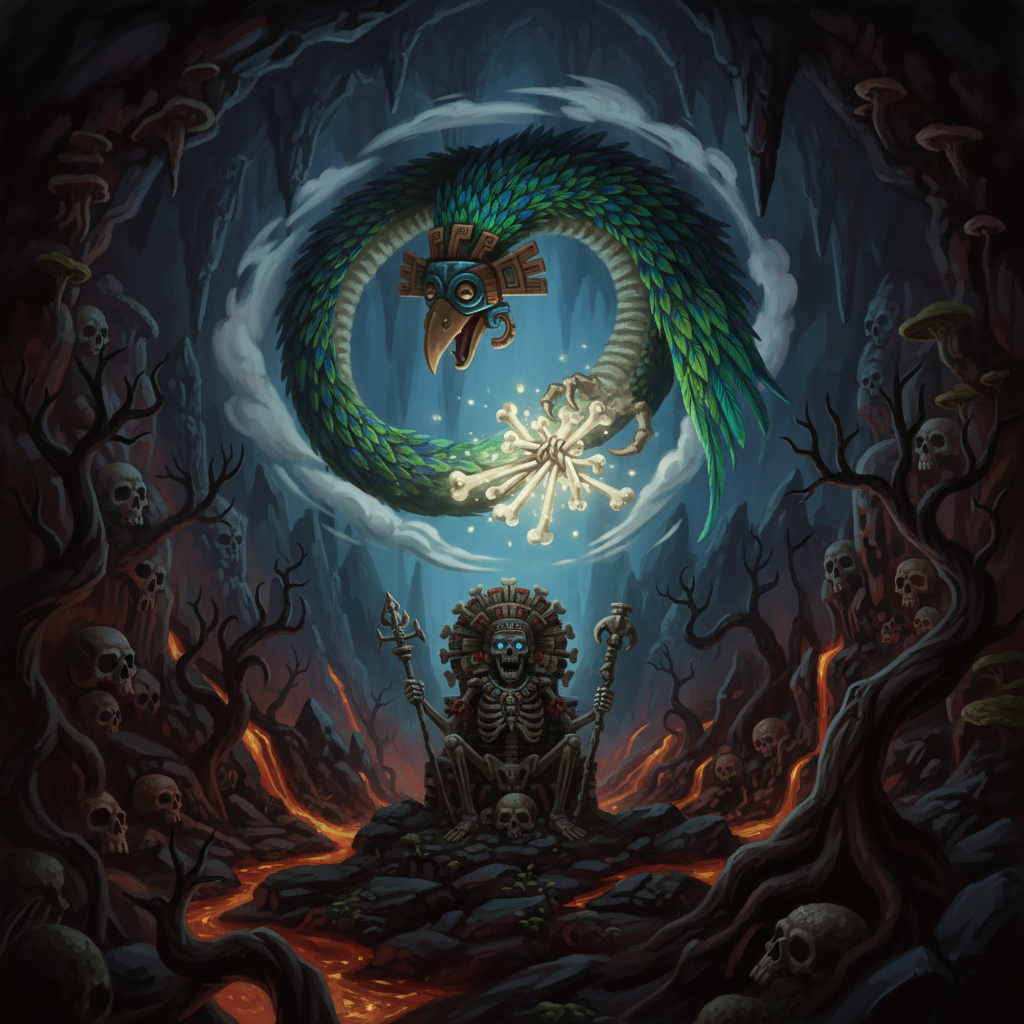
One of the most famous Quetzalcoatl-Ehecatl stories concerns the recreation of humanity at the start of the Fifth Sun. The previous humans had been destroyed. Their bones lay in Mictlan, the underworld of the dead. Quetzalcoatl, in his Ehecatl aspect, descended into Mictlan to retrieve them. The lord of the dead, Mictlantecuhtli, agreed to surrender the bones, but on the condition that Quetzalcoatl complete an impossible task: blow a conch trumpet that had no holes.
Quetzalcoatl asked the worms to bore holes in the conch and the bees to enter and make the conch sound. He blew the trumpet. Mictlantecuhtli was forced to honour his agreement, but he tried to trick Quetzalcoatl as he left, sending pursuers who startled him. Quetzalcoatl dropped the bones, and they shattered. He gathered the broken pieces and brought them to Tamoanchan, the place of origin, where the goddess Cihuacoatl ground them into powder and mixed them with the blood of the gods. From this dough, the new humanity was shaped.
The breaking of the bones is sometimes given as the reason humans are of different sizes. Some bones broke into long pieces, becoming tall people. Others broke into short pieces, becoming short people. The story is one of mythology’s most distinctive accounts of human origin, treating the variety of human bodies as a consequence of a botched ritual.
Round Temples and the Wind Path
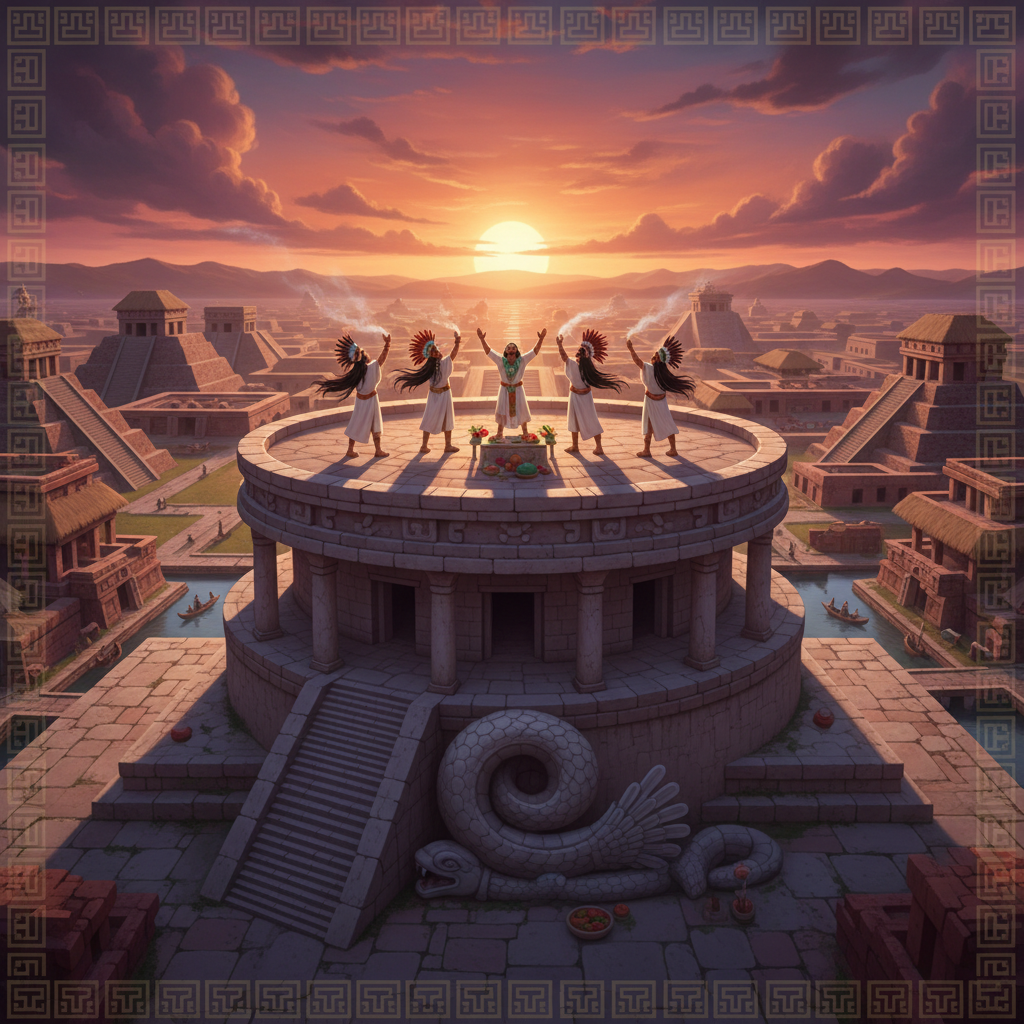
Aztec temples to most gods were rectangular pyramids. Ehecatl’s temples were different. They were round, with a circular plan, often built on a circular platform. The standard explanation in Aztec sources is that the wind cannot turn sharp corners, so a square temple would impede the god’s movement. A round temple lets the wind pass through unobstructed.
The most famous Ehecatl temple stood in central Tenochtitlan, just south of the Templo Mayor. Excavations in Mexico City in the 21st century have uncovered substantial remains of this round structure, now visible to visitors near the cathedral. Other major Ehecatl temples stood at Calixtlahuaca west of the valley, where a fully restored circular pyramid still stands, and at Tlatelolco, the twin city of Tenochtitlan.
The architectural choice is deeply meaningful. Aztec religion mapped its cosmology onto its built environment. Tlaloc and Huitzilopochtli shared a twin pyramid because their worship was paired. Ehecatl received round temples because he was wind. The geometry of the buildings was the geometry of the gods.
Symbolism and Meaning
Ehecatl embodies the Mesoamerican intuition that wind is breath and breath is life. To breathe is to be alive. To stop breathing is to die. The wind that moves through the world is the same substance, in different scale, as the breath that moves through a body. Ehecatl gives the breath. He is the source of life, made visible at the moment when the new humans first inhale.
His role also overlaps with the rain god Tlaloc. The wind moves the clouds. The clouds bring the rain. The two are partners, just as in many other traditions wind and storm gods belong to a single weather complex. The Greek Anemoi bring storms. The Japanese Fujin rides ahead of the rain. The Aztec Ehecatl announces the work of Tlaloc.
What sets Ehecatl apart is his identification with breath. Where other wind gods control the wind from outside, Ehecatl is the wind, and he is also the breath that makes life possible. The duckbill mask through which he blows is a literal pictorial statement: the god creates wind by breathing. The viewer is meant to see breath becoming weather.
Legacy and Modern Influence
Ehecatl remains one of the most archaeologically visible Aztec gods. The round Ehecatl temple at Calixtlahuaca, west of Mexico City, is one of the most striking surviving Mesoamerican structures, fully accessible to visitors and instantly recognisable for its circular form. The Ehecatl temple revealed under the Pino Suarez metro station in central Mexico City is a symbol of the deep continuity of the Aztec city beneath modern construction.
Modern Mexican culture continues to engage with Ehecatl through indigenous-led religious revivals, contemporary art, and academic study. The figure of the wind god with the duckbill mask appears in murals, in commercial design, in heritage signage. He shares space with Quetzalcoatl in the broader cultural memory of pre-Columbian religion.
For modern readers, Ehecatl offers a clear example of how Mesoamerican religion thought about life. To live is to breathe. To breathe is to receive a divine gift. The wind that moves through the lungs is, in this telling, a small piece of the wind that moves the world. The god of breath gave the first breath, and every breath since has been a continuation of that gift.
More From Mesoamerican Mythology
Continue exploring the gods and stories of the Maya, Aztec, and Inca worlds. New encyclopedia entries published every week.
Explore MoreFrequently Asked Questions
Who is Ehecatl in Aztec mythology?
Ehecatl is the Aztec god of wind, often considered an aspect of Quetzalcoatl the Plumed Serpent. His name in Nahuatl means “wind”. He is depicted with a distinctive duckbill mask through which he blows, and his temples were uniquely round to let the wind pass through.
Is Ehecatl the same as Quetzalcoatl?
Ehecatl is one of the four aspects of Quetzalcoatl, the wind aspect specifically. The full name Ehecatl-Quetzalcoatl reflects this identification. In some Aztec sources he is treated as a distinct deity; in others he is one face of the great Plumed Serpent god.
Why are Ehecatl’s temples round?
Aztec sources explain that the wind cannot turn sharp corners, so a rectangular temple would obstruct the wind god’s passage. A circular temple lets the wind move freely. The round Ehecatl temple at Calixtlahuaca and the one beneath modern Mexico City are among the most distinctive structures in Mesoamerican architecture.
What is the Sun of Wind?
In Aztec cosmology, the Sun of Wind was the second of the five great cosmic ages. It was ruled by Ehecatl-Quetzalcoatl and ended in catastrophic hurricanes that turned its people into monkeys. The present age is the Fifth Sun, ruled by Tonatiuh.
What did Ehecatl do at the creation of humanity?
In Aztec mythology, Quetzalcoatl in his Ehecatl aspect descended into Mictlan to retrieve the bones of previous humans. The bones broke during his escape and were ground into powder by the goddess Cihuacoatl, mixed with the blood of the gods, and shaped into new humans. Ehecatl gave them their first breath.
Is Ehecatl related to other wind gods?
Like the Maya Hurakan, the Greek Anemoi, the Japanese Fujin, the Hindu Vayu, and the Iroquois Dagwanoenyent, Ehecatl belongs to the great cross-cultural family of wind deities. Each tradition gives the wind a different face and a different role, but all recognise it as a force worth personifying.