Quick Summary
- Dagwanoenyent is a powerful flying-head witch of Iroquois folklore who travels as a whirlwind and devours the careless.
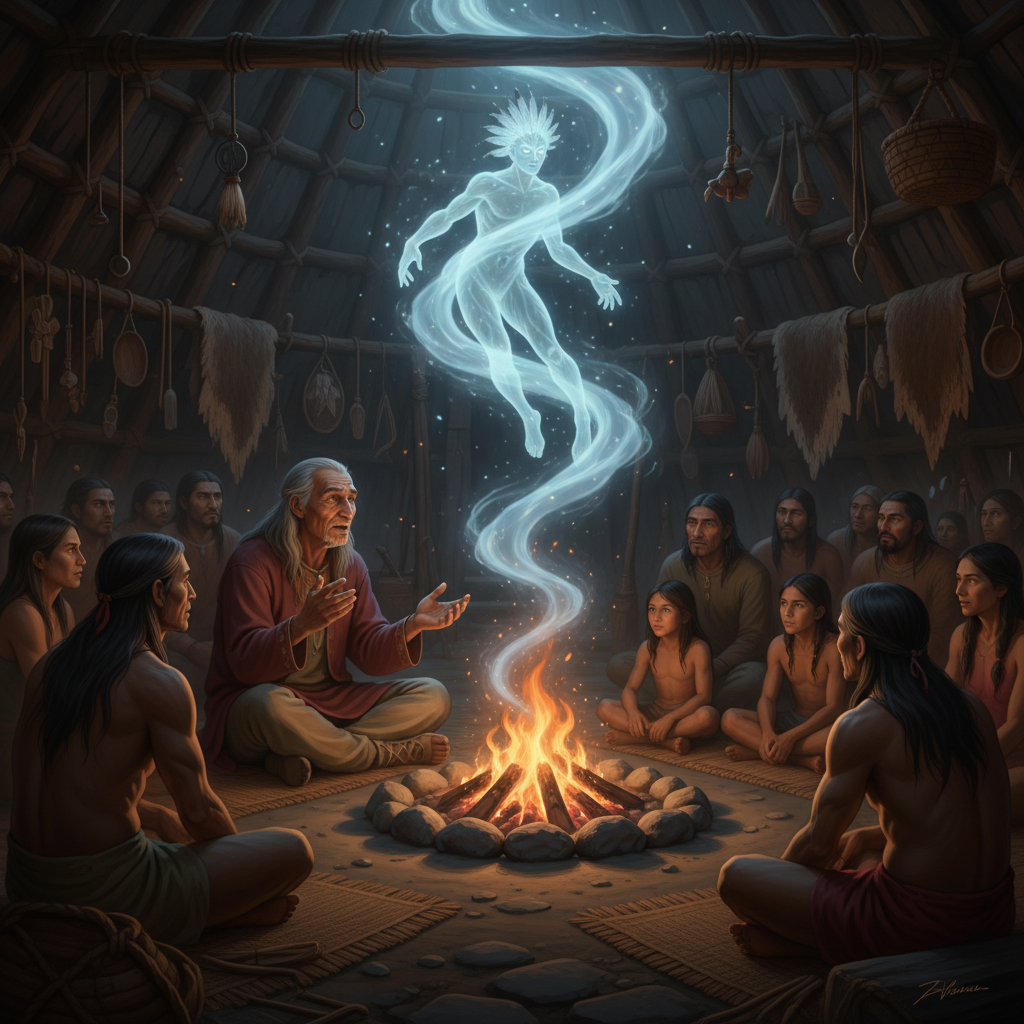
- She appears as a disembodied head crowned by long, snake-like hair that becomes the spinning column of a tornado as she flies.
- Stories of Dagwanoenyent come primarily from the Seneca and other Haudenosaunee (Iroquois) peoples of the northeastern woodlands.
- She is sometimes described as the daughter of the wind itself, and her destruction often requires not blade but cunning.
- Dagwanoenyent stands alongside other personified wind spirits worldwide, from the Greek Anemoi to the Japanese Fujin.
A storm rises out of nowhere on a clear afternoon. The trees bend, then snap. From the heart of the spinning air, a face leans out, hair lashing the sky, eyes fixed on the figure below. The storm has come for someone. The hunter looks up too late.
This is Dagwanoenyent, sometimes spelled Daganoweda or Dagwanoen’yent, one of the most striking figures in the folklore of the Haudenosaunee, the people known to outsiders as the Iroquois. She is a flying head, a witch of the air, a daughter of the wind. To meet her is rarely a meeting you survive.

Origins and Cultural Roots
The Haudenosaunee Confederacy, the union of the Mohawk, Oneida, Onondaga, Cayuga, Seneca, and later the Tuscarora, has preserved one of the richest oral traditions on the North American continent. Within that tradition, the figure of Dagwanoenyent surfaces in Seneca and Cayuga stories collected in the late 19th and early 20th centuries by ethnographers including Jeremiah Curtin and Arthur C. Parker, who recorded tales told by Iroquois elders before they could be lost.
The name itself carries her nature. Dagwanoenyent in some Seneca renderings means “she who flies in the wind”, though translations vary depending on dialect and source. Other accounts call her simply the Whirlwind Witch or the Flying Head. She is one of a class of supernatural beings in Iroquois folklore associated with hostile or capricious natural forces, alongside the stone giants, water cannibals, and the great horned serpents who live beneath rivers and lakes.
What sets Dagwanoenyent apart is the precision of her form. She is not simply a wind spirit. She is a head, severed and animate, crowned by hair that becomes the body of a tornado. The image is unsettling and specific. It belongs to a tradition where the boundary between human, monster, and weather is fluid in ways that mainstream Western mythology often forgets.
The Flying Head Tradition
Iroquois folklore contains several flying head beings, and Dagwanoenyent is the most famous of them. Stories describe a giant disembodied head, sometimes the size of a longhouse, with eyes that glow and teeth bared in permanent hunger. The head flies on the wind, hair streaming behind, and consumes anything in its path: deer, bears, careless travellers, entire camps if it catches them sleeping.
Some accounts describe Dagwanoenyent as the survivor of a once-living person, a witch whose body was destroyed but whose head escaped. Other versions treat her as a being who never had a body, born of the storm itself. The variation is part of the tradition. Stories told by different lineages, in different communities, give different origins and emphasise different powers. What remains constant is the image: the spinning wind, the hair, the face.
Iroquois storytellers used Dagwanoenyent to explain natural phenomena that the Haudenosaunee homelands could produce in abundance. The northeastern woodlands of New York and southern Ontario sit within a region prone to tornadoes, derecho windstorms, and the violent thunder squalls that move down off the Great Lakes. A whirlwind cutting across a forest, splintering trees as it goes, looks for all the world like something with intention.
How She Is Defeated
One of the most widely told Dagwanoenyent stories involves her death at the hands of a clever hero. In a typical version, recorded by Jeremiah Curtin from Seneca informants in the 1880s, a young man whose family has been devoured by the witch sets out to destroy her. He cannot match her power directly, so he uses his mind. He builds a great fire, heats stones until they glow, and waits. When Dagwanoenyent attacks, he tricks her into swallowing the burning stones, and she dies in the agony of her own hunger.
The pattern of the story is significant. The Haudenosaunee storyteller is not glorifying brute force. Dagwanoenyent cannot be wrestled or shot. She must be outwitted. The lesson, repeated across many Iroquois tales, is that human survival in a world of dangerous spirits depends on cleverness, on knowing the rules of the supernatural and using them against itself.
Other versions describe her being lured into a hollow log, pinned by a clever uncle, or trapped beneath a fallen tree. The instrument of her defeat changes. The principle does not. Wind cannot be defeated with wind.

Symbolism and Meaning
Dagwanoenyent embodies a particular relationship with weather. The wind, in this tradition, is not impersonal. It is not a system of pressure differentials. It is a being, sometimes hungry, sometimes cruel, who moves across the land with purpose. To live in the woodlands of the Iroquois homelands was to know that the air could turn on you. The flying head gave that danger a face.
Her form, head without body, also touches on something deeper in folklore: the fear of consumption without restraint. She is mouth and stomach, never sated. Her hair becomes the wind, but her face remains the focus, fixed on whatever she will eat next. In a culture where balance was a central value, where every taking required a giving, Dagwanoenyent represents the principle of imbalance itself. She gives nothing back. She only consumes.
The motif of the disembodied flying head appears beyond Iroquois country too. In Filipino folklore, the manananggal separates her torso from her lower body to fly through the night. In Japanese folklore, the nukekubi detaches her head while her body sleeps. Across cultures, the idea of a head that flies on its own carries a similar charge: violation of the natural order, hunger that has slipped its container.
The connection to wind gods is also worth drawing. Where the Greek Anemoi systematise the wind into four directions and the Japanese Fujin compresses it into a single demon with a sack, the Iroquois imagine it as a face moving through the trees. Each tradition gives the wind an identity. The shape that identity takes reflects the land in which the storyteller lives.

Legacy and Modern Influence
Dagwanoenyent survives in modern Iroquois storytelling, in published collections of Haudenosaunee folklore, and in the work of contemporary Indigenous writers reclaiming and reinterpreting traditional stories. She has appeared as a figure in graphic novels, in horror anthologies, and in academic studies of comparative folklore. Her image, the spinning head with streaming hair, is too vivid to disappear from the imagination once you have seen it.
What makes Dagwanoenyent significant beyond her own tradition is what she shows about the breadth of world mythology. She is not merely a “monster”. She is a sophisticated cosmological figure: a personification of the wind, a moral lesson about cunning over force, a meditation on hunger, and a reminder that the sky is alive. Encountering her properly means setting aside the categories of European monsterology and meeting her on her own terms.
Iroquois tradition continues to be a living tradition, told by Haudenosaunee elders to Haudenosaunee children. Dagwanoenyent belongs to that lineage first. She belongs to outside readers only as a guest belongs in a home: with respect, with attention, and with the understanding that the story is not theirs to take.
Mythology Delivered to Your Inbox
Join 25,000 readers exploring world myth, ancient legends, and the cosmic questions that have shaped human storytelling. New encyclopedia entries delivered every week.
SubscribeFrequently Asked Questions
Who is Dagwanoenyent in Iroquois folklore?
Dagwanoenyent is a powerful witch and wind spirit in Haudenosaunee (Iroquois) folklore. She appears as a giant flying head with long streaming hair that becomes the body of a tornado, and she travels on the wind devouring whatever crosses her path.
What does the name Dagwanoenyent mean?
The name comes from Seneca and other Haudenosaunee dialects. Translations vary, but a common rendering is “she who flies in the wind”. She is sometimes also called the Whirlwind Witch or the Flying Head.
How is Dagwanoenyent defeated in the stories?
The most common Iroquois story has a clever young man trick her into swallowing red-hot stones from a fire he prepares for the trap. The principle of the tale is that wind cannot be matched with force. Dagwanoenyent must be outwitted, not overpowered.
Is Dagwanoenyent connected to other flying head spirits?
Yes. The motif of a disembodied flying head appears in other folklore traditions, including the Filipino manananggal and the Japanese nukekubi. While the cultural meanings differ, all share the unsettling image of a head that travels alone, separated from its body.
Where do stories of Dagwanoenyent come from?
Most published versions of Dagwanoenyent stories were collected from Seneca and Cayuga storytellers in the late 19th and early 20th centuries by ethnographers like Jeremiah Curtin and Arthur C. Parker. The stories continue to be told by Haudenosaunee communities today.
How does Dagwanoenyent compare to other wind deities?
Many cultures personify the wind as a being with intent. The Greek Anemoi divide the wind into four named gods. The Japanese Fujin carries a sack of winds. The Aztec Ehecatl breathes life into the world. Dagwanoenyent gives the wind a single, terrifying face: a head that hunts.