Quick Summary
- Hurakan, also spelled Huracan or Jurakan, is the Maya and Taino god of wind, storm, fire, and creation, whose name gave English the word hurricane.
- He appears in the K’iche’ Maya creation epic the Popol Vuh as one of the three gods called Heart of Sky, who shaped the world and called forth the first humans.
- Iconographic tradition shows him as a one-legged figure, with the missing leg sometimes depicted as a serpent, lightning bolt, or whirlwind.
- Hurakan is credited with sending the great flood that destroyed the wooden people, an early failed creation attempt described in the Popol Vuh.
- The Taino peoples of the Caribbean carried versions of his cult, and the Spanish adopted his name for the storms they encountered in the New World.
The first humans the gods made were carved from wood. They could speak, but they could not feel. They lived in the world but did not honour those who had made them. So the gods sent a flood, and a great storm rose over the land, tearing the wooden people apart and washing them into the rivers. The storm had a name. It had a face. It was Hurakan, and the world it destroyed gave way to a world it would help create.
Hurakan is one of the most consequential figures in pre-Columbian American mythology. He is a creator god, a storm god, and the divine voice that speaks the world into being in the K’iche’ Maya creation epic. His name has travelled further than perhaps any other indigenous American word, embedded now in the meteorological vocabulary of every coastal nation touched by the Atlantic and the Caribbean. When you hear the word hurricane, you are pronouncing his name.

Origins and Cultural Roots
The principal source for Hurakan is the Popol Vuh, the K’iche’ Maya book of creation, written down in the K’iche’ language using Latin script in the mid-16th century by Maya scribes preserving an oral tradition that stretched back centuries. The K’iche’ Maya lived, and still live, in the highlands of what is now Guatemala. The Popol Vuh describes how the world came to be, how the gods made and unmade humanity several times before settling on people of maize, and how the hero twins Hunahpu and Xbalanque defeated the lords of Xibalba in the underworld.
Hurakan is one of three gods together called Heart of Sky (Uk’ux Kaj). The other two are Chipi-Caculha (Newborn Lightning) and Raxa-Caculha (Sudden Lightning). Together they form a single divine entity expressed in three modes, much like Christian trinitarian thinking, though the comparison can mislead if pushed too far. Hurakan himself is the first and most active of the three. His name is sometimes glossed as “one-legged” (hun meaning one, raqan meaning leg), an iconographic detail that recurs throughout Maya art.
The Taino peoples of the Caribbean, distant cultural cousins of the Maya through long pre-Columbian trade and migration, worshipped a similar storm god under names like Jurakan or Huracan. Spanish colonisers in the 16th century encountered the word as the Taino name for the catastrophic cyclones of the Atlantic basin and adopted it into Spanish, from which it passed into English, French, and most other European languages.
Hurakan in the Popol Vuh
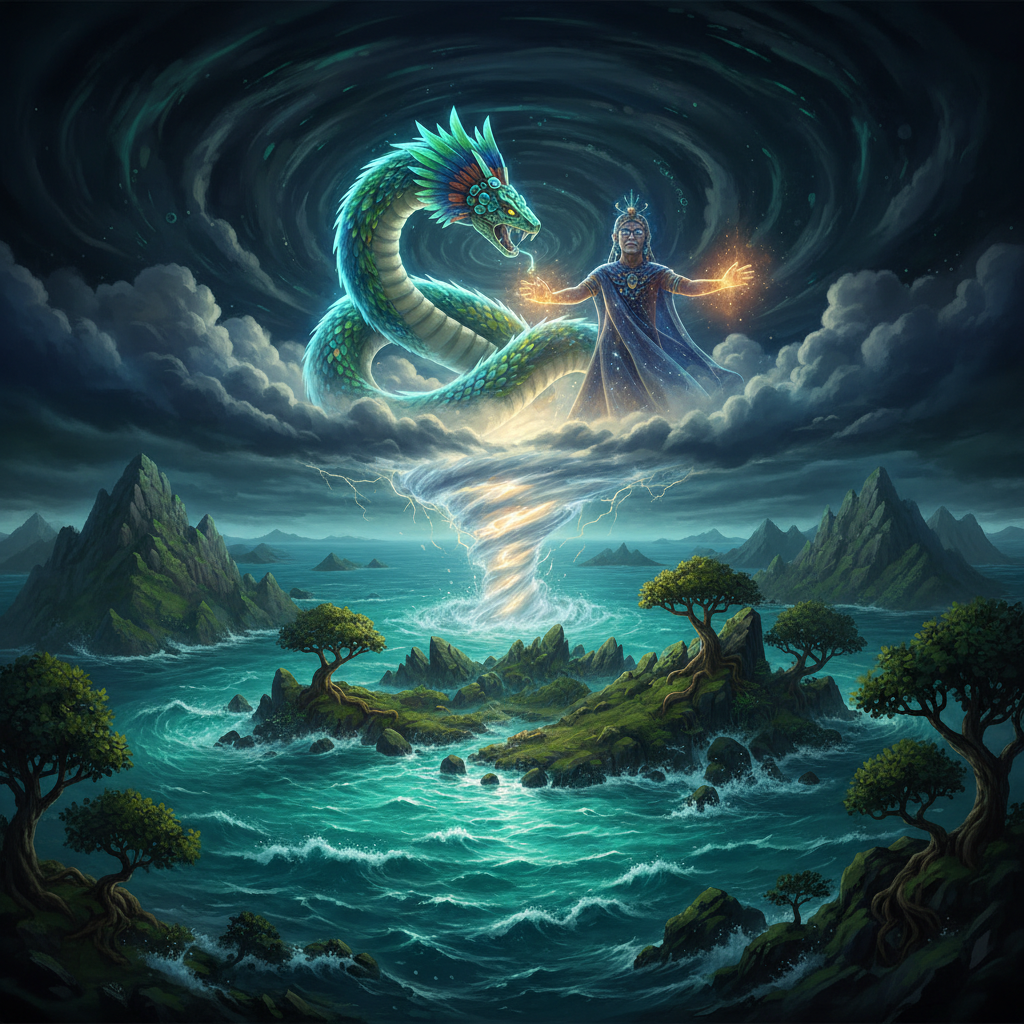
The Popol Vuh opens with primordial silence. There is only the sea, and above it the sky. Beneath the surface of the sea live the creator gods, including Tepeu and Gucumatz, the Plumed Serpent. They speak together and conceive of the world. At the moment of creation, Hurakan, Heart of Sky, descends and joins them. Together they call out: “Earth!” And the earth rises from the water.
This act of creation through speech places Hurakan at the very centre of K’iche’ cosmology. He is the breath that names the world. He is the wind that carries divine intention into form. The parallels with other creation traditions, including the opening of Genesis where the spirit of God moves over the waters, are striking and have been the subject of long scholarly discussion.
The first humans the gods make are animals: deer, jaguars, birds, snakes. But the animals cannot speak the names of the gods, so they are sent to the forests as the food of the people who will come. The gods then make people from mud. The mud people fall apart in the rain. The gods make people from wood. The wooden people speak, but they have no hearts. They forget their makers. So Hurakan sends the great flood, and the wooden people are destroyed. Some escape into the trees, and the Popol Vuh says they are the ancestors of the monkeys.
Only on the fourth attempt do the gods succeed. They grind maize and shape humans from the dough. These first true humans are made from corn, and they remember to pray. Hurakan’s storm, in this telling, is not destruction for its own sake. It is the cleansing that allows true humanity to emerge.

The One-Legged God
Maya art often depicts Hurakan with one leg. The other leg trails away into a serpent, a flame, or a column of swirling air. The image is striking and has parallels in other Mesoamerican deities, including the Aztec figures Tezcatlipoca and Ehecatl, both of whom appear with one foot replaced by something else. The one-legged form may represent the rotating spiral of a tornado or hurricane viewed from below: a single point of contact with the ground, with everything above it spinning.
This iconographic choice is more than aesthetic. In Mesoamerican thought, asymmetry often signals supernatural status. Gods are not built like humans. They are visibly different, and the difference marks them as belonging to a higher order. Hurakan’s one leg is a sign of his nature, the same way a halo or wings might mark a being in other traditions.
Symbolism and Meaning
Hurakan represents a worldview in which destruction and creation are not opposites. The flood that destroys the wooden people is the same divine action that prepares the world for true humanity. Storm is generative. The wind that tears down trees also clears space for new growth. To live in the path of hurricanes, as the Maya and Taino did, was to know this directly. The storm could destroy your village and remake your fields. Both were the work of the same god.
This view places Hurakan in conversation with other storm and wind deities around the world. The Japanese Fujin carries his bag of winds with the same dual potential, gentle breezes or destroying typhoons. The Greek Anemoi divide the sky into directional forces, each with its own temper. The Aztec Ehecatl, often considered a wind aspect of Quetzalcoatl, breathes life into creation. Across these traditions, the wind is more than weather. It is the breath of the world, and the world is alive.
The Popol Vuh also emphasises Hurakan’s role as the speaker of names. Creation begins when he says “Earth!” and the earth rises. To name something is to call it into being. This is not unique to Maya thought, but the Popol Vuh expresses it with rare clarity. The wind carries the voice. The voice shapes the world.

Legacy and Modern Influence
Hurakan’s name is the most widely travelled of any pre-Columbian deity. The word hurricane entered Spanish in the early 16th century from the Taino Juracan, then passed into English by the late 1500s. Shakespeare uses the word in King Lear: “You cataracts and hurricanoes, spout till you have drench’d our steeples.” Every modern weather report that names a tropical cyclone is, in a small way, invoking the storm god of the Maya and Taino.
In modern Latin American culture, Hurakan appears in literature, in popular music, and in indigenous activism reclaiming traditional knowledge. The Popol Vuh itself, translated into many languages, remains one of the great works of world literature. Scholars consider it equal in weight to Hesiod’s Theogony, the Rigveda, or the Norse Eddas: a primary text of human attempts to explain how the world came to be.
For modern readers, the figure of Hurakan offers something specific. He is a god of weather treated with seriousness and complexity, in a tradition often pushed to the margins of world mythology curricula. To meet him in the Popol Vuh is to recognise that the great cosmological questions belong to every culture, and the answers given by the K’iche’ Maya are as profound as any in the ancient world.
Mythology Delivered to Your Inbox
Join 25,000 readers exploring world myth, ancient legends, and the cosmic questions that have shaped human storytelling. New encyclopedia entries delivered every week.
SubscribeFrequently Asked Questions
Who is Hurakan in Maya mythology?
Hurakan is the Maya god of wind, storm, fire, and creation. He is one of three gods called Heart of Sky in the K’iche’ Maya creation epic the Popol Vuh, and he is credited with helping to create the world and with destroying earlier failed forms of humanity through storm and flood.
Did the word hurricane come from Hurakan?
Yes. The English word hurricane descends from the Taino Juracan, a name closely related to the K’iche’ Maya Hurakan. Spanish colonisers in the early 16th century adopted the word for the catastrophic Atlantic and Caribbean storms, and from Spanish it spread into English and most other European languages.
Why is Hurakan shown with one leg?
The one-legged form is a marker of supernatural status in Mesoamerican art and may also represent the spiral form of a tornado or hurricane viewed from below. The missing leg is sometimes shown as a serpent, a flame, or a swirling wind. Other Mesoamerican gods, including Tezcatlipoca, share this iconography.
What role does Hurakan play in the Popol Vuh?
Hurakan, as part of Heart of Sky, helps the other creator gods speak the world into being. He calls out “Earth!” and the earth rises from the sea. He also sends the great flood that destroys the wooden people, an early failed attempt at creating humanity, before the gods finally succeed by shaping humans from maize.
How is Hurakan related to other wind gods?
Hurakan shares the role of personified storm and wind with deities from many traditions: the Japanese Fujin, the Greek Anemoi, the Hindu Vayu, the Aztec Ehecatl, and the Iroquois Dagwanoenyent. Each tradition gives the wind a different face, but all recognise it as a being with intention.
Did the Taino worship Hurakan too?
The Taino peoples of the Caribbean had their own version of the storm god, called Jurakan or Huracan, closely related to the K’iche’ Maya figure. The Taino and Maya were distinct cultures with shared elements through long pre-Columbian contact across Mesoamerica and the Caribbean basin.