Quick Summary
- Loki is the Norse trickster god, a shape-shifter and blood-brother of Odin who lives among the Aesir but is born of giants.
- His children include Hel, ruler of the dead; Fenrir, the wolf who will kill Odin; and Jormungandr, the world serpent.
- His most famous deeds include arranging the death of Baldur, mocking the gods at Aegir’s feast, and being bound beneath a serpent dripping venom.
- At Ragnarok he leads the army of the dead and the giants against the Aesir, and dies in single combat with Heimdall.
- Modern adaptations including Marvel and Norse-inspired fantasy have made Loki one of the most globally recognised mythological figures alive today.
The other gods of Asgard fight, feast, and rule. Loki tells lies. He shape-shifts. He insults his hosts. He stitches up his own mouth as punishment for losing a wager and tears the stitches out again. He helps the gods more often than he hurts them, and yet at the end of the world he leads the dead against them. Of all the figures in Norse myth, Loki is the most slippery, the most modern, and in some ways the most heartbreakingly human.
To understand the Norse pantheon you must understand Loki, and to understand Loki you must accept that he refuses to be one thing. He is friend and enemy, parent and victim, fire and frost, god and giant. He is the necessary disruption of the Aesir’s order, and he is the ruin that brings their order down.

Origins and Cultural Roots
The principal sources for Loki are the same medieval Icelandic texts that preserve Norse myth: the Poetic Edda, an anonymous 13th-century compilation of older oral poetry, and the Prose Edda, written by the Icelandic chieftain Snorri Sturluson around 1220. Loki appears in many of the most important poems and stories: the Lokasenna (Loki’s flyting), the Thrymskvitha (the theft of Thor‘s hammer), the Gylfaginning (Snorri’s systematic mythology), and many others. He is one of the most-attested figures in the entire Norse corpus.
His parentage is unusual among the major Norse gods. He is the son of the giant Farbauti and the giantess Laufey. His name in Old Norse is simply Loki, meaning perhaps “knot” or perhaps something untranslatable, depending on the etymological theory. Despite being a giant by birth, he is counted among the Aesir, the principal Norse gods. Odin, ruler of the gods, has sworn blood-brotherhood with him. He sits at the council of the gods, eats at their feasts, and is treated as one of them.
This in-between status is the key to his character. He belongs to both worlds and neither. He is invited inside but never quite trusted. He turns up where he is needed and where he is not. He is family.
The Children of Loki
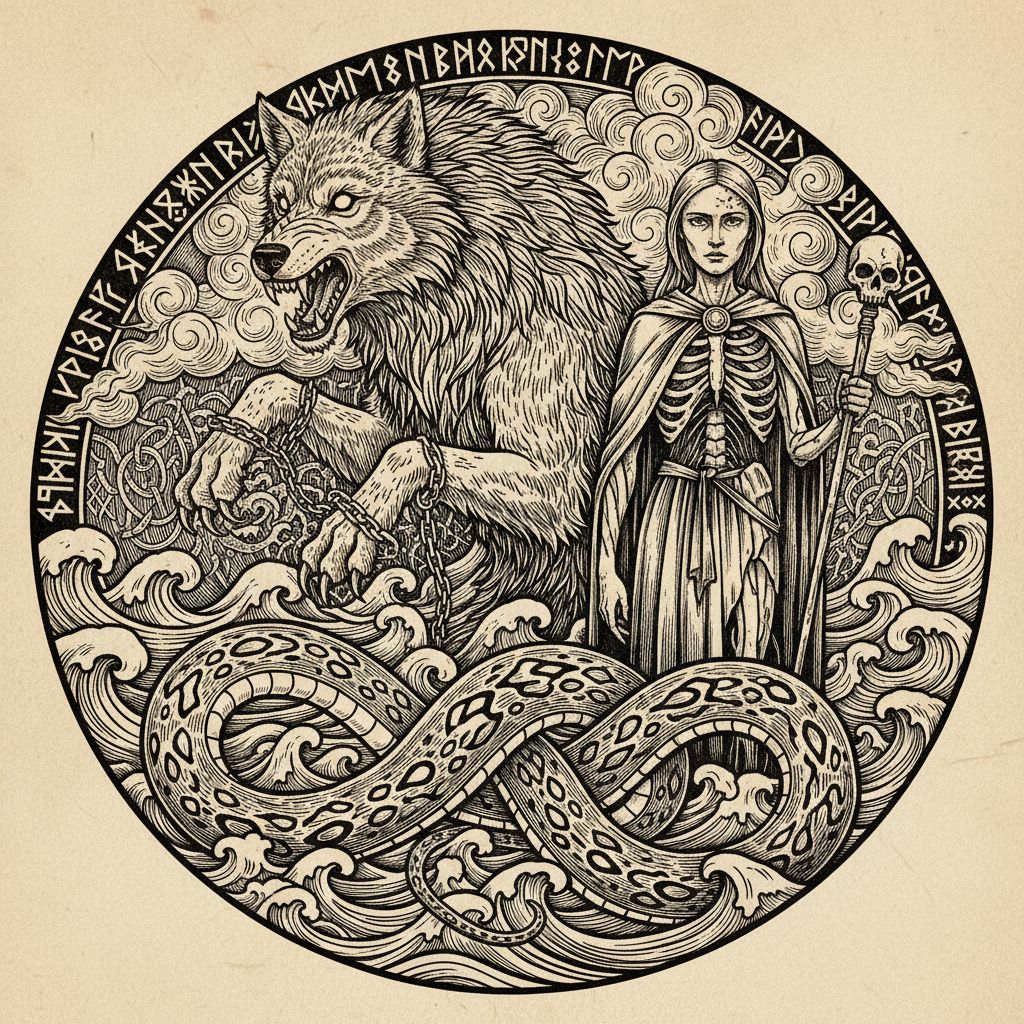
Loki has more than one family. By his wife Sigyn, the loyal goddess who stays with him through everything, he has the sons Narfi and Vali. By the giantess Angrboda, he fathers three children who terrify the gods: Hel, who rules the dead in the underworld of the same name; Fenrir, the great wolf who will kill Odin at Ragnarok; and Jormungandr, the Midgard Serpent, who coils around the world and meets Thor in the final battle.
The gods, foreseeing the ruin these children will cause, take steps. Hel they cast down to rule the underworld. Jormungandr they hurl into the sea, where he grows so large his coils circle the earth. Fenrir they bind with the magical chain Gleipnir, knowing the wolf will not stay bound forever. The story of the binding of Fenrir is one of the great tragedies of Norse myth, and Loki’s role as the wolf’s father places him at the heart of the cosmic tragedy of Ragnarok before it has even begun.
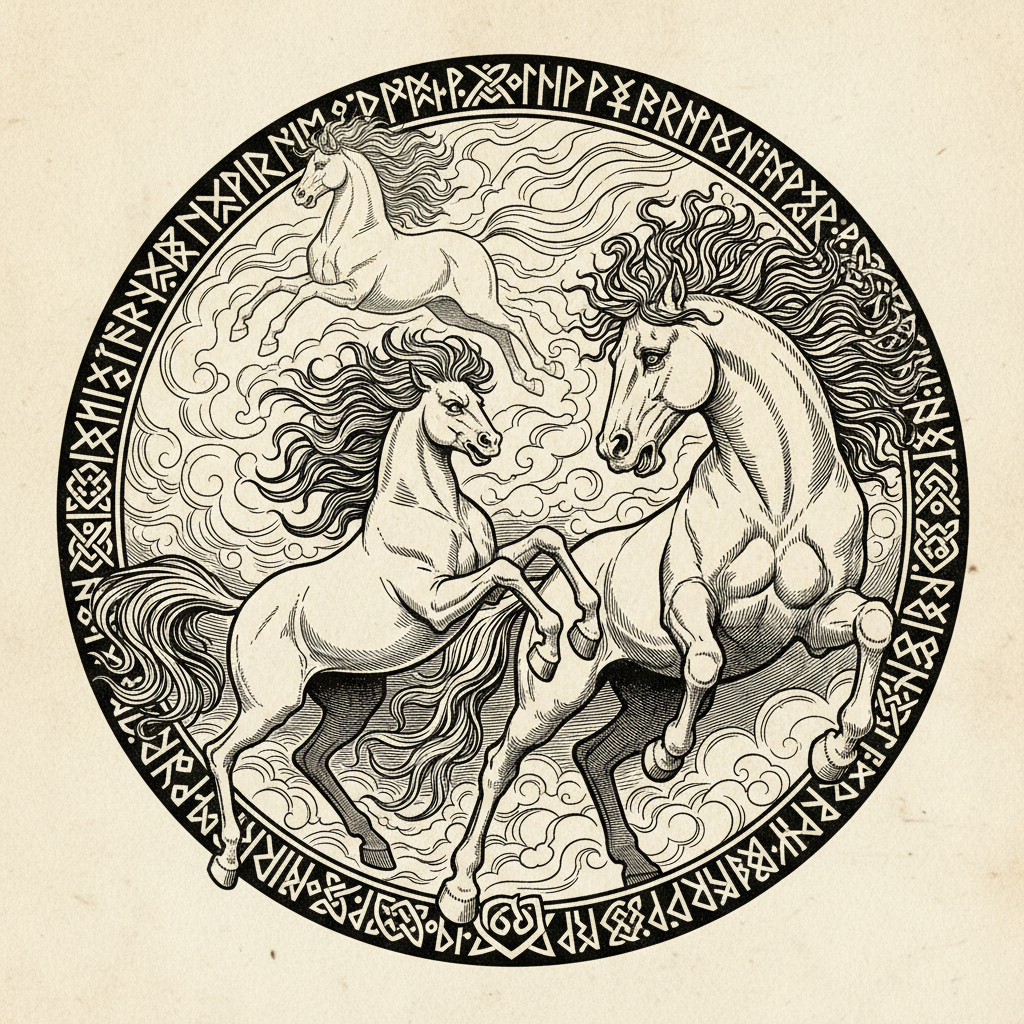
Loki also bears a child of his own body. In one of the strangest and most famous stories of the Eddas, he transforms into a mare to distract a giant’s stallion, and in due course gives birth to Sleipnir, the eight-legged horse who becomes Odin’s mount. Loki’s gender shifts as easily as his form. He is a god whose body refuses to obey the rules of bodies.
The Death of Baldur
The most consequential thing Loki does in Norse myth is engineer the death of Baldur, the beloved son of Odin and Frigg. Baldur is the brightest and gentlest of the gods. After he begins to dream of his own death, his mother Frigg goes through the world and exacts a promise from every living thing, every plant, every metal, every disease, that none will harm her son. Only the mistletoe is overlooked, considered too young to bother with.
The gods, knowing Baldur is now invulnerable, make a game of it. They throw weapons and stones at him, and everything bounces off. Loki, in disguise, learns from Frigg about the mistletoe. He shapes a dart from it. He gives it to Hodur, the blind brother of Baldur, and guides his hand. The dart strikes. Baldur falls. The shining god dies, and the gods know that Ragnarok approaches.
This is the act for which Loki cannot be forgiven. Even his mockery of the gods at Aegir’s feast in the Lokasenna, where he insults each of them in turn, can be read as wounded pride. The killing of Baldur is something else. The Aesir capture Loki, bind him beneath a great cave with the entrails of one of his own sons, and place a venomous serpent above him. The venom drips onto his face. Sigyn, his loyal wife, holds a bowl to catch the venom, but when she turns to empty it, the venom falls on Loki, and his writhing causes earthquakes. He will lie there until Ragnarok.

Ragnarok and the End
When Ragnarok comes, the bonds of Loki break. He sails the ship Naglfar, made from the fingernails of the dead, at the head of an army of the giants and the dishonoured dead. He crosses Bifrost and meets the gods on the plain of Vigrid. There he fights Heimdall, the watchman of the gods. The two kill each other in single combat. The world burns.
Loki’s role in Ragnarok closes a long arc. The trickster who sat at the gods’ feasts has become the captain of the army that destroys them. Yet even this is not the simple story of evil triumphant. Norse cosmology accepts Ragnarok as inevitable, woven into the fabric of fate. Loki is not the cause of the world’s end. He is the cause of his own end, and his end is part of the world’s. The two cannot be separated.
Symbolism and Meaning
Loki belongs to the great cross-cultural family of trickster figures: the West African Anansi, the Native American Coyote, the Polynesian Maui, the Greek Hermes in his more mischievous moments. Tricksters break rules, and in breaking them reveal the rules. They cannot be neatly categorised as good or evil. They are necessary precisely because they are uncategorisable.
What sets Loki apart from many of his peer tricksters is the depth of his tragedy. Anansi never suffers as Loki suffers. Coyote does not have a wife who holds a bowl above his face for centuries. The Norse let their trickster fall further than most traditions do. The image of Loki bound beneath the venom-dripping serpent is one of the most haunting in world mythology, comparable to Prometheus chained to the rock or Tantalus reaching for water that recedes.
Loki also embodies the Norse interest in the porous boundary between gods and giants. The two are not opposites. They mate. They feast together. They exchange children. The giants are not simply evil. They are older than the gods and will outlast them. Loki, half-giant and half-Aesir, is the figure through whom that older order is always present in Asgard.
Legacy and Modern Influence
Few mythological figures have had a more spectacular modern career than Loki. The Marvel Cinematic Universe version, played by Tom Hiddleston in Thor, The Avengers, and his own television series Loki, has made the Norse trickster one of the most recognisable mythological characters in the world today. The Marvel Loki is a remarkable adaptation, drawing on the Norse original while adding new layers of complexity around identity, family, and redemption.
Beyond Marvel, Loki appears in Neil Gaiman’s American Gods, in countless novels, video games, graphic novels, and stage productions. He is a frequent figure in modern Heathenry, a contemporary revival of Norse pre-Christian religion, where his place is debated. Some Heathen groups honour him. Others refuse to. The argument echoes the ambivalence of the original myths: Loki is family or he is enemy, and reasonable people will draw different lines.
For modern readers, Loki offers something rare: a god who is not a moral lesson. He is not a model. He is not a villain in the simple sense. He is a complicated person, possibly the only fully realised character in the entire Norse pantheon. The gods of order are easy. The gods of disorder, the ones who refuse the categories the rest of the pantheon tries to impose, are harder and more interesting. Loki has lasted a thousand years for a reason.
More From Norse Mythology
Continue exploring the gods, monsters, and worlds of Norse myth. New encyclopedia entries published every week.
Explore MoreFrequently Asked Questions
Who is Loki in Norse mythology?
Loki is the Norse trickster god, a shape-shifter born of giants but counted among the Aesir, the principal Norse gods. He is Odin’s blood-brother, the father of monstrous children including Hel, Fenrir, and Jormungandr, and ultimately the agent of Baldur’s death and the leader of the giants at Ragnarok.
Is Loki really evil?
Loki defies simple good-and-evil categories. In the early Eddic poems he often helps the gods, recovers Thor’s hammer when it is stolen, and provides clever solutions to crises. His later turn against the Aesir, especially the killing of Baldur, marks his fall, but his character throughout remains layered and tragic rather than simply villainous.
Who are Loki’s children?
By the giantess Angrboda, Loki fathers Hel, Fenrir, and Jormungandr. By his wife Sigyn, he has the sons Narfi and Vali. He also gives birth himself to Sleipnir, the eight-legged horse, after transforming into a mare to distract a giant’s stallion.
How does Loki die?
At Ragnarok, Loki breaks free of the cave where the gods bound him beneath a venom-dripping serpent. He leads the army of the dead and the giants against the Aesir, and dies in single combat with Heimdall, the watchman god. The two kill each other on the plain of Vigrid.
Why was Loki bound?
The Aesir bound Loki for engineering the death of Baldur, the beloved son of Odin and Frigg. After Loki guided the hand of the blind god Hodur to throw the mistletoe dart that killed Baldur, the gods captured Loki, bound him beneath a cave with the entrails of his own son, and placed a venomous serpent above him to drip venom on his face.
Is the Marvel Loki accurate to the myths?
The Marvel Cinematic Universe version of Loki draws on the Norse original but adds many new layers of plot and character. Both the myth and the Marvel version share the trickster nature, the shape-shifting, the complicated relationship with Thor, and the ambiguity between hero and villain. The Marvel version is loosely inspired rather than directly faithful.