Quick Summary
- Hodur, also spelled Hod, Hothr, or Hoder, is the blind Norse god who unwittingly kills his bright brother Baldur with a mistletoe dart guided by Loki’s hand.
- His name in Old Norse means “warrior” or “battle”, an ironic title for a god remembered as the unwilling agent of the Aesir’s first great loss.
- Hodur is killed in revenge by Vali, a son of Odin born specifically for the task and grown to maturity in a single day.
- After Ragnarok, Hodur returns from the underworld alongside Baldur to dwell in the new world, the Eddas suggesting a final reconciliation.
- His story is preserved in the Poetic Edda, the Prose Edda, and Saxo Grammaticus’s Gesta Danorum, which gives a strikingly different version.
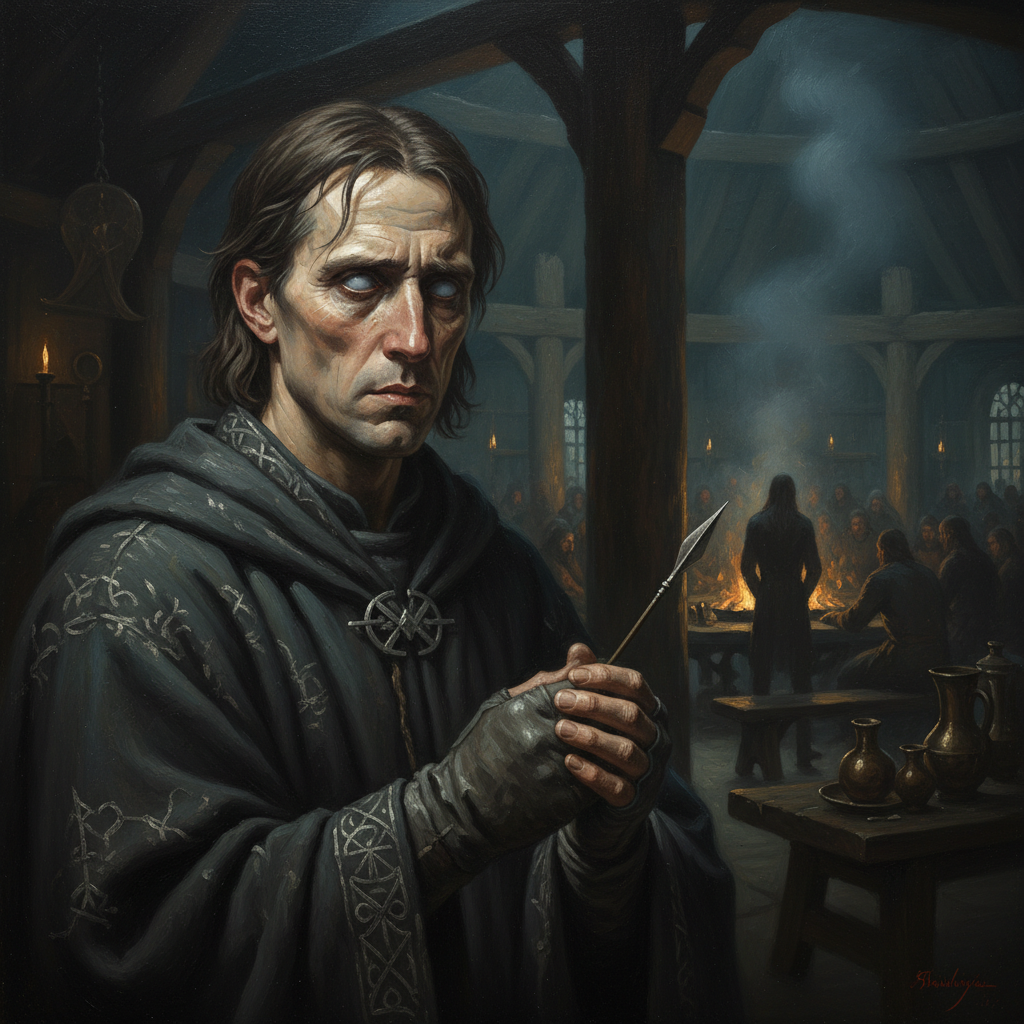
The gods of Asgard play a game. They throw stones, axes, and arrows at the bright god Baldur, who stands in the centre of the circle laughing because nothing can harm him. Every plant, every metal, every disease has sworn an oath to spare him. Beside the circle stands his brother Hodur, who cannot see. Someone presses a small dart of mistletoe into his hand and guides his arm. He throws. The shaft strikes. Baldur falls. The laughter stops. The world has changed.
Hodur is one of the most tragic figures in Norse myth. He is the blind brother who kills the bright one without meaning to. He is the agent of the catastrophe that begins the long chain leading to Ragnarok. He is also, in the strange logic of the Eddas, one of the gods who returns after the world ends. His story is brief, painful, and quietly central to the Norse imagination.
Origins and Cultural Roots
Hodur (Hodr in Old Norse) is the son of Odin and Frigg and the brother of Baldur. He is one of the principal gods of the Aesir, though he plays a smaller narrative role than his more famous brothers. The medieval Icelandic sources describe him as blind, strong, and reserved. The Prose Edda of Snorri Sturluson, written around 1220, gives the fullest account of his role in the killing of Baldur. The Poetic Edda, an older anonymous compilation, refers to the killing in several poems including Voluspa and Baldrs Draumar.
His name is interpreted variously. Some scholars derive it from a Germanic root meaning “warrior” or “battle”. Others connect it to a word for “hooded one” or “concealer”, which would resonate with his blindness. The exact etymology is uncertain, but the name carries martial weight. He is not a peripheral god in name. He is a fighter. The irony of his story is that the only blow remembered as his is the one he never meant to throw.
Saxo Grammaticus, the medieval Danish historian whose Gesta Danorum (around 1200 CE) preserves an alternative Scandinavian tradition, gives a markedly different version of Hodur. In Saxo’s telling, Hothus is a mortal hero, not a god, and his fight with Balderus is a long and bloody rivalry over the love of a woman named Nanna. The two traditions are separate, and most modern treatments follow the Eddic version.

The Death of Baldur
Baldur begins to dream of his own death. The dreams are vivid and persistent, and the gods grow alarmed. His mother Frigg, refusing to accept the omen, walks the world and exacts an oath from every creature, plant, mineral, and disease that none will harm her son. Only the mistletoe is overlooked. Frigg considers it too small and young to bother with.
The Aesir, now believing Baldur invulnerable, hold their stone-throwing game in his honour. Loki, the trickster god, learns of the oversight by tricking the secret out of Frigg in disguise. He shapes a dart from the mistletoe and slips it into the hand of Hodur. He guides Hodur’s arm, takes aim at the laughing Baldur, and lets fly.
The mistletoe pierces Baldur. The bright god dies. The Aesir are speechless with grief, but among the rules of the gods is a law against shedding blood in the sanctuary, so Hodur cannot be killed there. The vengeance must wait.
The Birth of Vali and the Vengeance
Odin, the ruler of the gods, fathers a son named Vali for one purpose only: to avenge Baldur. Vali is born of a giantess named Rind, and the rules of the cosmos require that he grow with supernatural speed. According to the Eddas, Vali is a day old when he kills Hodur. He neither washes his hands nor combs his hair until the act is done. The vengeance is swift, ritual, and terrible.
Hodur dies, and the gods send him to Hel, the underworld of those who do not die in battle. There he joins his brother Baldur, who has gone before him. The two brothers, the bright and the blind, sit together in the realm of the dead while the world above moves toward Ragnarok.
The grief of Frigg and Odin is absolute. Hermod, another son of Odin, rides to Hel to plead with the goddess of death for Baldur’s release. Hel agrees, on the condition that every creature in the world weep for Baldur. Every creature does, except for one giantess named Thokk, who is widely believed to be Loki in disguise. So Baldur remains in Hel. So does Hodur.

Hodur After Ragnarok
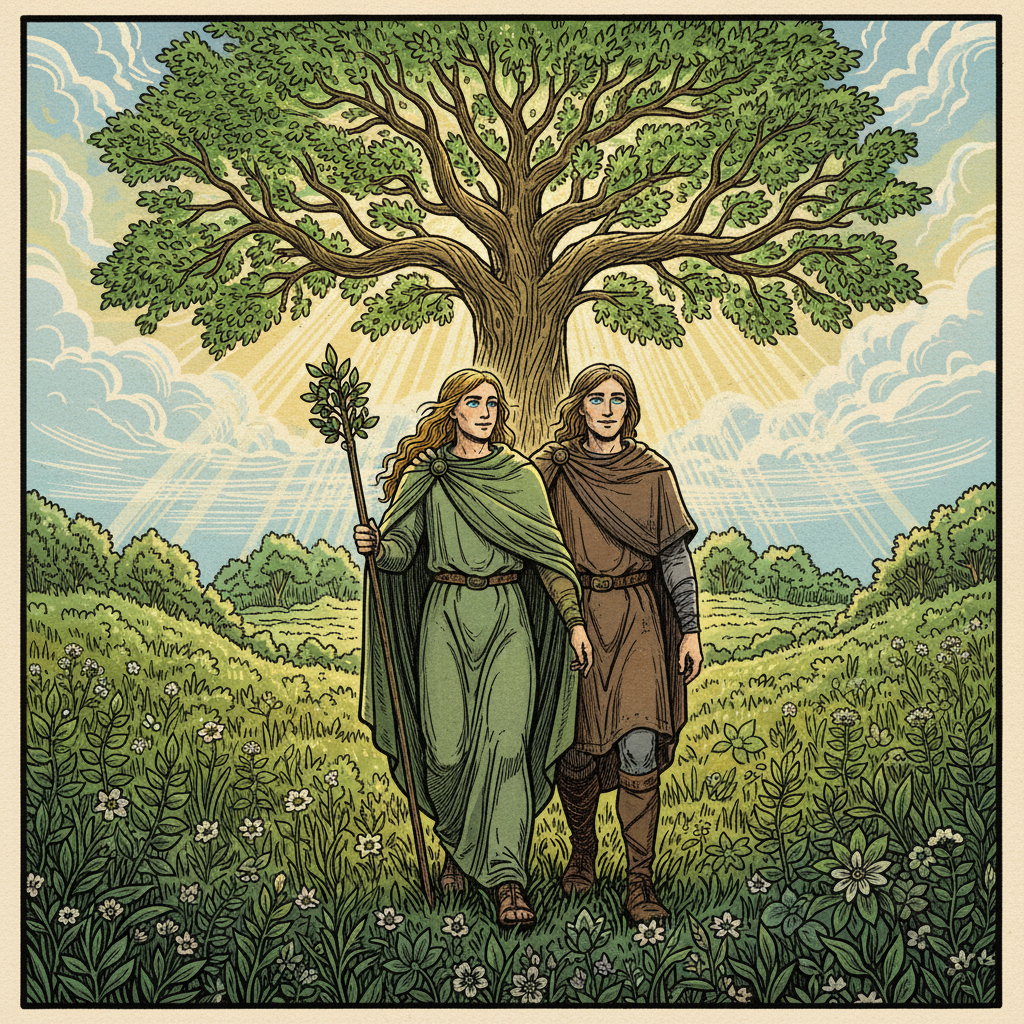
The Norse imagination of the end of the world is unusual among ancient mythologies in that it allows for a beginning afterward. Ragnarok burns the cosmos. Most of the gods die. The world sinks into the sea. Then, in a long passage that closes the Voluspa, a new green earth rises. Two human survivors emerge from the shelter of a tree to begin humanity again. Some of the gods, including Baldur and Hodur, return from Hel to dwell in the new world.
This is one of the most striking moments in all of Norse mythology. The blind god who killed his bright brother is restored beside him. The two who could not be reconciled in the old world walk together in the new. Whether this is to be read as forgiveness, as the closing of a wound, or simply as the cosmic accounting that Hodur was never truly responsible, the Eddas do not say. They simply put him there, alive again, alongside Baldur, in the new world.
Symbolism and Meaning
Hodur is the god of the unintended consequence. His blindness is not just physical. It is moral. He cannot see what he is doing because the trickster has placed the weapon in his hand. The Norse imagination uses him to ask a question that haunts every legal and moral tradition: when is a person responsible for what they did, and when is the responsibility someone else’s?
The Aesir do not, in the end, treat Hodur as fully responsible. Loki is the one bound beneath the venom-dripping serpent. Hodur’s death by Vali’s hand is presented less as punishment for a crime than as the completion of a ritual cycle that the cosmos requires. The killing must be answered. But the killing was not really Hodur’s. Loki guided his arm.
The figure of the blind god who unintentionally causes catastrophe has cross-cultural resonance. Greek myth has the figure of Tiresias, blind but seeing, whose knowledge cuts where his eyes cannot. The Greek hero Oedipus, gouging out his own eyes after the unintended murder of his father, is in some sense Hodur’s distant cousin. Wherever a tradition wrestles with the problem of action without sight, the figure of the blind hand recurs.
Legacy and Modern Influence
Hodur appears in modern fantasy with less prominence than Loki or Thor, but his story is one of the most quietly powerful in the Norse corpus. He has been adapted in the God of War video game series, in countless novels, and in graphic interpretations of the Norse cycle. His role in the Marvel Cinematic Universe is small, but the death of Baldur figures in some Marvel adaptations.
For modern readers, Hodur offers something the more famous gods of the pantheon often miss: silence. He says little in the Eddas. He throws once. He dies once. He returns once. His whole arc is a few moments. And yet he stands at the heart of the Norse tragedy. The brightest god dies. The blind god killed him. The trickster guided his hand. The world begins to end.
That his story ends not in damnation but in restoration tells us something about the Norse vision. The cosmos is unfair. The gods make terrible mistakes. The end comes anyway. But after the end, the new world makes a different choice. The brothers walk together again. The grief was not the last word.
More From Norse Mythology
Continue exploring the gods, monsters, and worlds of Norse myth. New encyclopedia entries published every week.
Explore MoreFrequently Asked Questions
Who is Hodur in Norse mythology?
Hodur is the blind Norse god, son of Odin and Frigg and brother of Baldur. He is famous for unwittingly killing Baldur with a mistletoe dart, his hand guided by the trickster god Loki. He is killed in revenge by Vali, a son of Odin born specifically for the task.
How does Hodur kill Baldur?
The gods, believing Baldur invulnerable because of an oath sworn by every creature, throw weapons at him as a game. Loki, having learned that the mistletoe was overlooked, fashions a dart from it and slips it into the hand of the blind Hodur, guiding his arm. The dart strikes Baldur and kills him.
Why is Hodur blind?
The Eddas describe Hodur simply as blind from birth, without offering an origin story. His blindness is essential to the plot of the Baldur killing: a sighted god could not be tricked into throwing a fatal dart at his own brother. The blindness is also a symbolic marker of the hidden hand of fate.
Who avenges Baldur’s death?
Odin fathers a son named Vali specifically to avenge Baldur. Vali is born of the giantess Rind and grows to maturity in a single day. He neither washes his hands nor combs his hair until he has killed Hodur. The vengeance is swift and ritual.
Does Hodur survive Ragnarok?
Yes, in a sense. Both Hodur and Baldur die before Ragnarok and dwell together in Hel. After the world ends and a new green earth rises, the Voluspa and the Prose Edda say that Baldur and Hodur return from the underworld to live in the new world. The two brothers are reconciled.
How does Saxo Grammaticus tell the story differently?
Saxo Grammaticus, the 12th-century Danish historian, gives a very different version in his Gesta Danorum. There Hothus is a mortal hero rather than a god, and his fight with Balderus is a long and bloody rivalry over the love of a woman named Nanna. Most modern treatments follow the Eddic version, but Saxo’s account preserves an alternative Scandinavian tradition.