Quick Summary
- Bifrost is the burning rainbow bridge in Norse mythology that connects Asgard, the home of the gods, to Midgard, the world of mortals.
- The bridge is described as having three colours, often interpreted as red, blue, and yellow or red, green, and blue, with the red being living fire.
- It is guarded by the god Heimdall, who can see and hear across all the worlds and who blows the Gjallarhorn at the start of Ragnarok.
- At Ragnarok, the end of the world, the fire giants of Muspelheim ride across Bifrost and shatter it under the weight of their charge.
- The Bifrost myth belongs to the same family of cross-cultural rainbow narratives as the Greek goddess Iris, the Japanese Ame-no-Ukihashi, and Aboriginal rainbow serpent traditions.
The first time you stand outside in a clearing rain and see a rainbow burn through the clouds, you understand instantly why every culture has imagined this thing as a road. The arc rises out of one horizon and falls toward another. Where it touches the ground feels like somewhere worth walking to. The Norse looked at the same sight and saw a bridge of fire, three-coloured and shimmering, leading from the world of mortals up to the home of the gods. They called it Bifrost, and over it walked Odin, Thor, and the rest of the Aesir.
Bifrost is one of the great pieces of Norse cosmic architecture. It is a road and a fortress all at once. It carries the gods between realms and serves as the first line of defence against the giants who would tear them down. It is beautiful and dangerous and, like most things in Norse myth, it is destined to break.

Origins and Cultural Roots
The earliest sources for Bifrost are the medieval Icelandic texts that preserve the bulk of Norse mythology: the Poetic Edda, a collection of anonymous poems written down in the 13th century from much older oral material, and the Prose Edda, written by the Icelandic chieftain and historian Snorri Sturluson around 1220. Both texts describe the bridge in similar terms, though Snorri offers the most systematic account.
The name Bifrost in Old Norse may come from bifa (to shake or shimmer) and rost (a measure of distance, perhaps a road or a league), giving a meaning along the lines of “the shimmering road” or “the trembling way”. Some manuscripts spell the name Bilrost, an alternative form whose first element may be bil (a moment or fleeting time), giving “the fleeting way”. Either reading captures the same image: a path that is here for an instant and then gone, like the rainbow itself.
The bridge is one piece of a much larger Norse cosmic geography. The Norse imagined nine worlds, arranged in a pattern around the great ash tree Yggdrasil. Asgard, the home of the gods, sits high in the branches. Midgard, the world of humans, lies in the middle. Beneath them stretches a multi-layered underworld and a series of giant lands. Bifrost connects Asgard and Midgard. Without the bridge, the gods would be cut off from the people who worshipped them.
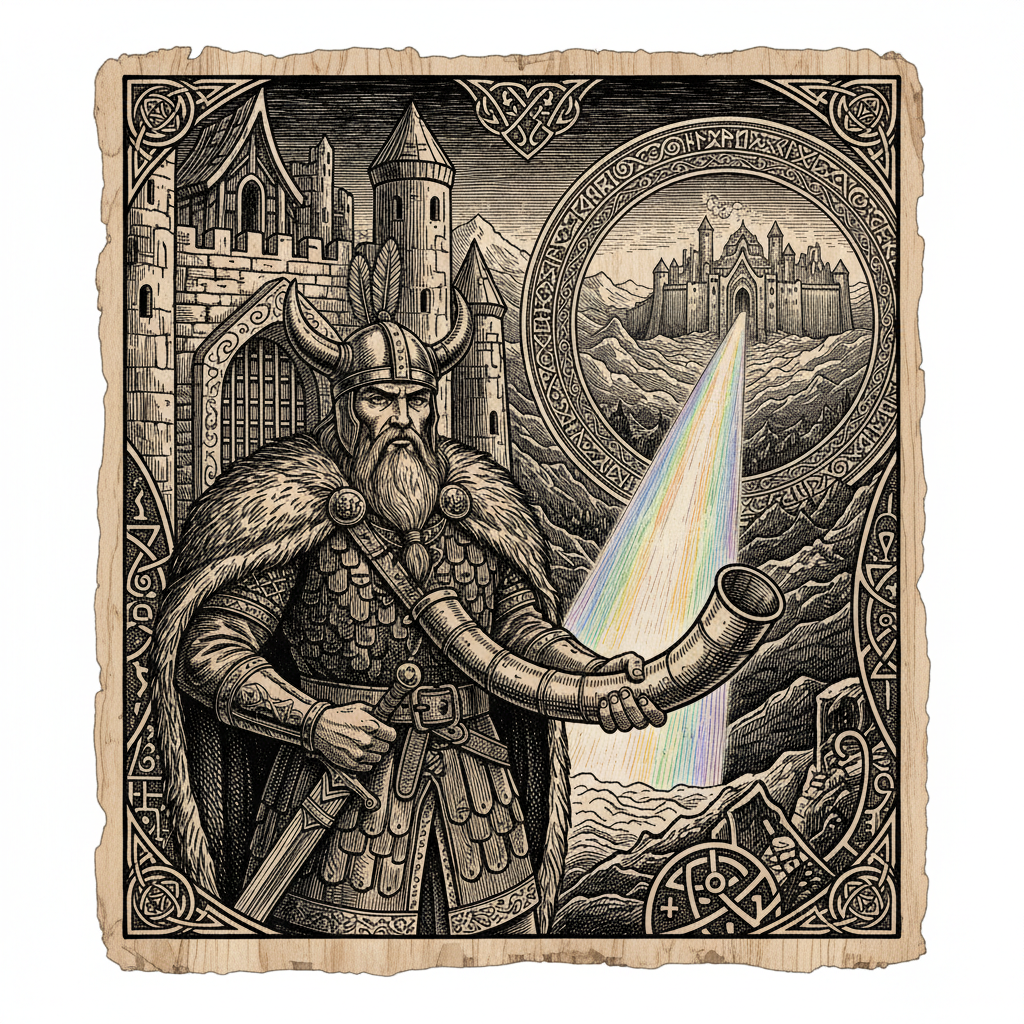
The Three Colours and the Living Fire
Snorri Sturluson, in the Gylfaginning section of the Prose Edda, describes Bifrost as having three colours. The red of the bridge, he says, is burning fire, which is what keeps the frost giants and other enemies from crossing. If the bridge were only painted, even strong men could climb it. But because part of it is living flame, only the gods and a few favoured mortals can walk its length.
This detail matters. Bifrost is not merely a cosmic decoration. It is a defensive structure. The Norse cosmos is at war. The Aesir, the principal Norse gods, are locked in a long and uneasy struggle with the jotnar, the giants who live in lands like Jotunheim and Muspelheim. The bridge that connects the world of the gods to the world of humans must also keep out the world of the giants. The fire is the gate.
The choice of three colours has invited speculation. Some interpreters take them as red, blue, and yellow, the primary colours of subtractive painting traditions. Others propose red, green, and blue, which match the additive colours of light. The physics of an actual rainbow shows seven colours, but three is the number Snorri chose, and the Norse mind seems to have preferred ordered triads to spectra. Whatever the original meaning, the three-coloured bridge is a striking image: not the soft pastel arc of Christian imagery but a fierce, flaming road through the sky.
Heimdall, the Watchman
The bridge is guarded. Where Bifrost meets Asgard stands a fortress called Himinbjorg, “Heaven’s Cliffs”, and the god who lives there is Heimdall, the watchman of the gods. Heimdall has senses no other being can match. He can see for hundreds of miles in every direction. He can hear the grass growing in the fields and the wool growing on the backs of sheep. He needs less sleep than a bird. He is born of nine mothers, said to be the nine waves of the sea.
Heimdall’s role is simple and absolute: watch the bridge. He stands at the gate and waits for the moment when the giants will come. At his side hangs the Gjallarhorn, “the loud-sounding horn”, which he will blow when the end begins. Until then, he watches, and he waits, and he does not sleep.
The relationship between Heimdall and the other Aesir is fascinating in its quietness. He is rarely the protagonist of stories. He is the steady presence on the edge of every other myth. He fights Loki at Ragnarok and dies with him. He fathers the social classes of Norse humanity in the strange poem Rigsthula. Mostly he watches.
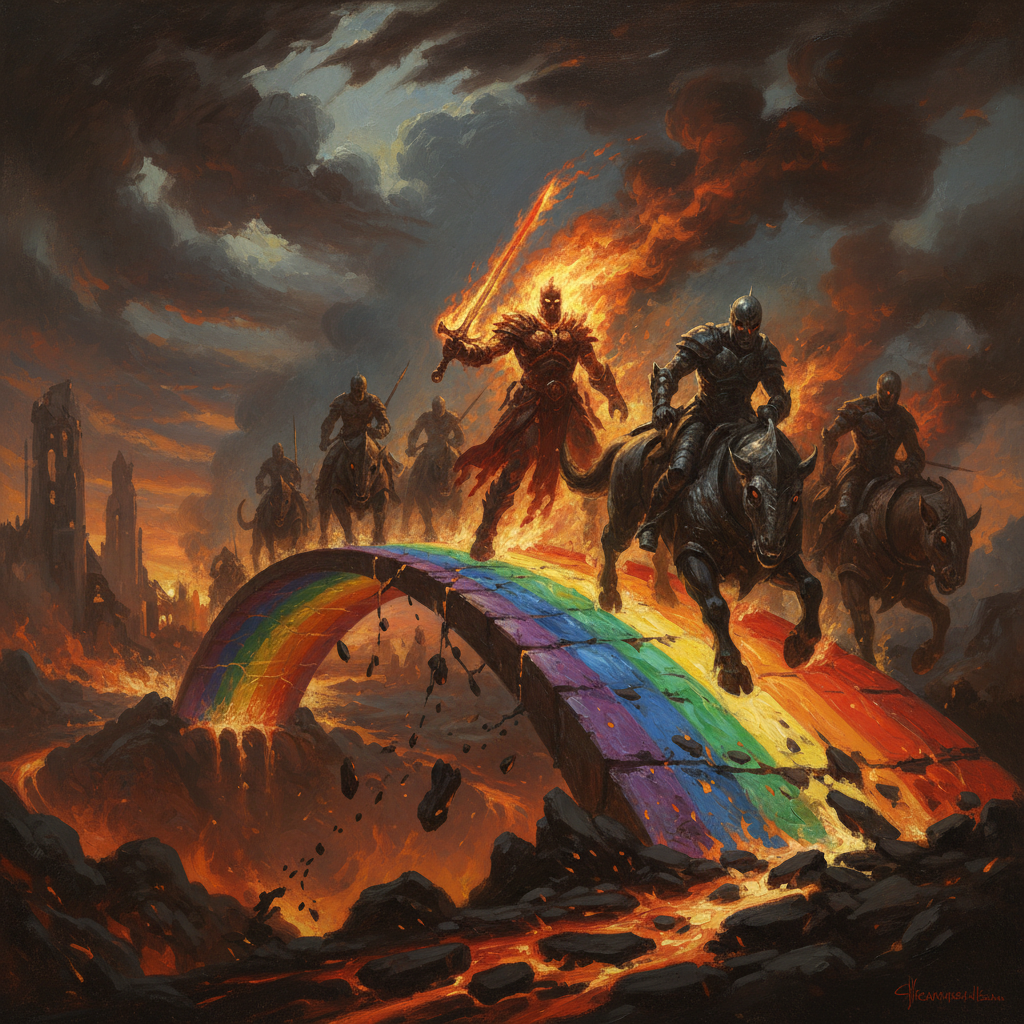
Ragnarok: The Bridge Breaks
Norse mythology is unusual among world traditions in that it foretells, in detail, the end of its own gods. Ragnarok, the doom of the powers, is the final battle in which the gods, the giants, and the cosmic monsters will clash, and most of them will die. Bifrost plays a central role.
When the time comes, the fire giants of Muspelheim will ride out under their leader Surtr, whose flaming sword burns brighter than the sun. They will charge across Bifrost in a great host. The bridge, designed to keep them out, will collapse under the weight of their attack. Heimdall will blow the Gjallarhorn, summoning the gods to battle. Odin will fall to the wolf Fenrir. Thor will kill the Midgard Serpent and die of its venom. Loki and Heimdall will kill each other. The world will burn.
Then, after the fire, a new world will rise. A green earth will emerge from the sea. Two humans will survive the burning, sheltered in a tree, to become the parents of a new humanity. Some of the gods will return, including Baldur, who has been waiting in the underworld. The bridge that broke will not be rebuilt. The new world has no need of it.
Symbolism and Meaning
Bifrost is not just a road. It is a meditation on what connects worlds. The Norse imagination did not place the gods in a separate metaphysical category, hovering apart from the human realm. The gods walked. They needed bridges. They could be reached, and they could reach down. The image of the rainbow as a road carries an enormous amount of theological weight in such a worldview. It says that the line between the divine and the human is not absolute. It says that there is a way across.
The image is also fragile. A road of fire cannot be permanent. A rainbow is, by nature, a fleeting thing. The Norse acknowledged this. The bridge will fall. Even the connection between gods and mortals can be severed. This is the mood of much of Norse mythology: beauty under threat, glory tied to its own ending. Bifrost burns in the sky knowing it will burn out.
Cross-cultural parallels are striking. The Greek rainbow goddess Iris serves as a messenger between the gods and humans, embodying the same idea: the rainbow as a path of communication. Japanese mythology has Ame-no-Ukihashi, the Floating Bridge of Heaven, used by the gods Izanagi and Izanami to descend and create the world. Aboriginal Australian traditions tell of the rainbow serpent who shaped the land and the rivers. Wherever a culture has lived under a sky that produces rainbows, the rainbow has invited stories of crossing.

Legacy and Modern Influence
Bifrost has had a remarkable second life in modern fantasy. The Marvel Cinematic Universe popularised the bridge for a global audience through the Thor films, where Heimdall, played by Idris Elba, opens the rainbow path between Asgard and the rest of the cosmos. Video games like God of War: Ragnarok from Santa Monica Studio render the bridge as a glowing crystalline structure stretching across worlds. Authors from J.R.R. Tolkien to Neil Gaiman have drawn on the image for their own cosmologies.
The figure of Heimdall, too, has become surprisingly visible. The Marvel version draws on the Norse original but emphasises his loneliness, his vigilance, his loyalty. The Norse Heimdall is the steady god, the one who never leaves his post. In a culture that often celebrates the loud and the heroic, Heimdall is a quieter ideal: the watcher who simply does not sleep.
For modern readers, Bifrost is also a reminder that the rainbow has been understood as something more than a meteorological phenomenon throughout most of human history. Long before Newton split white light through a prism in 1666, the rainbow was a road, a serpent, a goddess, a bridge of fire. Modern science has its own beautiful explanation. The mythological one is not in competition. It is the older language for the same wonder.
More From Norse Mythology
Continue exploring the gods, monsters, and worlds of Norse myth. New encyclopedia entries published every week.
Explore MoreFrequently Asked Questions
What is Bifrost in Norse mythology?
Bifrost is the rainbow bridge that connects Asgard, the home of the Norse gods, to Midgard, the world of humans. It is described in the Eddas as having three colours, with the red part being living fire. Heimdall, the watchman god, guards the bridge from his fortress at the Asgard end.
Why is Bifrost a rainbow?
The Norse, like many cultures, saw the rainbow as a path connecting the sky to the earth. The arc seems to rise from one horizon and descend toward another, suggesting a road. Norse poets imagined this road as a bridge of fire and shimmering colour built by the gods.
Who guards Bifrost?
Heimdall, the watchman god, guards Bifrost from his fortress Himinbjorg at the Asgard end. He has senses sharp enough to see across all the worlds and to hear the grass growing. At his side hangs the Gjallarhorn, which he will blow at the start of Ragnarok.
What happens to Bifrost at Ragnarok?
The fire giants of Muspelheim, led by Surtr, ride across Bifrost in a great host at the start of the final battle. The bridge collapses under the weight of their charge. After Ragnarok and the rebirth of the world, Bifrost is not rebuilt.
What does the name Bifrost mean?
The Old Norse name combines elements meaning “shimmering” or “trembling” with “road” or “way”. A common translation is “the shimmering road” or “the trembling way”, capturing the visual quality of a rainbow flickering through the sky.
Are there rainbow bridges in other mythologies?
Yes. The Greek goddess Iris is the personification of the rainbow as a divine messenger. Japanese mythology has Ame-no-Ukihashi, the Floating Bridge of Heaven. Aboriginal Australian traditions feature the Rainbow Serpent. The image of the rainbow as a passage between worlds appears in many cultures.