Quick Summary
- Thor is the Norse god of thunder, lightning, storms, and the protection of mortals, the most beloved of the Aesir among ordinary Norse worshippers.
- His hammer Mjolnir, forged by the dwarven brothers Brokkr and Sindri, returns to his hand when thrown and is the most famous weapon in Norse mythology.
- His enemies are the giants and the Midgard Serpent Jormungandr, whom he kills at Ragnarok at the cost of his own life.
- His name gives English the word Thursday, “Thor’s day”, and his hammer pendants were worn across the Viking world as protective amulets.
- Thor’s modern visibility in the Marvel Cinematic Universe has made him one of the most recognisable mythological figures alive today.
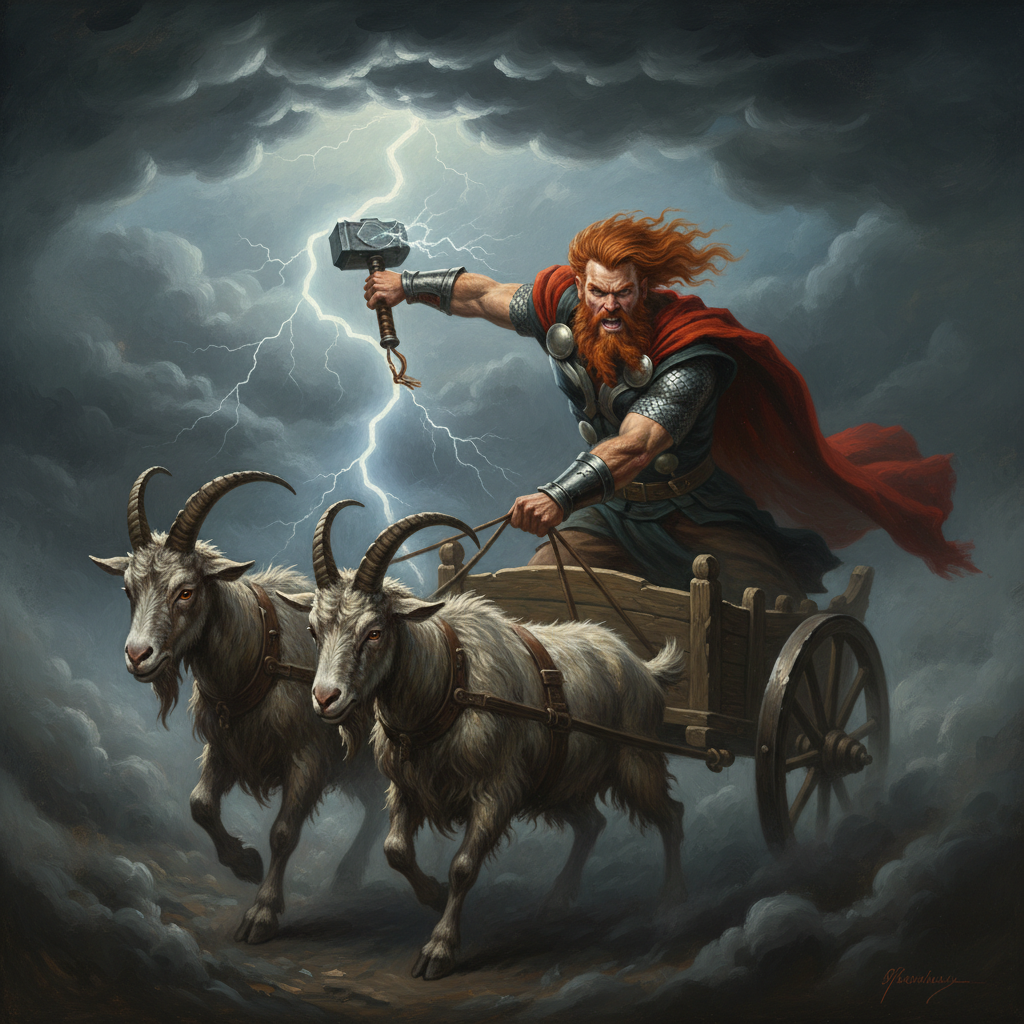
The thunder is not weather. The thunder is a god riding above the clouds in a chariot drawn by two goats, swinging a hammer that strikes lightning at every blow. The Norse looked up at every storm and saw Thor at work. They had no doubt about it. The lightning was his hammer-blow. The thunder was the cracking of his cart-wheels. When a giant fell beneath the storm, Norse listeners would have nodded and said: that is what he is for.
Thor (Old Norse Thorr) is the most beloved of the Norse gods. Odin gets the philosophy and the kingship. Loki gets the literary complexity. Baldur gets the tragedy. Thor gets the people. Where ordinary Norse farmers and fishermen named their sons after a god, they named them after Thor. Where they wore a divine pendant around their neck, they wore Mjolnir, the hammer. He is the working god of Norse religion, and his weapon is the most famous object in Norse myth.
Origins and Cultural Roots
Thor is the son of Odin, ruler of the Aesir, and Jord, a personification of the earth. He is the husband of Sif, the goddess of golden hair, and the father of several gods including Magni and Modi, who will survive Ragnarok. He has red hair, red beard, fierce eyes, and a hunger that takes some of the most amusing turns in the entire Norse corpus.
His name is one of the most widespread Indo-European theonyms. The Old Norse Thorr, the Old English Thunor, the Old High German Donar, and the Latin tonare (to thunder) all share a common Proto-Indo-European root meaning “thunder”. The same root produces the modern English thunder. Thor and his cognates appear across the Germanic world: the same red-bearded god of thunder, with the same hammer or axe, the same connection to oak trees, the same wars on giants.
His chariot is drawn by two goats, Tanngrisnir (Teeth-Barer) and Tanngnjostr (Teeth-Grinder). When Thor needs to eat on a journey, he kills and roasts the goats, eats their flesh, and then resurrects them by laying their bones inside the skins and consecrating them with Mjolnir. The next morning, the goats are alive and ready to pull the chariot again. The image is a perfect summary of Thor’s character: enormous appetite, raw resurrection power, and a hammer that does both.

The Forging of Mjolnir
The hammer Mjolnir was forged by two dwarven brothers, Brokkr and Sindri (sometimes called Eitri), in a famous contest engineered by Loki. Loki had wagered his head against the dwarves’ ability to make three magical objects to surpass three others. The dwarves laboured at the forge while Loki, in the form of a fly, tried to sabotage them. He bit Brokkr on the eye while he worked the bellows. The bellowman flinched. The handle of the hammer came out shorter than intended. But the hammer was still the most magnificent object in the universe.
Mjolnir’s powers, as described in the Prose Edda of Snorri Sturluson, are extraordinary. It can strike with such force that mountains shatter. It returns to Thor’s hand when thrown. It can be made small enough to carry inside a tunic. With it, Thor blesses, hallows, marriages, oaths, and births. The hammer is not only a weapon. It is a sacred instrument.
The short handle, Loki’s small sabotage, becomes part of Thor’s iconography. He needs iron gauntlets to wield the hammer properly because the handle is too short for his enormous hands. The detail is preserved in countless Viking-age depictions, where the hammer’s head is large but the handle is stubby.
Thor and the Giants
Thor’s principal occupation in Norse myth is killing giants. He travels east to Jotunheim, the land of the giants, with extraordinary regularity. He fights Hrungnir, the giant of stone. He drinks an ocean’s worth of mead in a horn that turns out to contain the sea itself, leaving the world’s tides as a permanent souvenir of the contest. He wrestles a cat that turns out to be the Midgard Serpent in disguise. He attempts to lift an old crone who turns out to be Old Age herself.
One of his most famous stories, preserved in the Thrymskvitha of the Poetic Edda, has the giant Thrym steal Mjolnir and demand the goddess Freyja in marriage as ransom. Thor must dress in Freyja’s wedding clothes and pose as the bride to retrieve the hammer. The story is a comedy and a moment of acute embarrassment for the thunder god, who eats so much at the wedding feast that Thrym grows suspicious. Loki, accompanying Thor as the bridesmaid, talks his way out. When the hammer is finally brought into the hall to consecrate the marriage, Thor seizes it and slaughters every giant in sight.
The story matters because it shows Thor at his most human. He is not too proud to wear the dress. He is willing to look ridiculous to recover his hammer and protect Asgard. Beneath the bluster is a dutiful, stubborn, and genuinely heroic figure.

The Midgard Serpent and Ragnarok
Thor’s greatest enemy is Jormungandr, the Midgard Serpent, the great snake who coils around the world. He is one of Loki’s monstrous children, cast into the sea by the gods, where he grew so large he could grasp his own tail. Thor and the Midgard Serpent meet several times in Norse myth. In one famous story, Thor goes fishing with the giant Hymir and hooks the serpent. He hauls the great snake up to the boat. Hymir, terrified, cuts the line before Thor can strike, and Jormungandr sinks back into the deep.
At Ragnarok, the final battle, the two meet again. The serpent rises from the sea, poisoning the air with its venom. Thor and Jormungandr fight. Thor strikes the killing blow with Mjolnir. The serpent dies. Thor takes nine paces and falls dead, the venom too strong for him to survive. The thunder god, the protector of Midgard, dies fighting the world serpent. His sons Magni and Modi inherit the hammer and walk into the new world that rises after the burning.
Symbolism and Meaning
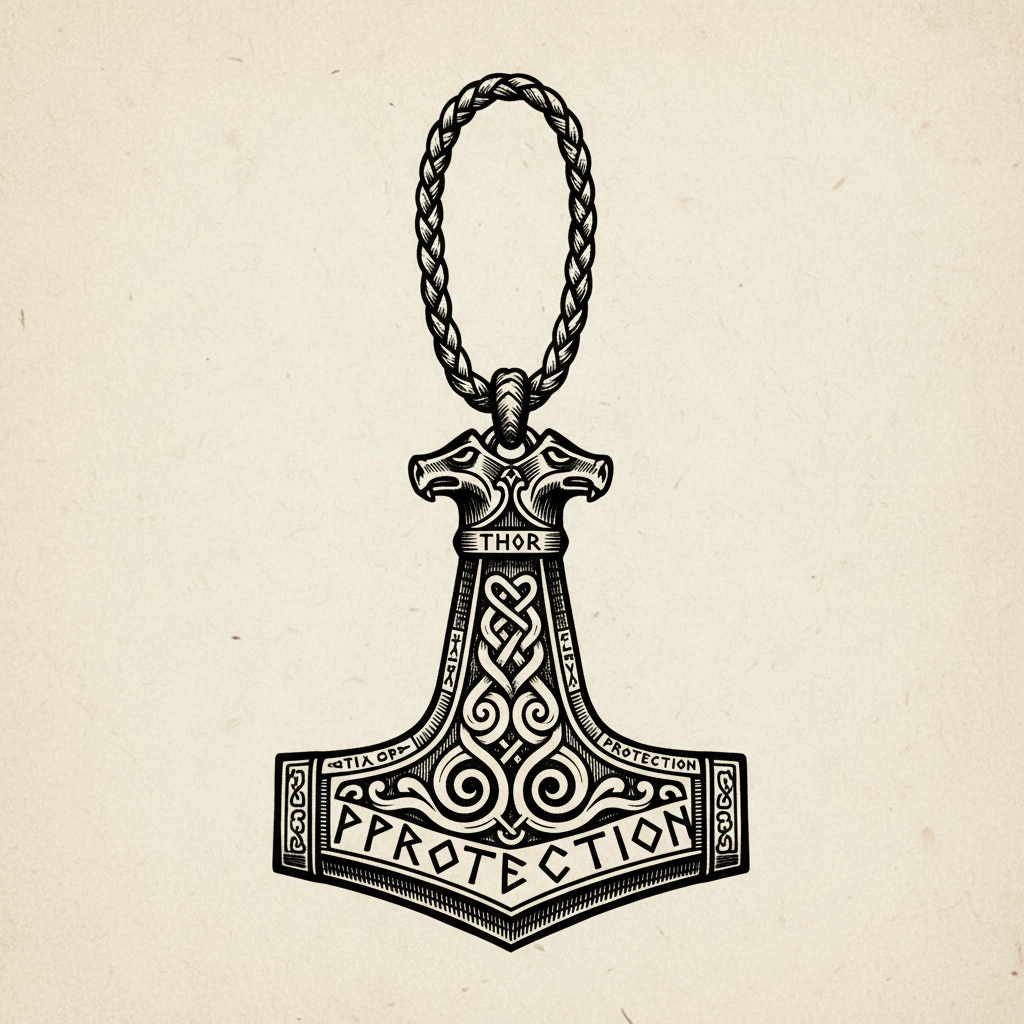
Thor is the people’s god of the Aesir. Where Odin presides over kings and skalds, Thor presides over farmers, sailors, smiths, and every ordinary Viking who needed a god capable of fighting back. His hammer is the protective symbol that Norse mothers hung over cradles, that Viking warriors wore around their necks, that priests carried to consecrate marriages and graves. When Christianity arrived in Scandinavia, the cross was deliberately mistaken for the hammer in some early Christian conversions, and Mjolnir pendants from the late pagan period sometimes incorporate cross-like designs as the religions blurred.
His role as a thunder god places him in the great cross-cultural family of storm deities. The Japanese Raijin beats his ring of drums. The Greek Zeus throws thunderbolts. The Hindu Indra wields the vajra. The Slavic Perun fights serpents with his thunder axe. Every Indo-European pantheon has a god who throws thunder at his enemies. Thor is the Norse member of that family, and his hammer is the Norse version of the divine thunderbolt.
What sets Thor apart is his accessibility. He is enormous, hungry, sometimes foolish, often lonely. He is not above wrestling old women. He is not above wearing a wedding dress. He is the god of those who have to work for what they keep, and of those who must fight to protect it. The Norse loved him for it.
Legacy and Modern Influence
Thor’s modern visibility owes a great deal to the Marvel Cinematic Universe, where his films and the broader Avengers franchise have made him one of the most recognisable mythological figures in the world today. The Marvel Thor takes considerable liberties with the original, but the core elements of red-haired thunder god, hammer, conflict with Loki, and lineage from Odin remain. The films have prompted millions of people to read about the Norse Thor for the first time.
Beyond Marvel, Thor remains active in modern Heathenry, in fantasy literature from Tolkien to Neil Gaiman, in heavy metal music (Bathory, Amon Amarth, and dozens of others), and in the names of warships, weather satellites, mountains, and racehorses. Mjolnir pendants are worn today by Heathens and by those who simply admire the symbol. Norway has at least two warships named after him.
Every Thursday, English speakers say his name. The day is Thor’s Day, and the connection survives in many Germanic languages: German Donnerstag, Dutch donderdag. Thor has been with us for two thousand years, and the thunder still cracks. His hammer still returns to his hand. The working god of the Norse pantheon turned out to be the one who lasted longest in the popular imagination.
More From Norse Mythology
Continue exploring the gods, monsters, and worlds of Norse myth. New encyclopedia entries published every week.
Explore MoreFrequently Asked Questions
Who is Thor in Norse mythology?
Thor is the Norse god of thunder, lightning, storms, and the protection of mortals. He is the son of Odin and Jord, husband of Sif, and the most beloved of the Aesir among ordinary Norse worshippers. His hammer Mjolnir is the most famous weapon in Norse mythology.
What is Mjolnir?
Mjolnir is the magical hammer of Thor, forged by the dwarven brothers Brokkr and Sindri. It returns to Thor’s hand when thrown, can be made small enough to hide in his tunic, and is used to bless marriages, oaths, and births as well as to slay giants. Mjolnir pendants were worn across the Viking world as protective amulets.
Why is Mjolnir’s handle short?
When the dwarves Brokkr and Sindri were forging the hammer, Loki transformed into a fly and bit Brokkr on the eye while he worked the bellows. Brokkr flinched, and the hammer’s handle came out shorter than intended. Thor must wear iron gauntlets to wield it because the handle is too short for his hands.
Who does Thor fight?
Thor’s principal enemies are the giants and the Midgard Serpent Jormungandr. He travels regularly to Jotunheim to slay giants, and he meets the serpent in several stories, including a famous fishing trip where he hooks the snake. At Ragnarok, Thor kills Jormungandr but dies of the serpent’s venom.
How does Thor die?
At Ragnarok, the final battle, Thor fights the Midgard Serpent Jormungandr. He strikes the killing blow with Mjolnir, but the serpent’s venom is too strong. Thor takes nine paces from the body before falling dead. His sons Magni and Modi inherit the hammer and survive into the new world.
Why is Thursday named after Thor?
The English Thursday comes from Old English Thunresdaeg, “Thunor’s day”, Thunor being the Old English name for Thor. The same naming pattern appears in German (Donnerstag) and Dutch (donderdag). The Germanic days of the week were named after gods including Tiw (Tuesday), Woden (Wednesday), Thor (Thursday), and Frige (Friday).