Quick Summary
- Skadi is the Norse jotun (giantess) of winter, mountains, skiing, hunting, and bowmanship, daughter of the slain giant Thjazi.
- She is briefly married to the sea god Njord but the marriage fails because they cannot live in each other’s homes: she hates the sound of seabirds, he hates the howling of wolves.
- She is one of the few jotnar to be accepted among the Aesir, taking part in their councils and adopting some of their concerns.
- Her name may be the source of the modern name Scandinavia, though the etymology is debated.
- She represents the Norse imagination of the high cold mountains as a divine domain, parallel to other winter goddesses across European traditions.
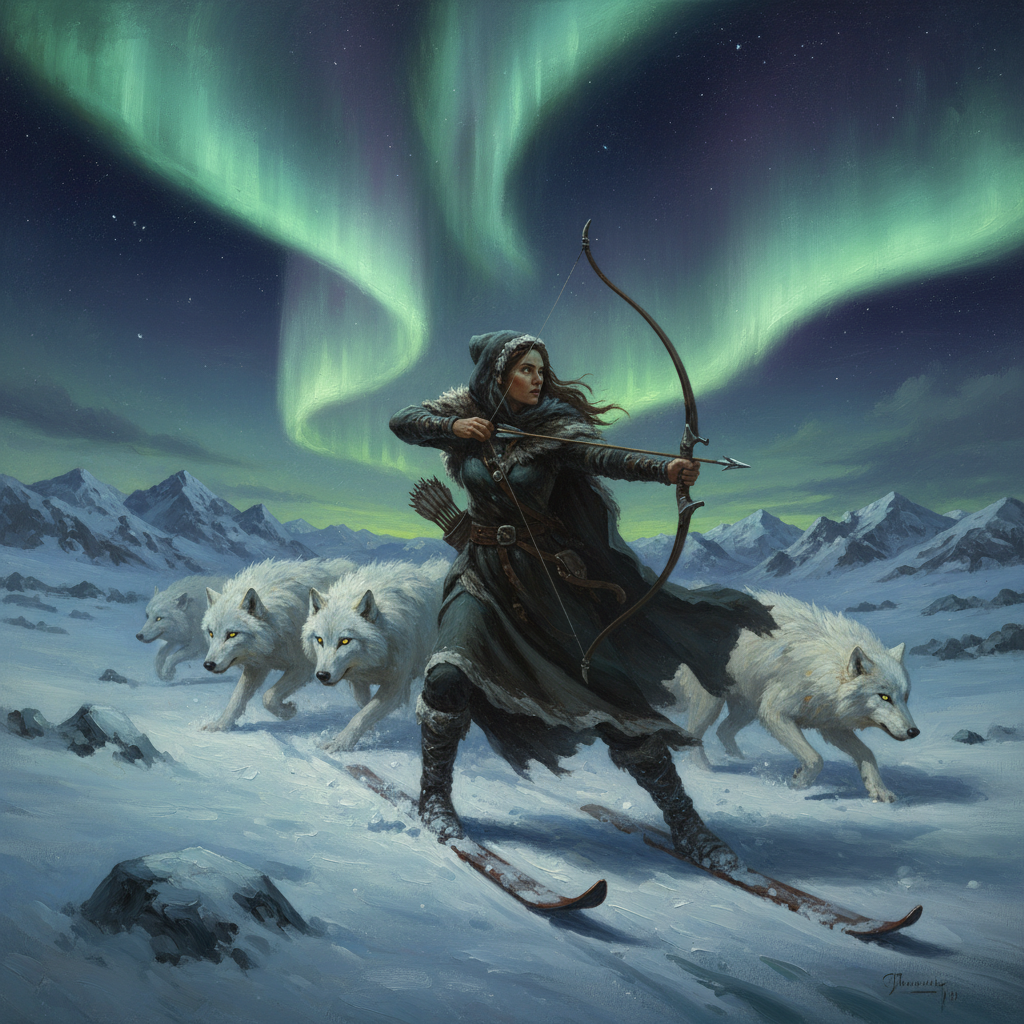
A woman in furs steps off a high cliff onto a wooden ski. The snow is unbroken in front of her. She lifts a great bow, lays an arrow against the string, and looks down at the white valleys far below. She lives here because no other god can. The sound of waves makes her ill. The clamour of mead halls bores her. The cold mountain peaks of the north are hers, and only hers, and she is happy.
This is Skadi, one of the most distinctive figures in Norse mythology. She is a giantess who became a goddess. She is a hunter who married a sailor and chose loneliness over compromise. She walks the high places where almost no one else of the Norse pantheon is comfortable. She is winter given a body and a bow.

Origins and Cultural Roots
Skadi (Old Norse Skaði) is described in the medieval Icelandic sources as a jotun, one of the giants who are the chief enemies and occasional allies of the Aesir. She is the daughter of Thjazi, a powerful giant who was killed by the Aesir after he kidnapped the goddess Idunn. Her story begins with her father’s death and her demand for compensation.
The principal sources for Skadi are the Gylfaginning and Skaldskaparmal sections of Snorri Sturluson’s Prose Edda, written around 1220, and several poems of the Poetic Edda. Her name has produced significant scholarly speculation. Some derive it from a Proto-Germanic root meaning “shadow” or “harm”. Others connect it to the Old Norse word for ski (skíð), making her literally “the one on skis”. The connection between her name and the modern Scandinavia is suggestive but not certain.

The Failed Marriage with Njord
After her father’s death, Skadi marches in full armour to Asgard to demand compensation. The Aesir offer terms. She may choose a husband from among them, but only by looking at their feet, not their faces. She hopes to choose Baldur, the most beautiful of the gods. She picks the cleanest and most beautiful pair of feet, expecting them to belong to Baldur. They turn out to belong to Njord, the sea god.
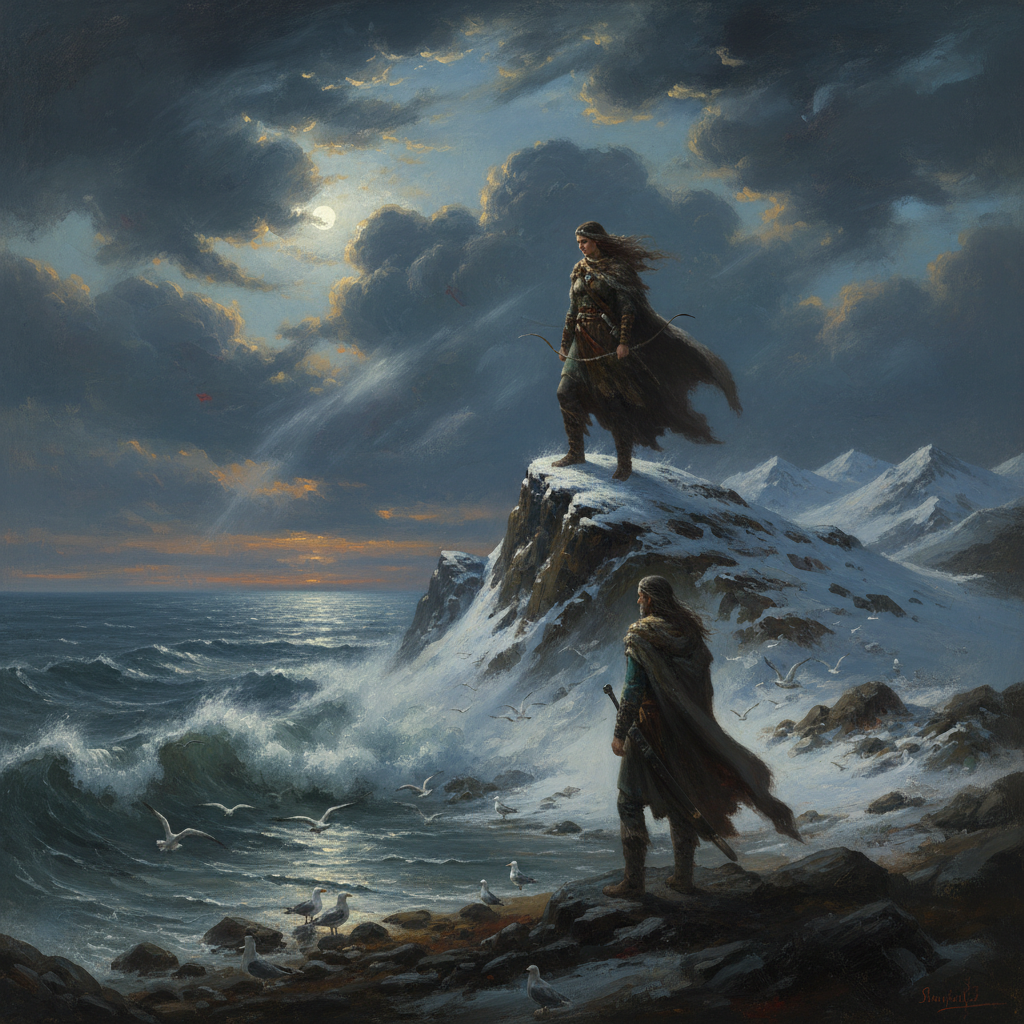
The marriage is a famous failure. Njord lives at Noatun, his home by the sea. Skadi lives at Thrymheim, her father’s mountain hall in the cold north. They try to compromise. They spend nine nights at Thrymheim and nine nights at Noatun. Each cannot stand the other’s home. Skadi hates the cries of the gulls and the noise of the surf. Njord hates the howling of the wolves and the deep cold. They part by mutual agreement.
The story is one of the most quietly poignant in Norse myth. There is no villain. There is no betrayal. Two beings simply cannot live in each other’s worlds. Skadi returns to her mountains. Njord remains by his sea. The Norse imagination accepts that not every marriage can survive geography.
The Binding of Loki
Skadi appears at one of the most consequential moments in Norse myth: the binding of Loki after the killing of Baldur. When the Aesir capture Loki and bind him beneath a venomous serpent, Skadi is the one who places the serpent above his face. The act is sometimes interpreted as personal revenge: Loki had mocked Skadi at Aegir’s feast, and she now repays the insult. It is also part of the broader judicial role she takes on after joining the Aesir.
Her presence at the binding is a sign of how fully she has been accepted into the divine order. She is not a friend of Loki. She is not a friend of his children. She is, by this point, one of the powers of Asgard, taking part in the great judgments and the great burdens.
Symbolism and Meaning
Skadi embodies the Norse imagination of the high cold north. Where most of the Aesir live in fields and halls, Skadi belongs to the alpine peaks. Her tools are the ski and the bow. Her companions are wolves. Her diet is the meat of cold-country game. She is the mountain side of Norse religion, an aspect that the more domestic Aesir do not fully cover.
Her status as a giantess accepted among the gods is also significant. The Norse cosmos is not a simple binary of gods versus giants. The two groups are entangled. Loki is half-giant. Odin’s mother was a giantess. Several Aesir gods married jotnar. Skadi’s incorporation into Asgard is one of the clearest examples of the porousness of the boundary between divine and giant in Norse thought.
Cross-culturally, Skadi belongs to the family of winter and mountain goddesses. The Slavic Marzanna personifies the cold months in a different mode. The Greek Chione, daughter of the north wind, is a snow nymph. The Inuit Sedna, the Sami winter spirits, the Germanic Holda all overlap with parts of Skadi’s domain. What sets Skadi apart is her active personality. She does not just preside over the cold. She skis through it, hunts in it, and chooses to live nowhere else.
Legacy and Modern Influence
Skadi has had a particularly visible modern afterlife. The 2018 video game God of War from Santa Monica Studio includes her among its Norse characters. She appears in the Marvel Comics universe. She is featured prominently in Neil Gaiman’s Norse Mythology. The name has been popular for ships, mountain huts, and outdoor brands across Scandinavia and beyond.
The connection to the name Scandinavia, whether or not it is etymologically secure, has given her a place in regional identity. The figure of the woman on skis with a bow, hunting in the deep snow, is part of how Scandinavia imagines itself, and Skadi is the mythological underpinning of that image. Modern Heathen practice in Scandinavia and elsewhere honours her as one of the principal goddesses of the winter half of the year.
For modern readers, Skadi offers a model of integrity. She left a marriage rather than abandon her mountains. She joined a pantheon without losing her giant nature. She made the cosmos accommodate her rather than shrinking herself to fit it. The Norse let her have all of that. They put her among the gods. They gave her the bow. They never tried to bring her down to the warmer lands.
More From Norse Mythology
Continue exploring the gods, monsters, and worlds of Norse myth. New encyclopedia entries published every week.
Explore MoreFrequently Asked Questions
Who is Skadi in Norse mythology?
Skadi is the Norse jotun (giantess) of winter, mountains, skiing, and hunting. She is the daughter of the slain giant Thjazi, the briefly-wed wife of the sea god Njord, and one of the few jotnar to be accepted among the Aesir gods of Asgard.
How did Skadi end up with Njord?
After the Aesir killed her father Thjazi, Skadi demanded compensation. As part of the settlement, she was allowed to choose a husband from among the gods, but only by looking at their feet. She picked the cleanest pair, expecting Baldur, but the feet belonged to Njord, the sea god.
Why did the marriage fail?
Skadi’s home was Thrymheim, a cold mountain hall, and Njord’s home was Noatun, by the sea. They tried alternating nine nights in each. Skadi hated the cries of the gulls and the noise of the surf. Njord hated the howling of the wolves and the deep cold. They parted by mutual agreement.
Is Scandinavia named after Skadi?
The connection is suggestive but not certain. Some scholars derive Scandinavia from a name related to Skadi, but the etymology is debated. Other proposed roots also exist. The name has nevertheless made Skadi feel like a regional patron of the cold north.
What role does Skadi play in the binding of Loki?
After the gods bound Loki for engineering Baldur’s death, Skadi placed the venomous serpent above Loki’s face. The act is sometimes interpreted as personal revenge for Loki’s mockery of her at Aegir’s feast, but it also reflects her role as a member of the Aesir judicial order.
How is Skadi connected to other winter goddesses?
She belongs to the wider European family of winter and mountain deities, alongside the Slavic Marzanna, the Greek Chione, the Germanic Holda, and the Inuit Sedna. What sets Skadi apart is her active personality, the woman on skis with a bow rather than a passive personification of cold.