Quick Summary
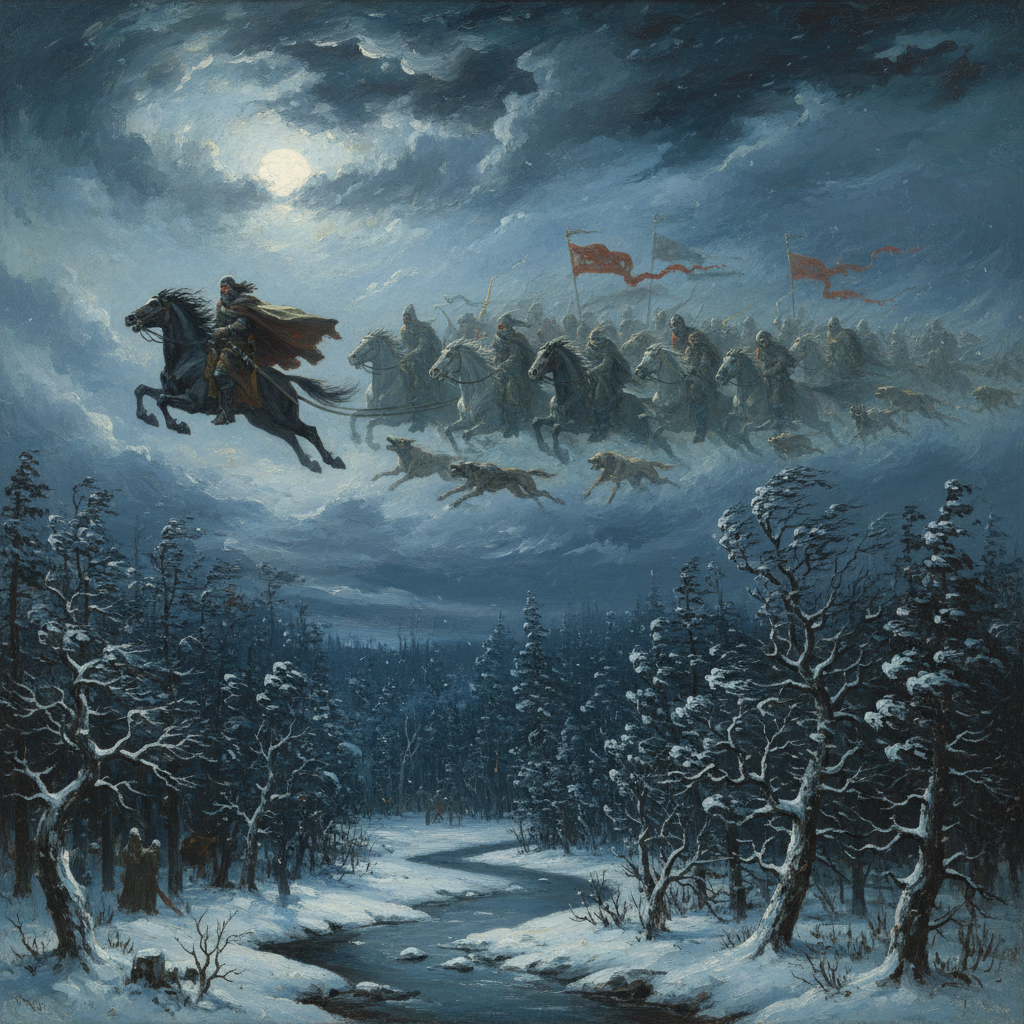
- The Wild Hunt is a folkloric procession of ghostly riders, hounds, and supernatural beings that sweeps through the winter sky in northern European tradition.
- In Germanic and Norse traditions, the Hunt is most often led by Odin, riding his eight-legged horse Sleipnir at the head of the dead.
- Other regional traditions name different leaders, including Wodan, King Arthur, Herne the Hunter, the Celtic deity Gwyn ap Nudd, and the Slavic Diaboli.
- Witnesses of the Hunt were said to be carried away with it, struck by ill fortune, or to receive prophecies of death and disaster.
- The Hunt remains one of the most evocative folk traditions of northern Europe and lives on in modern fantasy, from Tolkien to The Witcher.
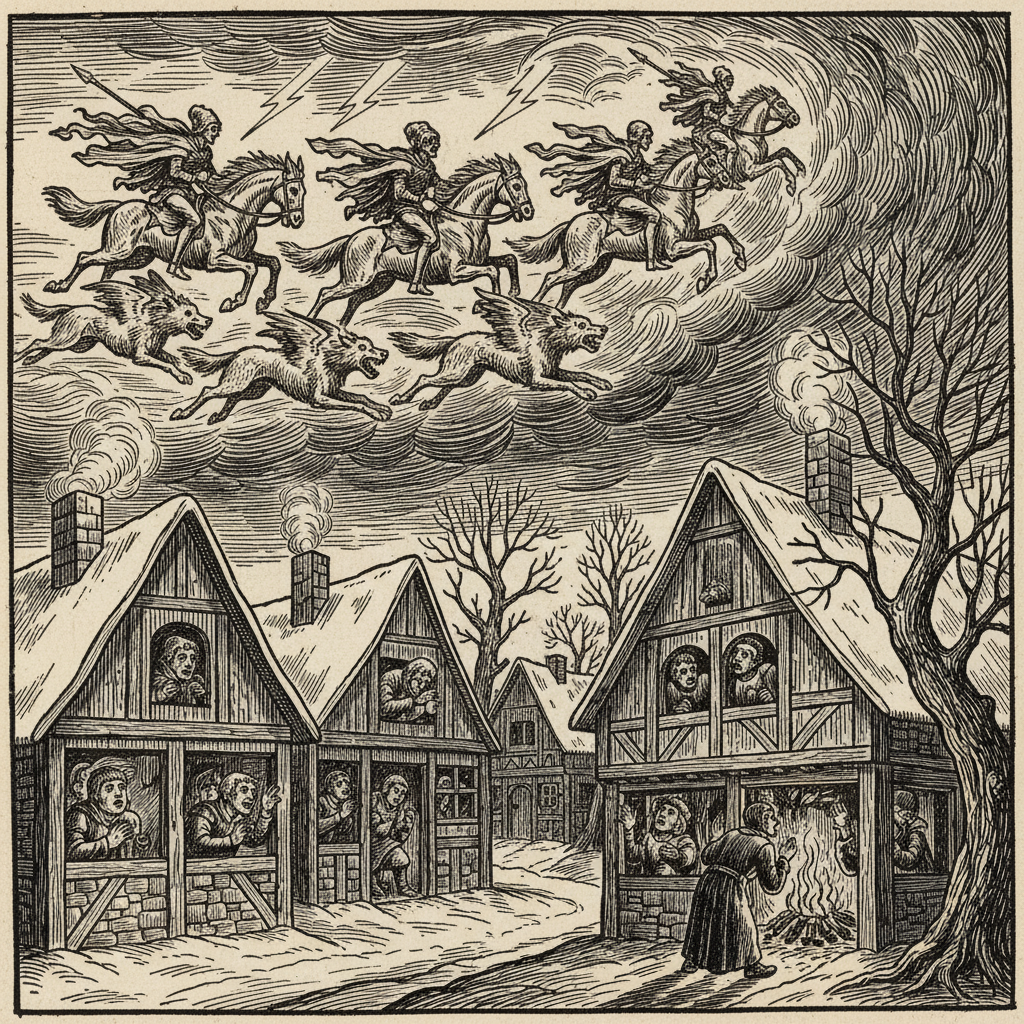
A storm rolls in over the dark fields of December. The wind rises. From inside their houses, the people hear something more than wind: hoofbeats, the baying of hounds, the cry of a hunting horn far off. They cross themselves. They move closer to the fire. They do not look out the window. The Wild Hunt is passing, and to be seen by it is dangerous.
The Wild Hunt is one of the great folk traditions of northern Europe. It crosses regional lines and survives religious change. The hunters are usually the dead, often the unbaptised, sometimes the gods. Their leader changes by region but everywhere is a figure of awe and fear. In Germanic and Norse tradition, the leader is most often Odin, the one-eyed wanderer god who rules the slain.
Origins and Cultural Roots
The Wild Hunt (Old High German wuotanes her, “Wodan’s host”; Old English Herla cynning; German Wilde Jagd) is attested in folk tradition across the Germanic and Celtic-speaking world from medieval times to the present. The name varies. The figure of the leader varies. The basic image, a procession of riders sweeping across the winter sky, is remarkably consistent.
In the Norse and Germanic strand, the leader is Odin, also called Wodan, Wotan, or Woden. He rides his eight-legged horse Sleipnir, swept along by the wind, with his ravens Huginn and Muninn flying beside him and his wolves Geri and Freki running ahead. The Wild Hunt represents one face of Odin in his more shadowy aspect, the god of the dead, the lord of the warriors who fall in battle and join him in Valhalla.
Folklorists have long noted that the Wild Hunt motif crosses cultures with remarkable consistency. It appears in French traditions of King Herla and the chasse-galerie. In England, the leader is sometimes King Arthur, sometimes Herne the Hunter (a spectral huntsman from Windsor Forest immortalised by Shakespeare), sometimes the Devil. In Welsh tradition, Gwyn ap Nudd leads the Hunt with his white hounds with red ears. In Slavic tradition, similar processions are led by the Slavic Diaboli or by the spirits of the unbaptised dead.
Odin as Leader of the Hunt
Odin’s role as leader of the Wild Hunt makes sense within the broader Norse picture of him. He is the god of the slain. He gathers warriors who die in battle to Valhalla, where they will fight beside him at Ragnarok. He travels in disguise, often as an old man in a hooded cloak, accompanied by his ravens and his wolves. He gives knowledge to the worthy and madness to the unwary. The image of Odin riding through the winter sky at the head of the dead is consistent with his lifelong role as the wanderer between worlds.
The Hunt is most often associated with the twelve nights of Yule, the midwinter festival from which Christmas inherits many customs. In some regional traditions, the Hunt is more dangerous on certain nights of Yule than on others. To leave food out for the Hunt, to keep windows closed and fires lit, to avoid travelling at night during the Yule period: these were practical precautions in many German, Scandinavian, and Anglo-Saxon communities.
The Hunt was sometimes seen as a portent of war, of plague, or of the death of a king. Certain witnesses, gifted with second sight, were said to recognise individuals among the riders, finding the faces of the recently dead among them. Such recognitions were treated as confirmations that the Hunt was a literal procession of the dead.
Encounters with the Hunt
Folk tradition is full of stories of mortals who encountered the Wild Hunt. Some were unlucky and were carried off, never to be seen again. Some recognised the leader and were granted boons. Some, like the protagonist of an old German tale, refused to give the Hunt their name when challenged and were left untouched, knowing that to give one’s name to the Hunt was to be claimed by it.
One particularly common motif involves a mortal joining the Hunt for a single ride, only to discover, on returning to their village, that decades have passed. The motif of supernatural time dilation in such encounters is a near-universal feature of folk traditions involving the otherworld. The Hunt is not just dangerous in the moment. It is dangerous in the way it warps time around it.

Symbolism and Meaning
The Wild Hunt embodies the relationship between winter, death, and the supernatural in northern European folk thought. The cold months are the months of bare trees and short days, when the boundary between the world of the living and the world of the dead grows thin. The Hunt is the procession that crosses that boundary, sweeping through the air, briefly visible to those who happen to be outside.
Odin’s leadership in the Norse and Germanic strand connects the Hunt to the broader theology of death in the Norse world. To die well in battle is to join the Einherjar in Valhalla, who feast each night and fight each day. To die otherwise is to descend to Hel, the cold realm of those who die in their beds. The Wild Hunt may be one expression of the Einherjar travelling, or one expression of those who have not been claimed by either Valhalla or Hel and are now bound to the wind.
The cross-cultural reach of the motif is also striking. From the Hindu tradition of the marudgana, the troops of storm gods, to the Polynesian sky processions, traditions of supernatural cavalcades crossing the night sky exist in many parts of the world. The Wild Hunt is the northern European member of that family, distinct in its details but recognisable in its broad form.

Legacy and Modern Influence
The Wild Hunt has had a remarkable second life in modern fantasy. Tolkien drew on it for the appearance of the Black Riders of Mordor. Susanna Clarke’s Jonathan Strange and Mr Norrell features a memorable Wild Hunt sequence. The Witcher series of novels and video games by Andrzej Sapkowski makes the Wild Hunt central to its plot, with the spectral riders led by an immortal king. Neil Gaiman’s American Gods includes a version. Diana Wynne Jones’s Dogsbody uses it as a major plot element.
Beyond fiction, the Wild Hunt continues to be observed in some folk traditions across northern Europe. Krampus parades, sometimes referred to as a folk descendant of the Hunt, still take place in Alpine regions during Advent. Certain Scandinavian winter traditions, including the Swedish Lussinatten on the night of 13 December, preserve elements of belief in supernatural night-riders.
For modern readers, the Wild Hunt offers something the formalised mythologies of Greece and Rome rarely provide: a folk tradition that is at once ancient, regionally varied, and still alive in the imagination. Every windy December night somewhere in northern Europe, somebody hears something that sounds like hounds, and an old idea stirs: the Hunt is passing, and we are inside while it goes by.
More From Norse Mythology
Continue exploring the gods, monsters, and worlds of Norse myth. New encyclopedia entries published every week.
Explore MoreFrequently Asked Questions
What is the Wild Hunt?
The Wild Hunt is a folkloric procession of ghostly riders, hounds, and supernatural beings that sweeps through the winter sky in northern European traditions. In the Norse and Germanic strand, it is led by Odin riding his eight-legged horse Sleipnir at the head of the dead.
Who leads the Wild Hunt?
The leader varies by region. Odin (Wotan, Woden) leads in Germanic and Norse traditions. Herne the Hunter, King Arthur, or even the Devil leads in some English traditions. Gwyn ap Nudd leads in Welsh tradition. Slavic traditions name different figures depending on the region.
When does the Wild Hunt ride?
The Hunt is most often associated with the twelve nights of Yule, the midwinter period from late December into early January. Some traditions place it on specific nights, such as Lussinatten in Sweden on 13 December, or All Hallows’ Eve. The common factor is the depth of winter, when the boundary between worlds was thought to be thin.
What happens if you encounter the Wild Hunt?
Folk tradition warns of several outcomes. The unlucky may be carried off, never to be seen again. The clever may slip past unrecognised. The gifted may receive boons or prophecies. The most dangerous response is to give one’s name to the Hunt, which is treated as accepting the claim of the dead.
Why does Odin lead the Hunt?
Odin is the Norse god of the slain, the wanderer between worlds, the lord of warriors who die in battle. The image of him riding through the winter sky at the head of the dead is consistent with his role as god of death and the otherworld. He travels with his ravens Huginn and Muninn and his wolves Geri and Freki.
Is the Wild Hunt still believed in?
Active belief has faded with secularisation, but folk customs descended from the Hunt persist. Krampus parades in Alpine regions, certain Scandinavian winter traditions, and modern Heathen practice all preserve elements. The Hunt also has a robust afterlife in modern fantasy, from Tolkien to The Witcher.