Quick Summary
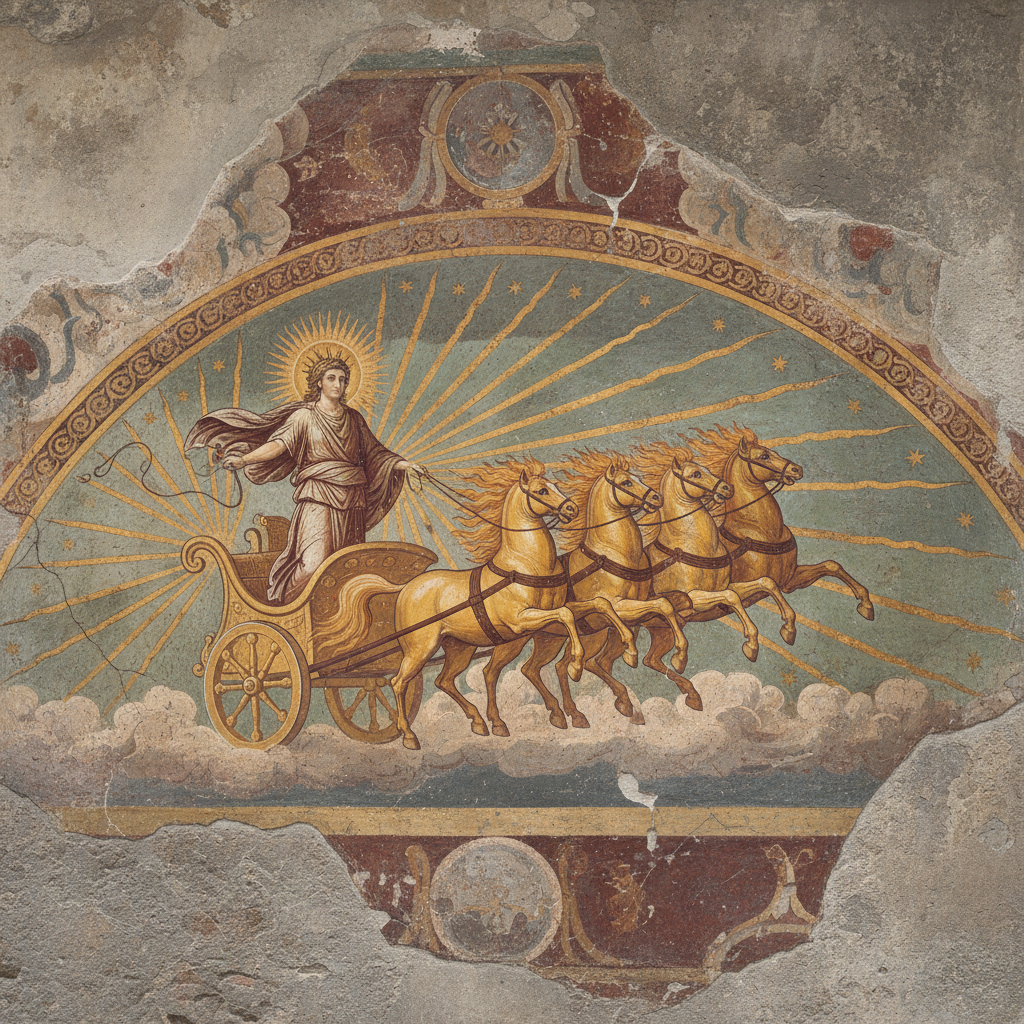
- Helios is the Greek personification of the sun, who drives a fiery chariot across the sky each day from east to west.
- His son Phaethon begged to drive the chariot for one day, lost control of the immortal horses, and was struck down by a thunderbolt of Zeus to save the world from burning.
- The Phaethon myth is preserved most famously in Ovid’s Metamorphoses, in Euripides’ lost play Phaethon, and in earlier Greek lyric poetry.
- Helios was eventually conflated with Apollo in Greek religious thought, but he retains his own distinct character as the daily sun.
- The story of Phaethon is one of mythology’s great parables of pride, inheritance, and the dangers of taking on what only the gods can hold.
A boy stands at the gate of a palace built of gold. His mother has told him his father is a god. He has come to ask the god to prove it. Helios, who has never refused his son anything, swears by the river Styx that he will grant whatever the boy asks. The boy asks for one day at the reins of the sun chariot. Helios begs him to ask for anything else. The boy will not be moved. By dawn, he is dead, the world is burning, and the rivers of the sky are running red.
The story of Phaethon is one of the oldest cautionary tales in Greek mythology. It is also a love story between a father and son, an account of the cost of pride, and a cosmological myth about the time the sun went wrong. To understand it you must first meet Helios, the great sun god of the Greeks, who rides his chariot across the sky every day from the moment of dawn to the moment of dusk.
Origins and Cultural Roots
Helios (Ἥλιος) is the personification of the sun in Greek myth, distinct in early tradition from Apollo, with whom he was later conflated. He is the son of the Titans Hyperion and Theia, and the brother of Selene, goddess of the moon, and Eos, goddess of the dawn. Together the three siblings represent the sun, the moon, and the rosy moment between night and day. Their parentage places Helios firmly among the older generation of Greek gods, the Titans who preceded the Olympian order.
Each morning, according to the standard Greek tradition, Helios rises from the eastern ocean Okeanos. He drives a four-horse chariot of gold across the dome of the sky. The horses are immortal and breathe fire from their nostrils. Their names, given variously in Greek and Roman sources, include Pyrois (Fiery), Eous (Eastern), Aethon (Blazing), and Phlegon (Burning). At the end of the day Helios descends into the western ocean and, according to one tradition, is carried back to the east by night in a great golden cup.
Helios sees everything that happens on earth. In Homer’s Odyssey, when Odysseus’s crew kills the cattle of Helios on the island of Thrinacia, the sun god demands that Zeus punish them. Zeus complies, and the men are drowned at sea. The detail matters: Helios is not just a sphere of light. He is a witness, a watcher, a god who notices what mortals do.
The Cult of Helios
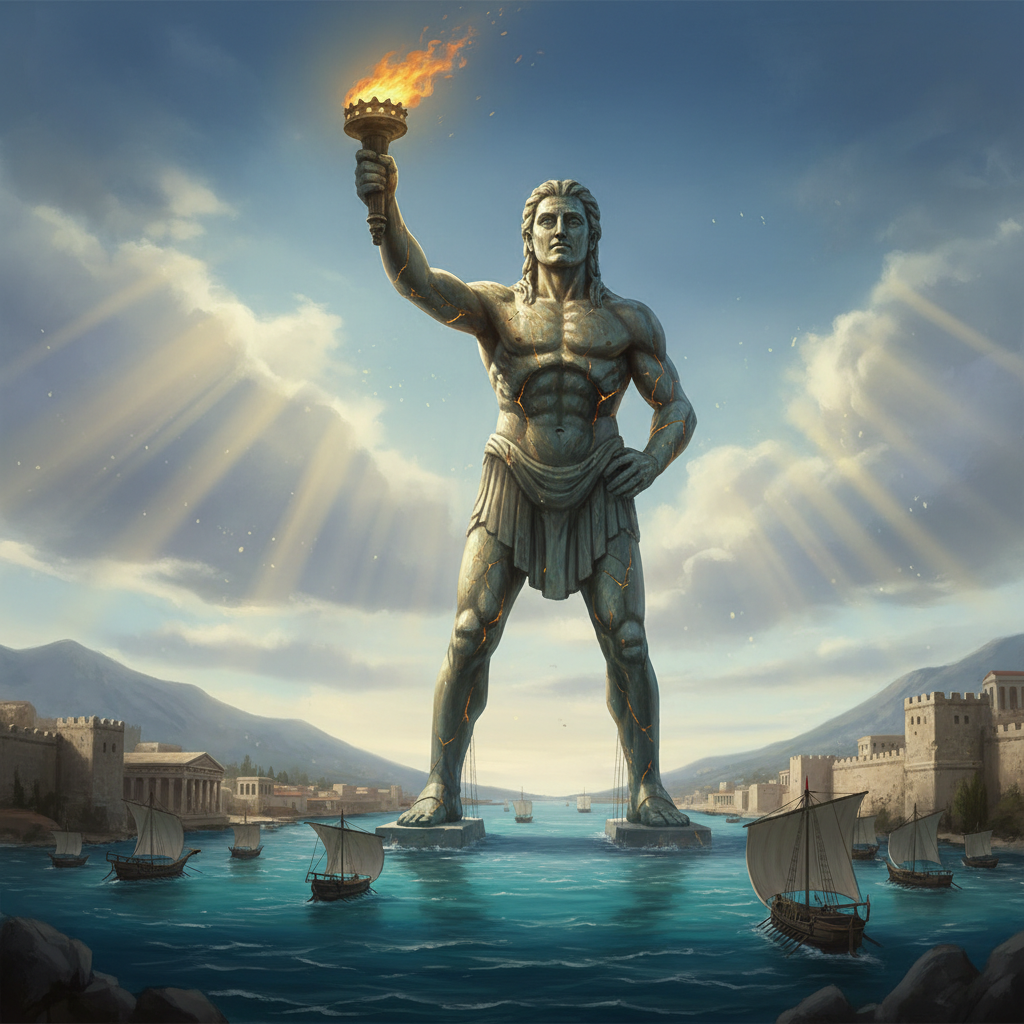
Most Greek city-states honoured Helios in passing rather than as a major cult figure. The great exception was Rhodes, the eastern Aegean island that took Helios as its patron god. The Colossus of Rhodes, one of the Seven Wonders of the Ancient World, was a colossal bronze statue of Helios erected at the harbour entrance around 280 BCE to celebrate the island’s deliverance from a Macedonian siege. The statue stood roughly 33 metres tall and was destroyed by an earthquake in 226 BCE, but the memory of it shaped depictions of monumental statuary for two millennia.
By the late classical and Hellenistic periods, Greek religious thought began merging Helios with Apollo, the Olympian god of music, prophecy, and many other domains who had also gathered solar associations. The two became increasingly difficult to separate in Roman tradition, where Apollo-Sol-Helios sometimes appears as a single composite figure. In some philosophical and Neoplatonic writing, Helios takes on a cosmic role as the visible image of the divine intellect, the literal sun standing for an inner sun of reason.
The Story of Phaethon
Phaethon (Φαέθων) is the son of Helios and the mortal woman Klymene. He is raised in his mother’s house, far from his divine father. As a young man, taunted by friends who do not believe his claim to divine parentage, he travels to the eastern palace of Helios to demand proof. The palace, in Ovid’s telling, is a wonder: built of gold and ivory, carved with images of the cosmos, surrounded by hours and seasons personified.
Helios receives the boy with joy. He embraces him, calls him son, and swears by the unbreakable oath of the Styx that he will grant whatever Phaethon asks. Phaethon asks for the chariot. Helios pales. He warns the boy that the path is too steep at dawn, too high at midday, too treacherous at dusk. The horses are fierce and obey only their master. Even Zeus, lord of the sky, cannot drive the chariot of the sun. But the oath is sworn, and Helios cannot break it.
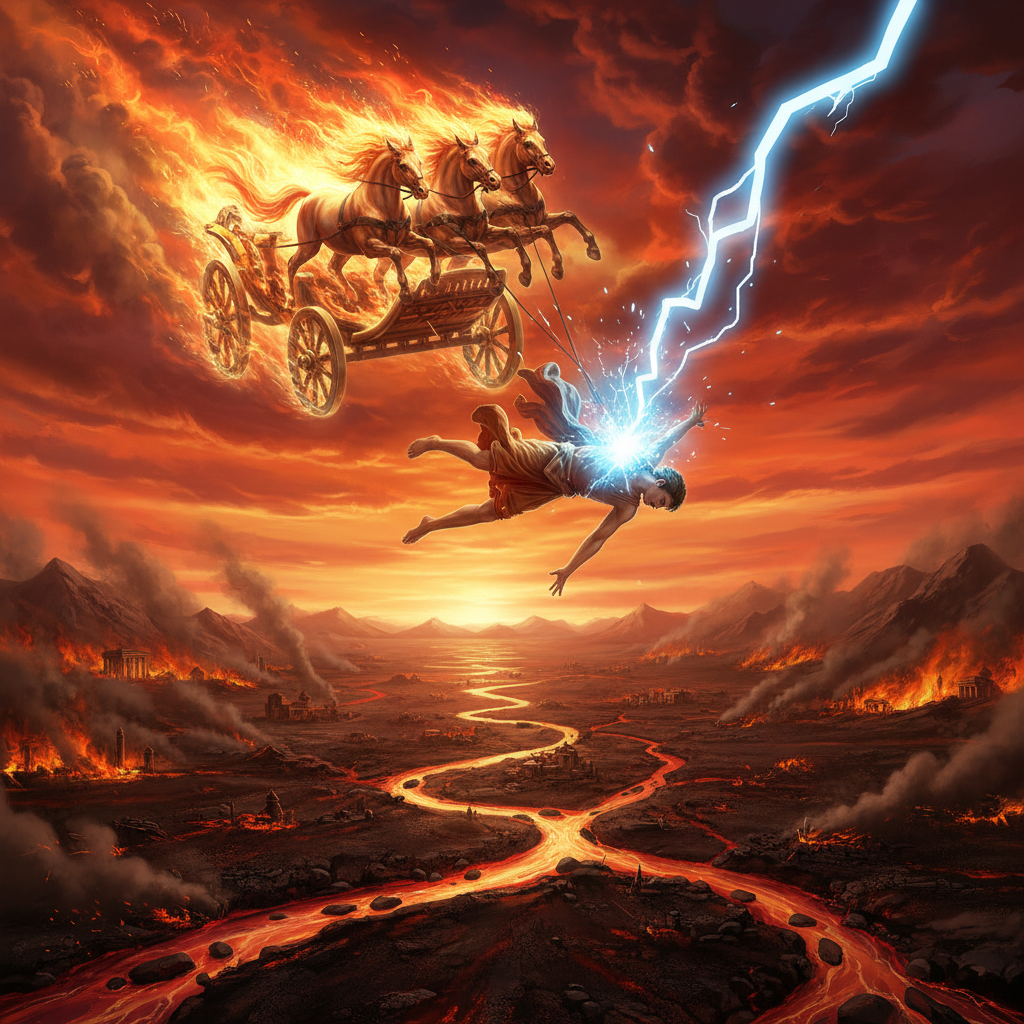
At dawn, Phaethon climbs into the chariot. The horses, sensing the lighter weight and weaker hand, bolt. The chariot swings too high. The sun retreats from the world, and the earth grows cold. Then the horses plunge too low. The chariot rakes across the surface of the world. Mountains catch fire. Rivers boil dry. The sands of Africa are burned to deserts. The skin of the people of Ethiopia is darkened by the heat. The seas retreat. The stars themselves are scorched.
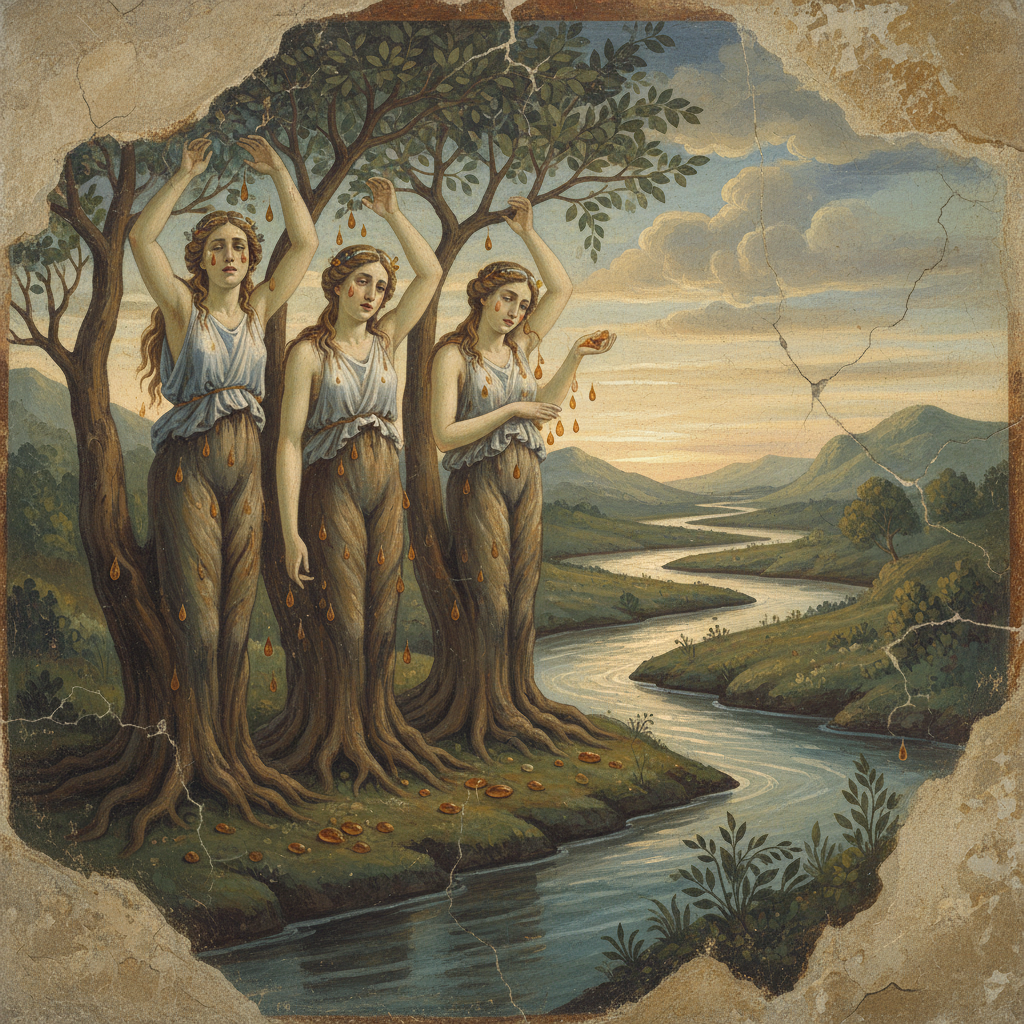
Earth, personified, cries out to Zeus. The lord of Olympus, to save the world, hurls a thunderbolt at the chariot. Phaethon falls. He plummets through the burning sky like a comet, landing in the river Eridanus, where his sisters, the Heliades, find his body. They weep so long over his grave that they are transformed into poplar trees, and their tears harden into amber.
Symbolism and Meaning
The Phaethon story is one of the great Greek myths of overreach. The boy demands what he cannot handle. His father, bound by an oath he should not have sworn, watches his son die. The world is nearly destroyed. The lesson is grim, but the myth is more complicated than a simple warning against pride. It is also a story about the loneliness of mixed inheritance, about the longing of a boy to claim his father, and about the impossibility of holding the work of a god in mortal hands.
The image of the wandering chariot has resonated in every age since. Plato uses it in the Timaeus to allude to a real cosmic disaster. Some scholars have suggested the myth preserves cultural memory of a catastrophic comet impact or volcanic event. Others read it as a moral parable, plain and simple. Either way, the story has lent itself to commentary from Plato to the Renaissance to modern climate writing, where the falling chariot is sometimes invoked as a metaphor for ecological overreach.
The motif of the divine chariot of the sun is not unique to the Greeks. The Vedic sun god Surya drives a similar chariot across the Hindu sky. The Norse Sol rides a chariot pulled by horses, pursued by a wolf. The Egyptian Ra crosses the sky in a solar barque. Each tradition independently arrived at the image of the sun as something carried, as something needing to be driven by a hand, as a vehicle in the daily geography of the cosmos.
Legacy and Modern Influence
Phaethon’s name has become shorthand in many languages for spectacular failure. A Phaethon, in old astronomy, was a name occasionally given to fire-trailing comets or meteors. The asteroid 3200 Phaethon, discovered in 1983, is the parent body of the Geminid meteor shower, which lights the December sky each year, an arguably appropriate name for an object whose orbit takes it closer to the sun than that of any other named asteroid.
Helios appears in modern fiction throughout. Rick Riordan’s Heroes of Olympus series, the video game Hades from Supergiant, countless novels and graphic novels treat him as a lingering, sometimes resentful figure displaced by Apollo. The story of Phaethon has been retold by Goethe, Camus, Shelley, and others as a parable of youthful ambition and tragic inheritance. The poet Percy Bysshe Shelley invokes him repeatedly in Adonais.
What endures is the image of the falling chariot. The sun goes wrong. A boy reaches too high. The cosmos reels. The Greeks understood that even the order of heaven could break, and they put the breaking into a story.
More From Greek Mythology
Continue exploring the gods, monsters, and heroes of ancient Greece. New encyclopedia entries published every week.
Explore MoreFrequently Asked Questions
Who is Helios in Greek mythology?
Helios is the Greek god of the sun, son of the Titans Hyperion and Theia. He drives a fiery four-horse chariot across the sky every day from east to west, and he is the brother of Selene the moon goddess and Eos the dawn goddess. In later Greek tradition he was often conflated with Apollo.
Who was Phaethon?
Phaethon was the mortal son of Helios and the mortal woman Klymene. He demanded to drive his father’s sun chariot for a day to prove his divine parentage. He lost control, scorched the earth, and was struck down by a thunderbolt of Zeus to save the world.
What is the moral of the Phaethon story?
The Phaethon myth is most often read as a parable of pride and overreach. A mortal demands the work of a god and is destroyed by it. But the story also concerns the bond between a divine father and a mortal son, and the impossible cost of a promise sworn too quickly.
What is the Colossus of Rhodes?
The Colossus of Rhodes was a roughly 33-metre bronze statue of Helios erected at the harbour of the island of Rhodes around 280 BCE, one of the Seven Wonders of the Ancient World. It was destroyed by an earthquake in 226 BCE, but its memory shaped monumental statuary for two thousand years.
Are Helios and Apollo the same god?
In early Greek religion they were distinct: Helios is the literal personification of the sun, while Apollo is an Olympian god of music, prophecy, and many other domains. From the late classical period onward they were increasingly conflated, and in Roman religion Apollo-Sol-Helios is often a single composite figure.
What happened to Phaethon’s sisters?
The Heliades, Phaethon’s sisters, wept so long at his grave on the river Eridanus that they were transformed into poplar trees. Their tears, falling from the trees, are said to have hardened into amber. The Greeks used this myth to explain the origin of amber as a material.