Quick Summary
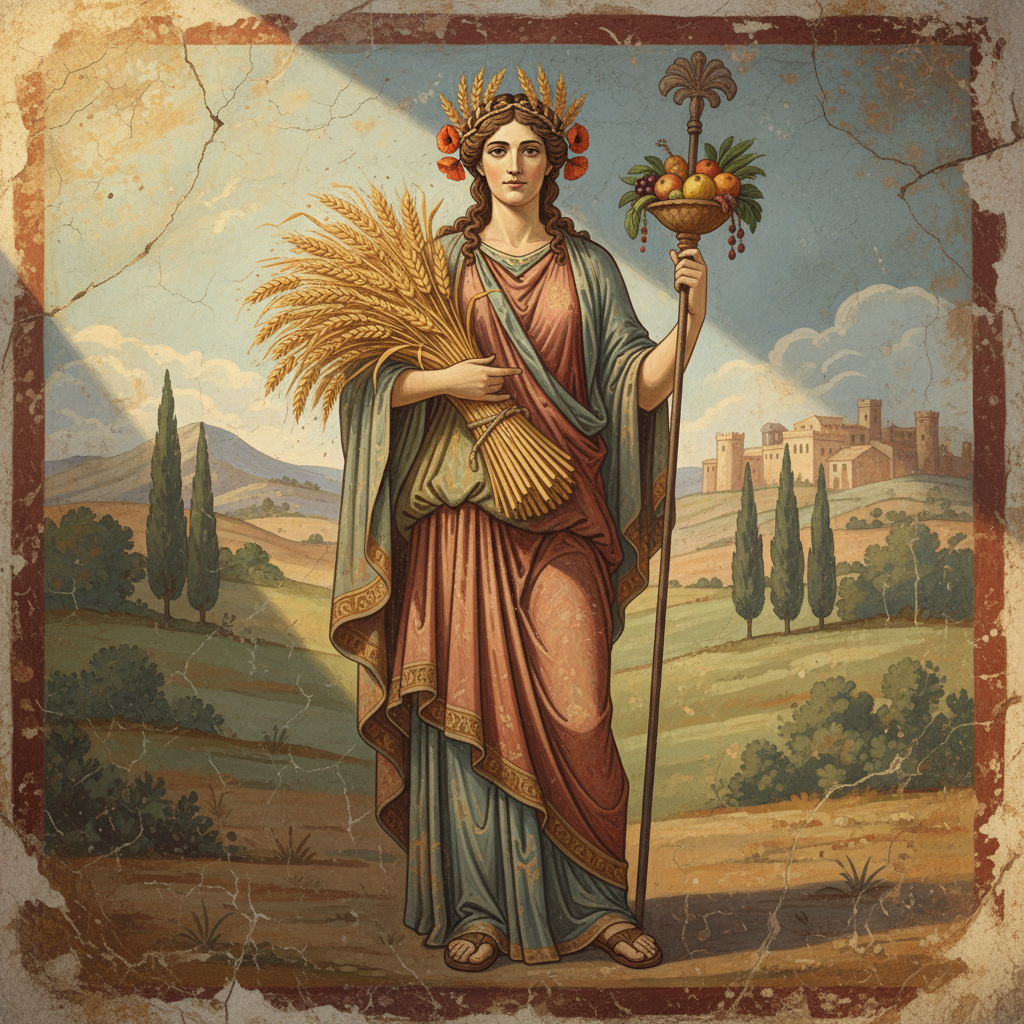
- Demeter is the Greek goddess of grain, agriculture, and the fertile earth, one of the twelve Olympians and a daughter of Cronus and Rhea.
- Her daughter Persephone was abducted by Hades to rule the underworld, and the grief of Demeter explains the cycle of seasons.
- The Eleusinian Mysteries, the most famous mystery cult of the ancient Mediterranean, centred on the Demeter and Persephone story for nearly two thousand years.
- The myth is preserved most fully in the Homeric Hymn to Demeter, an anonymous 7th-century BCE Greek poem of remarkable emotional depth.
- The seasonal cycle of Persephone’s descent and return parallels other “dying and rising” deities across world mythology.
A girl in a meadow stoops to pick a flower. The flower is a narcissus, planted by the earth at the request of Hades. The instant her fingers close around the stem, the ground splits. A black chariot drawn by black horses rises from the chasm. The lord of the dead reaches down and pulls her into the dark. Her cry is heard only by Hecate, the witch, and by Helios, the sun. Her mother does not yet know.
The mother is Demeter, goddess of grain and the green earth. The girl is Persephone, her only child. The story of how Demeter searches for her daughter, of how the world freezes during her grief, of how the gods must broker a compromise that allows Persephone to return for half the year, is one of the most beautiful and devastating in Greek myth. It is also one of the oldest, and one of the longest worshipped. For nearly two thousand years, the people of the Mediterranean walked at night to Eleusis to hear it told again.

Origins and Cultural Roots
Demeter (Δημήτηρ) is one of the twelve Olympian gods of Greek myth, daughter of the Titans Cronus and Rhea, sister of Zeus, Hera, Poseidon, Hades, and Hestia. She belongs to the older generation of Olympians, the children of Cronus, swallowed by their father at birth and freed when Zeus overthrew him. Her name is often interpreted as containing the elements de (perhaps “earth”) and meter (mother), giving “earth mother” or “grain mother”. Even in antiquity the etymology was contested. What is clear is that she is bound to the earth in a way no other Olympian is.
Her domains are grain, the fertile earth, agriculture, the cycle of planting and harvest, and the laws of marriage and motherhood. She is sometimes paired with Dionysus, the god of wine, as the divine couple presiding over the great staples of Mediterranean civilisation: bread and wine. She is the goddess to whom farmers prayed at sowing time, harvest time, and threshing.
Persephone, her only child, is daughter of Demeter and Zeus. In the early sources she is called Kore (Κόρη), simply “the maiden”, and her status as Demeter’s daughter is the heart of her identity. The story of her abduction transforms her from Kore the daughter into Persephone the queen of the underworld, a transformation that the entire myth turns on.
The Abduction of Persephone
The fullest surviving telling is the Homeric Hymn to Demeter, an anonymous Greek poem composed around the 7th century BCE. The hymn opens with Persephone playing in a meadow with the daughters of Oceanus. She reaches for a narcissus. The earth opens. Hades, lord of the underworld, has taken her with the consent of Zeus, her father, who has agreed to give her in marriage without consulting her mother.
Demeter hears the cry and runs through the world in search of her daughter. For nine days she neither eats nor sleeps. On the tenth day, Hecate and Helios tell her what has happened. Demeter, in grief and rage, withdraws her gifts from the earth. The crops fail. Cattle starve. Children grow thin. Humanity is on the brink of extinction. The other gods plead with her to relent, but her grief is greater than any persuasion.
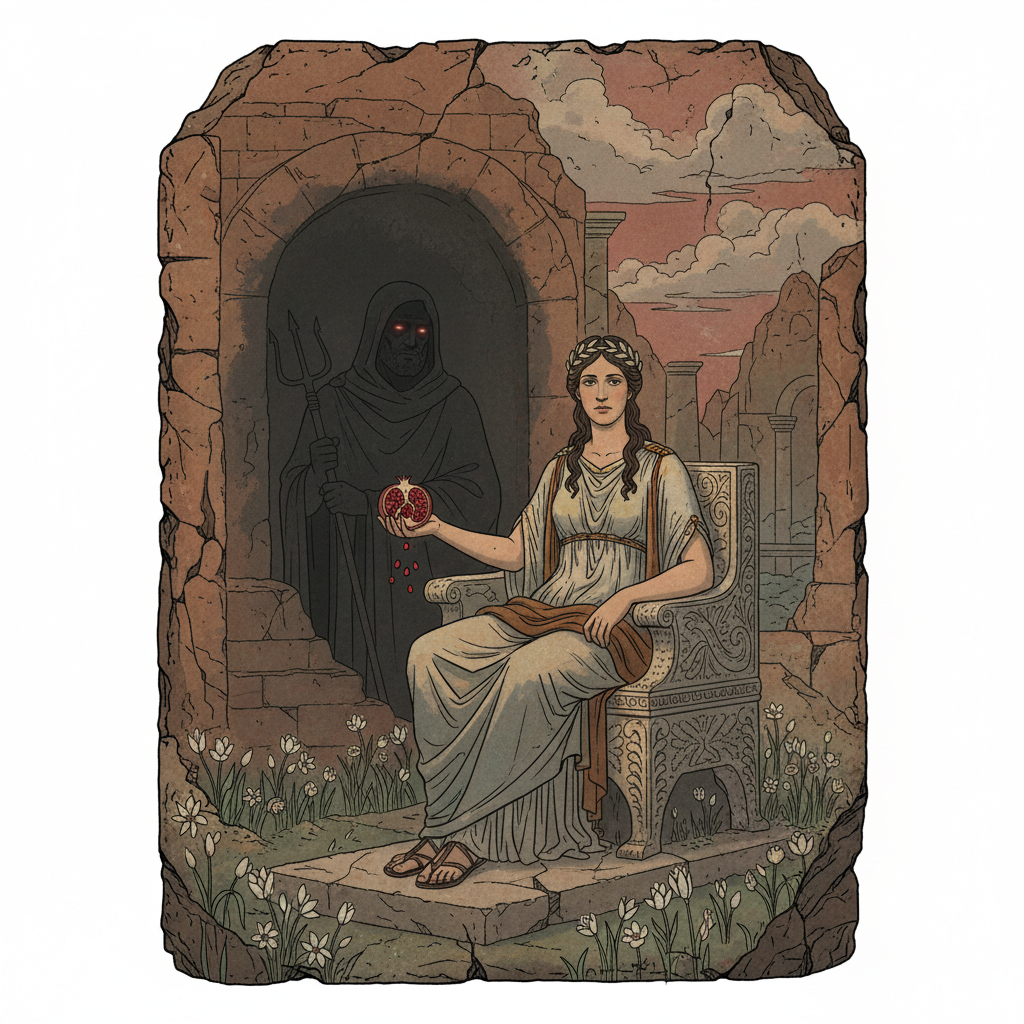
Eventually Zeus sends Hermes to Hades with an order: return Persephone to her mother. Hades agrees, but before letting her go, he gives her seeds of pomegranate to eat. Whether by trickery or by free choice, Persephone tastes the fruit. Six seeds, in some versions; one seed, in others. The number matters. Anyone who has eaten the food of the dead cannot fully return to the world of the living. A compromise is reached: Persephone will spend a portion of each year with her mother on the earth, and a portion in the underworld with Hades. The portion she spends below is the time of winter, when the earth grows cold and the fields lie bare. The portion she spends above is the time of growing things.

The Eleusinian Mysteries
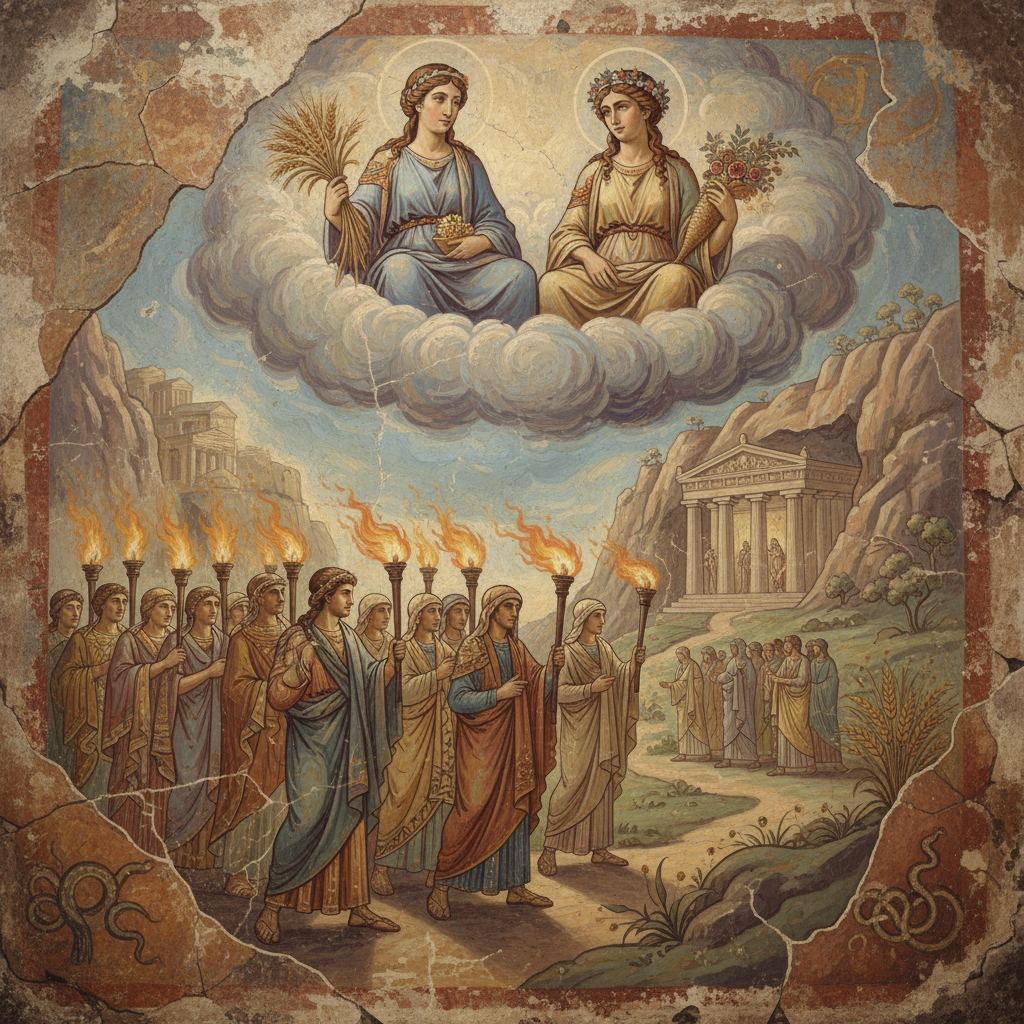
The story of Demeter and Persephone became the basis for the Eleusinian Mysteries, the most famous and enduring mystery cult of the ancient Mediterranean world. Held annually at the sanctuary of Eleusis, fifteen miles northwest of Athens, the rites began around the 15th century BCE and continued until the destruction of the sanctuary by Christian forces in 396 CE. For nearly two thousand years, initiates walked the Sacred Way from Athens to Eleusis, fasted, drank a sacred barley drink called kykeon, and witnessed something in the inner sanctuary that they were sworn never to describe.
The vow of secrecy was kept. We know what was around the Mysteries, the calendar, the procession, the public elements. We do not know what was at the centre. Initiates included philosophers (Plato, Plotinus), playwrights (Sophocles, Euripides), generals (Alcibiades), Roman emperors (Hadrian, Marcus Aurelius), and ordinary citizens. They report transformative experiences. They report a confidence about death that comes from having seen something. What they saw remains, to this day, the great unknown of the ancient religious world.
What is clear is that the Mysteries promised something to those who underwent them: a different relationship to death, a confidence in the continuity of life, a sense of belonging to the cycle that Persephone embodied. The grain that dies in the ground and rises again as wheat was both image and reality. The goddess who ate the pomegranate, who lived in two worlds, who came back each spring, offered something the Olympian religion of public sacrifice could not.
Symbolism and Meaning
The Demeter and Persephone myth is the Greek explanation of the seasons, but to call it only that is to miss what the Greeks heard in it. The cycle of grief and return is the cycle of every loss and every recovery. The mother who searches the world for her child speaks to a real and universal experience. The girl who is taken into the dark speaks to another. The compromise that allows Persephone to come back, but not all at once, not all the way, captures something true about how grief actually heals: in cycles, with relapses, with permanent changes that are also somehow returns.
The story belongs to a wide cross-cultural family of seasonal cycle myths. The Sumerian Inanna descends to the underworld and is held there by her sister Ereshkigal until her servants free her. The Mesopotamian Tammuz dies and is mourned annually. The Egyptian Osiris is killed and resurrected, his death tied to the flooding of the Nile. The Norse Baldur dies and is awaited in Hel until after Ragnarok. Wherever a tradition has wrestled with the cycle of crops, with the cold of winter and the green of spring, it has produced a story like this.
What sets the Greek version apart is its emphasis on the relationship of mother and daughter. Most parallel myths centre on a husband and wife, or a god and a vegetation deity. The Greek myth foregrounds maternal grief. Demeter is not Persephone’s lover. She is her mother. The story belongs to a kind of love that the Greek pantheon, otherwise so taken with romantic and erotic relationships, rarely centres elsewhere.
Legacy and Modern Influence
Demeter and Persephone have remained powerful figures in Western culture. The Roman versions Ceres and Proserpina were honoured throughout the Empire. The word cereal comes from Ceres. Modern poetry, from H.D. (Hilda Doolittle) to Louise Gluck, has drawn on the story to explore grief and motherhood. Gluck’s collection Averno (2006) is among the most powerful modern engagements with the myth. The Italian poet Cesare Pavese’s Dialoghi con Leuco contains a haunting Demeter-and-Persephone exchange.
The story has been reimagined in countless novels, films, and plays. Margaret Atwood, Madeline Miller, Pat Barker, and others have written significant adaptations. The 2013 video game The Legend of Zelda: A Link Between Worlds draws on Persephone-style themes. Hadestown, the Tony Award-winning Broadway musical by Anais Mitchell, retells the story alongside the Orpheus and Eurydice myth.
For modern readers, the myth offers something archaeology cannot: a story so durable that initiates kept it secret for two thousand years and we still do not know what they saw. What we have is what they did not protect: the surface of the story, the abducted daughter, the searching mother, the divided year. That has been enough to keep the myth alive in the Western imagination for thirty centuries.
More From Greek Mythology
Continue exploring the gods, monsters, and heroes of ancient Greece. New encyclopedia entries published every week.
Explore MoreFrequently Asked Questions
Who is Demeter in Greek mythology?
Demeter is the Greek goddess of grain, agriculture, and the fertile earth, one of the twelve Olympian gods. She is a daughter of Cronus and Rhea and a sister of Zeus, Hera, Poseidon, Hades, and Hestia. Her only child Persephone is the centre of her most famous myth.
Why did Hades abduct Persephone?
According to the Homeric Hymn to Demeter, Zeus agreed to give Persephone to Hades in marriage without consulting her mother. Hades arranged for the earth to open beneath Persephone as she gathered flowers, and the lord of the dead seized her in his black chariot and carried her to the underworld.
Why did Persephone eat the pomegranate?
Before letting Persephone return to her mother, Hades gave her seeds of pomegranate to eat. The number varies (six seeds, four seeds, or one seed in different versions). Eating the food of the dead bound her to return to the underworld for a portion of each year, creating the seasonal cycle.
How does the myth explain the seasons?
When Persephone is in the underworld with Hades, Demeter grieves and the earth grows barren. This is winter. When Persephone returns to her mother, Demeter rejoices and the earth blooms. This is spring and summer. The grain dies in the ground and rises again as wheat, mirroring the daughter’s descent and return.
What were the Eleusinian Mysteries?
The Eleusinian Mysteries were the most famous mystery cult of the ancient Mediterranean, held annually at the sanctuary of Eleusis northwest of Athens. They centred on the Demeter and Persephone story and offered initiates a transformative experience and a different relationship to death. The rites lasted for nearly two thousand years.
How does the myth compare to other seasonal cycle stories?
The Demeter and Persephone story belongs to a wide family of seasonal cycle myths, including the Sumerian Inanna in the underworld, the Mesopotamian Tammuz, the Egyptian Osiris, and the Norse Baldur. What sets the Greek version apart is its emphasis on the relationship between mother and daughter rather than husband and wife.