Too Long, Didn’t Read
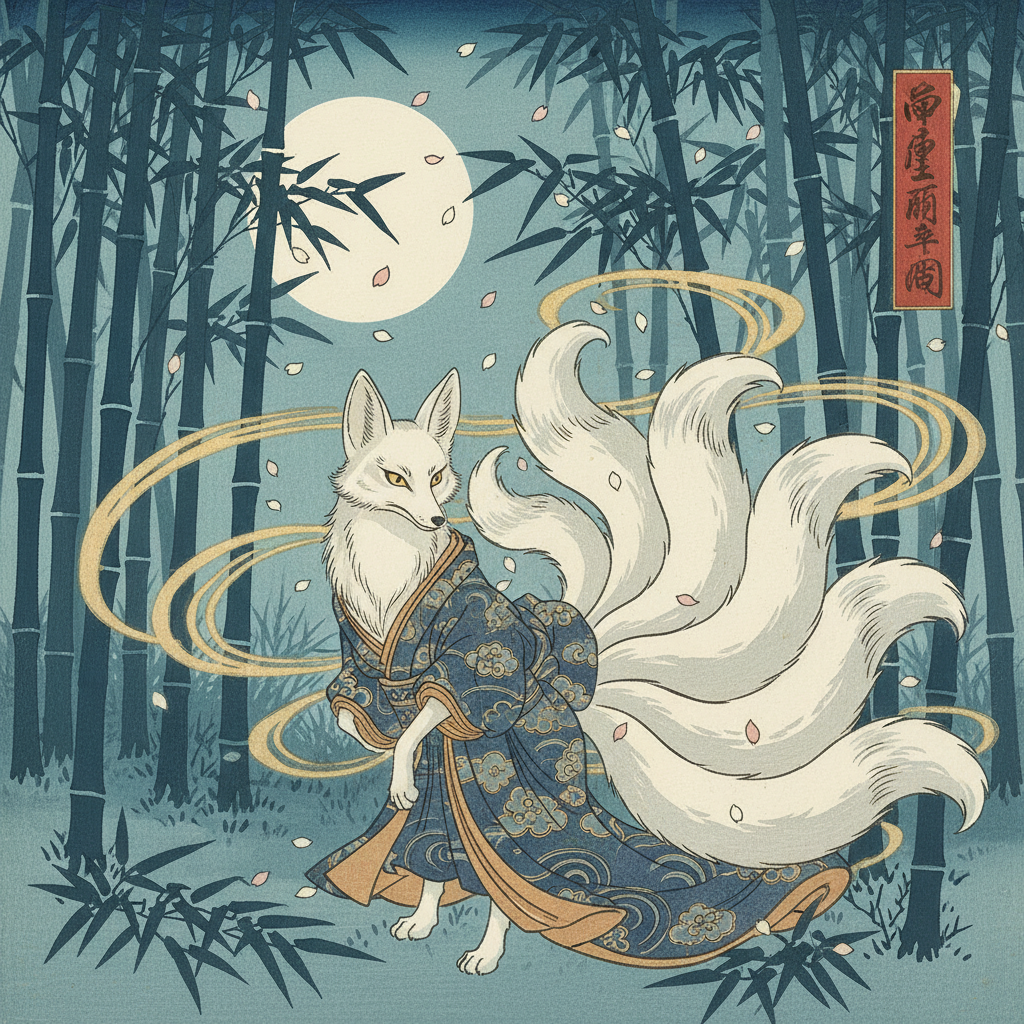
- Kitsune are supernatural foxes in Japanese folklore that gain wisdom and magical power as they age, growing additional tails up to a maximum of nine.
- They appear in two main forms: zenko (benevolent foxes associated with the god Inari) and yako (wild, mischievous trickster foxes).
- Kitsune possess the ability to shape-shift into human form, most commonly taking the appearance of beautiful women.
- Fox spirits appear across East Asian mythology, with parallel traditions in China (huli jing) and Korea (kumiho), each with distinct cultural meanings.
A traveller walks a mountain road at dusk. The light is fading. Ahead, a woman in white stands at the edge of the tree line, watching. She is beautiful, impossibly still. When the traveller calls out, she turns and smiles. Her shadow, stretching long across the path, does not match her shape. It has a tail.
This scene, in one version or another, has been told in Japan for over a thousand years. The kitsune (fox) is one of the most famous and complex figures in all of Japanese folklore. Neither purely good nor purely evil, kitsune occupy a space between the human world and the spirit world that few other creatures in world mythology can match. They are tricksters, guardians, lovers, and gods. Understanding kitsune means understanding something central about how Japan has imagined the boundary between the natural and the supernatural.
Origins and Cultural Roots
The fox has held a special place in Japanese culture since at least the Nara period (710-794 CE). The oldest surviving Japanese texts, including the Nihon Shoki (Chronicles of Japan, 720 CE) and later collections like the Konjaku Monogatarishu (Tales of Times Now Past, 12th century), contain stories of foxes that transform, deceive, and sometimes fall in love with humans.
The Japanese red fox (Vulpes vulpes japonica) was a common sight in rural Japan, living close to villages and rice paddies. This proximity bred both familiarity and suspicion. Foxes were observed to be intelligent, elusive, and capable of behaviour that seemed almost deliberate. Over centuries, these observations layered into a mythology where the fox became something more than an animal.
The Chinese fox spirit tradition (huli jing) almost certainly influenced early Japanese kitsune beliefs. Fox spirits appear in Chinese texts dating back to the Warring States period (475-221 BCE), and elements of Chinese fox lore entered Japan alongside Buddhism and Chinese literary culture. But Japan made the kitsune its own. Where Chinese fox spirits tend toward the dangerous and seductive, the Japanese kitsune developed a dual nature that is unique in world folklore.

The Two Faces of the Kitsune
Japanese folklore divides kitsune into two broad categories, and this division reveals something fundamental about how the culture understood supernatural power.
Zenko: The Celestial Foxes
Zenko (善狐, literally “good foxes”) are benevolent fox spirits closely associated with the Shinto god Inari. They serve as Inari’s messengers and guardians, and you can see their stone statues flanking the entrance to Inari shrines across Japan. The famous Fushimi Inari shrine in Kyoto, with its thousands of vermillion torii gates, is dedicated to this deity, and fox statues stand watch at every turn.
Zenko protect rice harvests, bring prosperity, and ward off evil spirits. They are associated with fertility, agriculture, and good fortune. Farmers in feudal Japan would leave offerings of aburaage (fried tofu) at small roadside Inari shrines, hoping to earn the favour of these celestial foxes. This tradition continues today. Walk through any Japanese city and you will find Inari shrines tucked between modern buildings, fox statues still watching over the neighbourhood.
Yako: The Wild Foxes
Yako (野狐, literally “field foxes”) are the tricksters. These are the foxes of campfire stories, the ones that lead travellers astray, steal food, possess the unwary, and create illusions so convincing that entire villages can be fooled. Yako are not inherently evil in the way Western demons are evil. They are mischievous, self-interested, and sometimes cruel, but they operate by their own logic. A yako might ruin a man out of spite or boredom, but it might also reward someone who shows it kindness.
The distinction between zenko and yako is not always clean. Some stories feature foxes that shift between benevolence and mischief depending on how they are treated. This ambiguity is part of what makes kitsune so compelling. They are not simple moral categories. They are as unpredictable as nature itself.
Powers and Abilities
Kitsune grow more powerful with age. A young fox has limited abilities, but as it ages, its intelligence and magical power increase. The most visible sign of a kitsune’s power is its tails.
The Nine Tails
A kitsune grows a new tail every hundred years. A one-tailed fox is a relative beginner. A nine-tailed fox, the kyubi no kitsune (九尾の狐), has lived for at least nine hundred years and possesses near-godlike power. Nine-tailed foxes are described as having golden or white fur, and their wisdom is said to be boundless. They can see and hear anything happening anywhere in the world.
The number nine holds particular significance in East Asian numerology, representing completeness and celestial power. A nine-tailed fox has reached the pinnacle of its spiritual development. In some traditions, reaching this stage transforms the fox into a fully divine being.
Shape-Shifting
The most famous kitsune ability is bakeru (化ける), the power to change shape. Kitsune most commonly take the form of beautiful young women, though they can also appear as old men, children, or other animals entirely. The transformation is usually convincing, but folklore warns of telltale signs. A kitsune in human form might cast a fox-shaped shadow. It might have difficulty hiding its tail. It might be unusually afraid of dogs, who can sense a fox’s true nature.
Some kitsune are said to create entire illusory landscapes. A traveller might stumble upon a grand mansion in the forest, complete with servants and a feast, only to wake the next morning lying in an empty field. These large-scale illusions are called kitsune no yomeiri (fox’s wedding) when they involve phantom lights, or kitsune-bi (fox fire) when they manifest as ghostly flames hovering in the darkness.
Fox Possession
Kitsunetsuki (狐憑き) is the Japanese term for fox possession. A person possessed by a kitsune might exhibit sudden changes in personality, speak in voices not their own, develop unusual cravings (particularly for aburaage), or display knowledge they could not possibly have. In historical Japan, kitsunetsuki was considered a real medical and spiritual condition. Exorcisms were performed by Shinto priests, Buddhist monks, or folk healers called kitoshi. The concept shares parallels with the Oni possession traditions, though oni are far less subtle in their approach.
The phenomenon was taken seriously enough that it appears in legal and medical documents from the Edo period (1603-1868). Entire families could be stigmatised as “fox-owning families” (kitsune-mochi), accused of using fox spirits to curse their neighbours or steal wealth. These accusations often targeted prosperous families and carried real social consequences.

The Kitsune Wife: Love Between Worlds
One of the most enduring kitsune story types is the fox wife tale. In these stories, a man encounters a beautiful woman, often under unusual circumstances. They marry. She is the perfect wife, devoted, clever, and gentle. They have children. Then one day, a dog barks, or a mirror catches an angle, or the husband glimpses a tail beneath the bedsheets. The wife’s true nature is revealed. She flees into the forest, leaving behind a family caught between two worlds.
The most famous version is the legend of Kuzunoha. A nobleman named Abe no Yasuna rescues an injured white fox. Later, a beautiful woman named Kuzunoha appears and nurses him back to health. They marry and have a son, Abe no Seimei, who would grow up to become the most famous onmyoji (diviner) in Japanese history. When Kuzunoha’s fox nature is accidentally revealed, she leaves a poem on a screen: “If you love me, come find me. You will find me in the great forest of Shinoda.” Abe no Seimei’s legendary magical abilities were said to come from his fox mother’s blood.
These stories are not simply about deception. They explore the boundaries between the human and the non-human, the pain of love that cannot survive exposure to truth, and the children born between worlds who carry the gifts of both. The same theme appears in selkie legends from Scotland, swan maiden tales from Scandinavia, and crane wife stories from Japan itself. The Manananggal of Filipino folklore shares a similar fascination with beings that shift between human and supernatural forms. Across cultures, the idea that love between species is real but ultimately doomed runs deep in the human imagination.

Symbolism and Meaning
The kitsune embodies several themes that run through Japanese culture and beyond.
The duality of nature. The fox is both guardian and trickster, helper and threat. This mirrors the Shinto understanding of kami (spirits), which are neither good nor evil but simply powerful. A kami that protects a village can destroy it if disrespected. The kitsune is a small-scale version of this principle.
Transformation and identity. In a culture that values social roles and proper behaviour, the kitsune represents the fear and fascination of what lies beneath the surface. Anyone could be a fox in disguise. Your neighbour, your spouse, the stranger on the road. The kitsune asks: how well do you really know the people around you?
The relationship between humans and nature. Kitsune stories emerge from a world where humans and animals lived in close proximity. The fox was neither domesticated nor fully wild. It existed in a liminal space, and the mythology reflects that. Kitsune are beings of the threshold, belonging fully to neither the human world nor the spirit world.
Feminine power and deception. Many kitsune take female form, and these stories often explore anxieties about feminine intelligence, sexuality, and autonomy. A kitsune wife is too perfect, too beautiful, too clever. The revelation of her true nature can be read as a cultural expression of suspicion toward women who exceed expected roles. But it can also be read as a celebration of feminine power that transcends human limitations.
Cross-Cultural Connections
Fox spirits appear across East Asia, each tradition giving the figure its own cultural weight.
In China, the huli jing (狐狸精) is predominantly a dangerous seductress. The most famous example is Daji, the fox spirit concubine who supposedly caused the downfall of the Shang Dynasty. Chinese fox spirits tend to drain the life force of their victims, making them more overtly threatening than their Japanese counterparts.
In Korea, the kumiho (구미호) is almost always malevolent. Korean nine-tailed foxes eat human hearts or livers to maintain their human disguise. There is less of the moral ambiguity that characterises Japanese kitsune.
The differences are telling. Japanese kitsune can be benevolent gods, devoted wives, or petty tricksters. Chinese huli jing are seductive and dangerous. Korean kumiho are predatory. Each culture projected its own anxieties and values onto the same basic figure: a clever, shape-shifting fox.
Legacy and Modern Influence
Kitsune remain one of the most recognisable figures in Japanese popular culture. They appear in anime, manga, video games, and literature with remarkable frequency.
In Naruto, the nine-tailed fox Kurama is sealed within the protagonist. In the Pokémon franchise, Ninetales and Vulpix are directly inspired by kitsune mythology. The Persona and Shin Megami Tensei game series feature kitsune as summonable spirits. Films like Pom Poko and The Tale of the Princess Kaguya draw on fox folklore traditions.
Beyond entertainment, the kitsune’s influence is visible in everyday Japanese life. Inari shrines with their fox guardians remain among the most common type of shrine in Japan, with an estimated 30,000 across the country. Inari-zushi (rice stuffed in fried tofu pockets) is named for the fox’s favourite food. Kitsune udon, a popular noodle dish topped with fried tofu, carries the same reference.
The figure has also crossed into Western awareness. Kitsune masks are popular at anime conventions and in fashion. The concept of the nine-tailed fox has become a recognisable fantasy archetype in Western games and fiction, often stripped of its cultural context but retaining the core idea of a powerful, magical, shape-shifting fox.
More Japanese Folklore in Your Inbox
Join 25,000+ readers exploring myths and ancient stories from cultures around the world. New entries every week, from kitsune to kappa and beyond.
SubscribeFrequently Asked Questions
What is a kitsune in Japanese mythology?
A kitsune is a supernatural fox spirit in Japanese folklore. Kitsune possess intelligence, magical abilities, and the power to shape-shift into human form. They grow additional tails as they age, with the most powerful having nine tails. Kitsune can be benevolent guardians associated with the Shinto god Inari, or mischievous tricksters that deceive and possess humans.
How many tails can a kitsune have?
A kitsune can have up to nine tails. According to tradition, a fox grows one new tail every hundred years. A nine-tailed fox has lived for at least 900 years and possesses near-divine power, including the ability to see and hear anything in the world. The nine-tailed fox is called kyubi no kitsune in Japanese.
What is the difference between a kitsune and a kumiho?
Both are fox spirits, but they come from different cultures with different characterisations. Japanese kitsune can be either benevolent or mischievous, and some serve as divine messengers for the god Inari. Korean kumiho are almost always malevolent, typically depicted as predators that eat human hearts or livers. Chinese huli jing fall between the two, tending toward dangerous seductresses.
Why are fox statues at Japanese shrines?
The fox statues found at Inari shrines represent kitsune serving as messengers and guardians of Inari, the Shinto god of rice, fertility, and prosperity. There are over 30,000 Inari shrines across Japan, making them the most common type of Shinto shrine. The foxes are depicted holding a key, jewel, or scroll in their mouths, symbolising their role as protectors of sacred knowledge.
Can kitsune be male?
Yes. While kitsune most famously take the form of beautiful women in folklore, they can be any gender. Male kitsune appear in stories as wise old men, scholars, or monks. The association with female form is partly because the most popular story type, the fox wife tale, features a female kitsune marrying a human man. But the mythology does not limit kitsune to any single gender.
What is kitsunetsuki (fox possession)?
Kitsunetsuki is the Japanese term for possession by a fox spirit. Symptoms include sudden personality changes, speaking in strange voices, craving fried tofu, and displaying knowledge the person should not have. In historical Japan, it was treated as a real condition requiring exorcism by Shinto priests or Buddhist monks. The belief was widespread enough to appear in legal and medical records from the Edo period.
Who is Kuzunoha in kitsune mythology?
Kuzunoha is the most famous kitsune wife in Japanese folklore. She is a white fox who takes human form after being rescued by a nobleman named Abe no Yasuna. They marry and have a son, Abe no Seimei, who becomes the most renowned onmyoji (diviner) in Japanese history. When her fox nature is revealed, she disappears into the forest of Shinoda, leaving behind a poem for her family.