Quick Summary
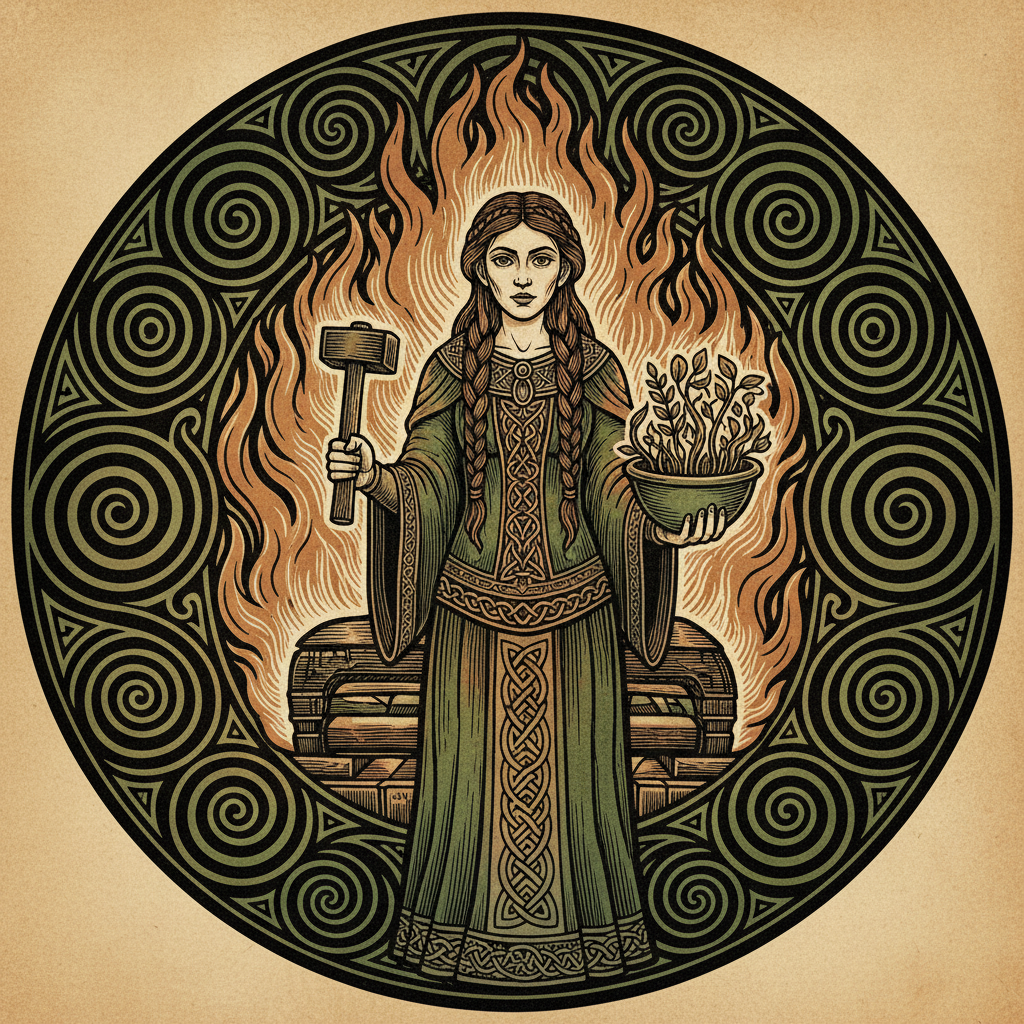
- Brigid is the Celtic goddess of fire, poetry, healing, smithcraft, and fertility, daughter of the great god the Dagda.
- Her festival Imbolc, celebrated on 1 February, marks the midpoint between winter solstice and spring equinox in the Celtic seasonal calendar.
- Brigid is so beloved that her cult survived the Christian conversion of Ireland as Saint Brigid of Kildare, whose feast day is still 1 February.
- She is sometimes described as a triple goddess, three sisters who share a name and rule the three crafts of poetry, smithing, and healing.
- Imbolc has been revived in modern times as one of the eight festivals of the contemporary pagan Wheel of the Year.
The first of February in Ireland is the moment when winter starts to lose. The hours of light have begun to lengthen. The ewes begin to lactate. The first lambs are born. The earth, still cold and grey, holds the first hint of spring inside it. The Celts looked at this turning and built a festival to mark it. They called it Imbolc, and they put a goddess at the heart of it. Her name was Brigid, and she carried fire and poetry in her hands.
Brigid is one of the great survivor figures of European mythology. She was a Celtic goddess. When the Irish converted to Christianity, she became Saint Brigid of Kildare, the second patron of Ireland after Patrick. Her sacred fire burned at her sanctuary continuously for over a thousand years. Her feast day, 1 February, has remained on the Irish calendar without interruption from the Iron Age to the present. Few mythological figures have so successfully crossed the line between religions.
Origins and Cultural Roots
Brigid (in Old Irish Brigit, in modern Irish Brid) belongs to the Tuatha De Danann, the divine race of pre-Christian Irish mythology. She is described in the medieval Irish text Cath Maige Tuired (The Battle of Mag Tuired) and in the Lebor Gabala Erenn (Book of Invasions) as the daughter of the Dagda, the great chieftain god of the Tuatha. Her name comes from a Proto-Celtic root *Briganti, meaning “the exalted one” or “the high one”, and is cognate with the British goddess Brigantia, worshipped by the Celtic Brigantes tribe in northern Britain.
She is associated with three principal crafts: poetry (or learning more broadly), smithcraft, and healing. In some sources she is treated as a single goddess presiding over all three. In others, she is three sisters of the same name, each ruling one craft. The triple form is common in Celtic mythology, where a divine figure can be one, three, or many depending on the context.
Her sacred animals include the cow, especially a white red-eared cow that gives milk in extraordinary quantities, and the swan. Her sacred objects include perpetual flames, healing wells, and the cloak that she spread over the land of Kildare to mark out her domain. Sacred fires and holy wells, both associated with Brigid in Ireland, remain features of the Irish landscape today.
Imbolc: The Festival of Lights
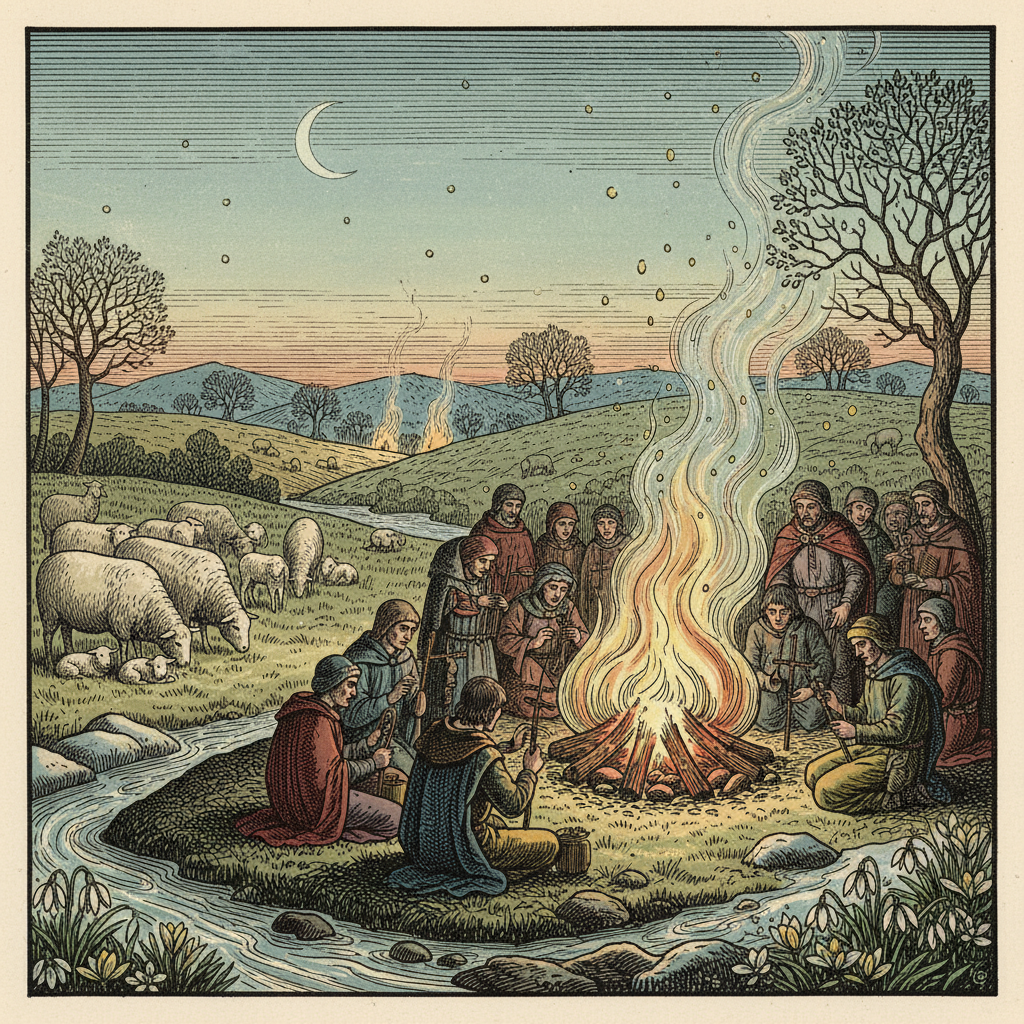
Imbolc is one of the four great quarter-day festivals of the Celtic year, falling at the cross-quarter between the winter solstice and the spring equinox. The other three are Bealtaine (1 May), Lughnasadh (1 August), and Samhain (1 November). Imbolc marks the moment when winter has half passed and spring is on the way, even if not yet visible.
The name Imbolc may derive from an Old Irish word meaning “in the belly”, a reference to the pregnancy of the ewes whose milk was the first sign of returning fertility. Other etymologies have been proposed, including oimelc, “ewe milk”, attested in some early sources. Whatever the precise origin, the festival is bound to the lambing season and to the first stirring of life after winter.
Traditional Imbolc customs included the lighting of fires, the weaving of Brigid’s crosses from rushes, the blessing of seed and tools, and the bringing of a Brigid doll (Brideog) from house to house. In some districts, the housewife made a bed of straw for Brigid by the hearth on the eve of the festival, expecting the goddess to visit during the night and bless the home. The customs survived into Christian Ireland and persisted in many forms into the 20th century.
Saint Brigid of Kildare
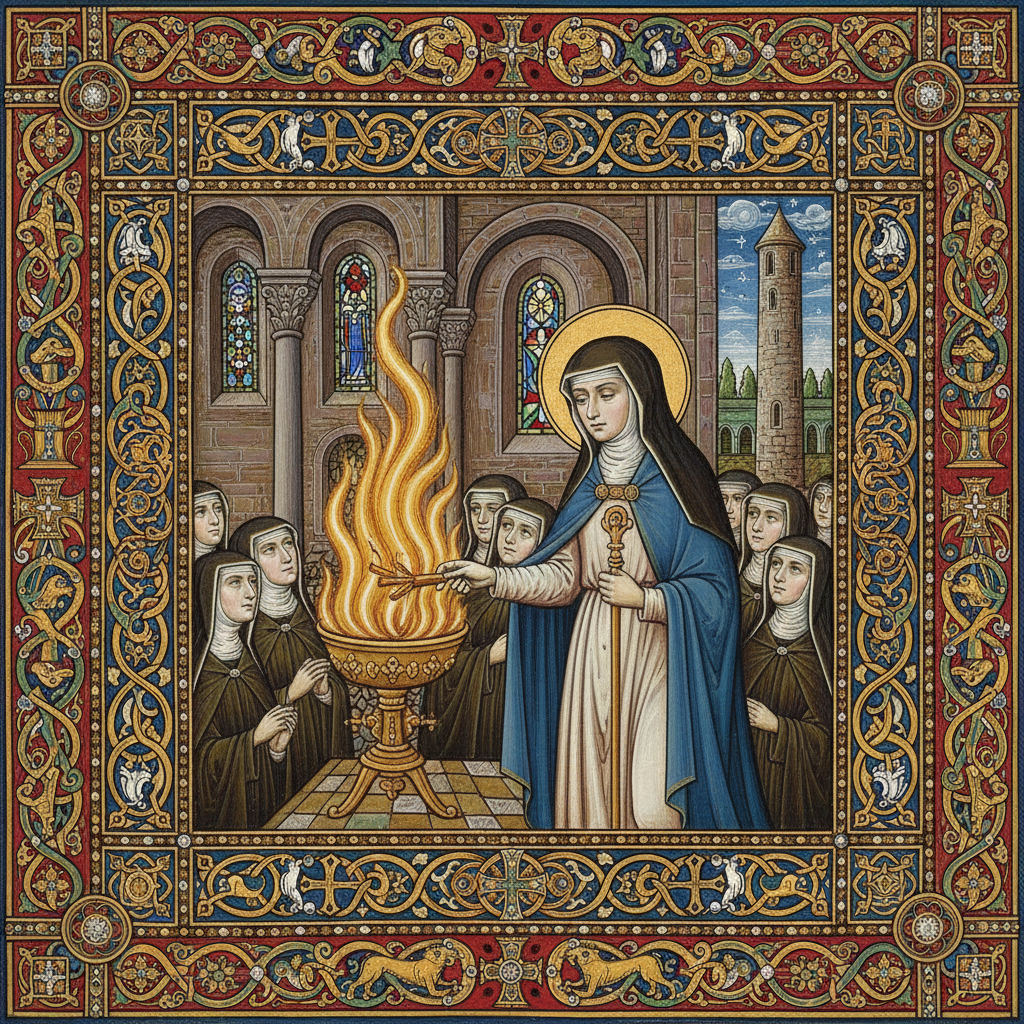
When Ireland converted to Christianity in the 5th century, the cult of Brigid did something remarkable: it survived intact. The name, the feast day, the sacred sites, the perpetual fire, the healing wells, even much of the iconography passed without break from goddess to saint. Saint Brigid of Kildare, traditionally said to have lived from 451 to 525 CE, became the second patron of Ireland after Patrick. Her abbey at Kildare became one of the great religious centres of medieval Ireland.
The continuity is so striking that scholars have argued for centuries about how to interpret it. Some see Saint Brigid as a real historical figure who happened to share a name with a goddess. Others see the saint as essentially a Christianised form of the goddess, with the church accommodating local devotion by canonising the older deity. The truth is probably somewhere between: a real abbess named Brigid, around whom older traditions clustered, and whose feast day was placed on the existing Imbolc to ease the transition.
Whatever the historical answer, the cultural fact is clear. The sacred fire at Kildare burned continuously, tended by nuns, from at least the 5th century until 1220, when a bishop ordered it extinguished, and then again from 1993 when the Brigidine Sisters relit it. The fire has not gone out since. Sites associated with Brigid, including the holy wells of Kildare, Liscannor, and many others, remain places of pilgrimage today.
Symbolism and Meaning
Brigid embodies the Celtic understanding of fire as a sacred element. Fire is what cooks food, heats the home, forges metal, and inspires the poet. Each of her three crafts depends on fire in a different way. The smith’s forge, the healer’s purifying flame, the inspiration of the bard, all are fire in different forms. Brigid is the goddess in whom these three are one.
Her place in the seasonal cycle is also significant. Imbolc is the festival of returning light. The days have begun to grow noticeably longer. The cold is at its sharpest, but the turn has been made. Brigid, like the Anglo-Saxon Eostre a few months later, is the goddess of light returning when the world is still mostly dark. Her cross-cultural relatives include other dawn-and-light goddesses: Eostre, the Greek Eos, the Vedic Ushas, the Latin Aurora, and the Lithuanian Ausrine.
The triple form, Brigid as three sisters of one name, is one of the most distinctive features of Celtic mythological thought. The Morrigan also appears in triple form, as do many other Celtic goddesses. The pattern is older than the Celts and may reach back to Indo-European roots. The three sisters may represent maiden, mother, crone; or poetry, smithcraft, healing; or simply the divine threefold nature of certain forces in the world.
Legacy and Modern Influence
Brigid is alive in modern Ireland in ways that few ancient deities are alive anywhere. Saint Brigid’s Day, 1 February, was made an official Irish national holiday in 2023, the first new Irish public holiday in nearly forty years and the first ever named after a woman. Imbolc itself has been revived as one of the eight festivals of the contemporary pagan Wheel of the Year, observed by Wiccans, Druids, and other neopagan practitioners around the world.
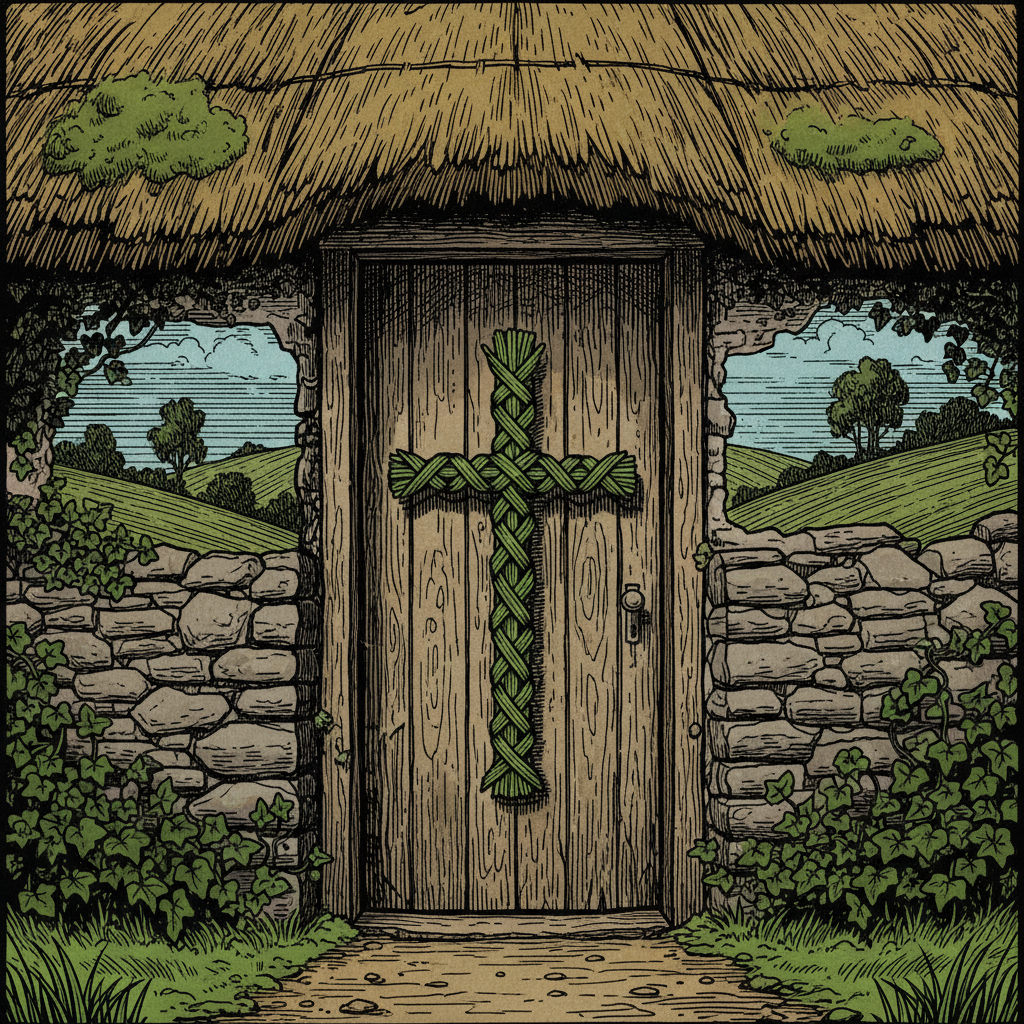
The Brigidine Sisters in Kildare maintain the perpetual flame, organise pilgrimages, and run a research and education centre that has become a focal point for renewed interest in Celtic spirituality. Brigid’s crosses, woven from rushes on Imbolc Eve, hang in many Irish homes. The practice of weaving them has been recognised as part of the intangible cultural heritage of Ireland.
For modern readers, Brigid offers a model of how mythology can survive across religious change. She did not need to be defeated by the new religion. She made the crossing herself. The fire she keeps was a Celtic fire and a Christian fire and is now also a fire of contemporary spiritual revival. The continuity is the point. The goddess and the saint are, in some real sense, the same warmth in the dark of February.
Mythology Delivered to Your Inbox
Join 25,000 readers exploring world myth, ancient legends, and the cosmic questions that have shaped human storytelling. New encyclopedia entries delivered every week.
SubscribeFrequently Asked Questions
Who is Brigid in Celtic mythology?
Brigid is the Celtic goddess of fire, poetry, healing, smithcraft, and fertility. She is a daughter of the Dagda, the great chieftain god of the Tuatha De Danann. She is sometimes described as a triple goddess, three sisters of the same name who rule the three crafts of poetry, smithing, and healing.
What is Imbolc?
Imbolc is the Celtic festival of 1 February, marking the midpoint between the winter solstice and the spring equinox. It is associated with Brigid and with the lambing season, when ewes begin to give milk and the earth shows the first signs of returning life.
Is Saint Brigid the same as the goddess?
The relationship is debated. Saint Brigid of Kildare, traditionally dated to 451-525 CE, may have been a real historical abbess around whom older Brigid traditions clustered. The feast day, sacred sites, perpetual flame, and many customs passed continuously from goddess to saint, suggesting a deliberate accommodation by the early Irish church.
What is a Brigid’s cross?
A Brigid’s cross is a four-armed cross woven from rushes, traditionally made on Imbolc Eve and hung in the home for protection. The weaving of Brigid’s crosses is recognised as part of Ireland’s intangible cultural heritage and continues to be practised today.
Why is Brigid associated with three crafts?
Poetry, smithcraft, and healing all involve the transformative power of fire: the inspiration of the bard, the forging of metal, and the purifying flame of the healer. Brigid presides over all three because all three are facets of the same sacred element. The triple form may also reflect older Indo-European patterns of triple goddesses.
Is Imbolc still celebrated?
Yes. Saint Brigid’s Day on 1 February became an official Irish national holiday in 2023. Imbolc is also one of the eight festivals of the contemporary pagan Wheel of the Year, observed by neopagans, Wiccans, and Druids worldwide. Traditional Irish customs, including Brigid’s crosses, continue to be practised.