Quick Summary
- Eostre is an Anglo-Saxon goddess of spring, dawn, and renewal whose name gave English the word Easter.
- The earliest written reference to her comes from the Venerable Bede in his De Temporum Ratione (725 CE), where he says her festival fell in the month later called Eostur-monath.
- Modern associations of Eostre with hares, eggs, and spring fertility largely come from 19th-century scholarship, especially Jacob Grimm, rather than from any surviving early medieval source.
- Her Germanic counterpart Ostara is reconstructed from continental traditions and from comparative philology with Indo-European dawn goddesses including Greek Eos and Vedic Ushas.
- Eostre’s legacy lives on in the modern Easter holiday, the German Ostern, and in countless springtime symbols of rebirth that long predate Christianity in northern Europe.
Spring comes late in the north. Through long dark winters, the ancestors of the English watched the days grow shorter, the food stores thin, the fires burn low. When the first warm wind broke the cold and the hares returned to the fields, that moment of return was felt as a deliverance. They named the month for it. They held a festival. The festival had a goddess.
Her name was Eostre. We know almost nothing about her, and what we do know comes from a single sentence written by a Northumbrian monk in the 8th century. Yet her name survives in modern English as the word for the most important Christian feast of the year, and her legacy ripples through every springtime image of egg, hare, and bloom in Western culture. To meet Eostre is to meet a goddess we glimpse only in shadow, and yet who shaped a thousand years of seasonal imagination.

Origins and Cultural Roots
The Anglo-Saxons were Germanic peoples who migrated to the island of Britain from the 5th century CE onward, settling much of what would become England. Their religion, before the Christian conversion of the 7th century, was a branch of the wider Germanic paganism shared with their cousins on the continent and in Scandinavia. They worshipped gods including Woden, Thunor, Tiw, and Frige, names that survive in the days of the week (Wednesday, Thursday, Tuesday, Friday).
Eostre belongs to the same Anglo-Saxon religious world. Our single explicit reference to her comes from the Venerable Bede, a Northumbrian monk and historian who wrote De Temporum Ratione (On the Reckoning of Time) around 725 CE. In that book, while explaining the names of the months in the old English calendar, Bede writes that the month corresponding roughly to April was called Eostur-monath, and that it took its name from a goddess named Eostre whose feasts the pagan English had celebrated in that month before their conversion to Christianity. By Bede’s day the goddess herself was no longer worshipped, but the month name had survived, and the new Christian feast of the resurrection had taken on her name in English.
That is everything Bede tells us. He does not describe her, attribute myths to her, or explain how she was honoured. Everything else we say about Eostre is reconstruction, comparison, and inference from later sources.

Reconstructing the Goddess
The 19th-century German philologist Jacob Grimm took up Bede’s brief mention and tried to reconstruct a more complete picture of Eostre. In his 1835 work Deutsche Mythologie, Grimm proposed that Eostre’s continental Germanic counterpart was a goddess called Ostara, whose name he derived from continental month names like Old High German ostarmanoth. He argued that both names came from a Proto-Germanic root meaning “dawn” or “east”, linking the goddess to the rising sun and the start of the brighter half of the year.
The linguistic argument has held up reasonably well. The Proto-Indo-European root *h₂ews-, meaning “dawn”, produced a remarkable family of dawn goddesses across the Indo-European world: Greek Eos, Latin Aurora, Vedic Ushas, and Lithuanian Ausrine. The Anglo-Saxon Eostre and the reconstructed Germanic Ostara fit naturally into this family. The cultural argument, that they were worshipped exactly as Grimm imagined, is harder to verify, since Grimm worked partly from folk customs of his own era.
Modern scholars are divided. Some accept the broad outline that Eostre was a dawn-and-spring goddess in the Indo-European pattern. Others note that the reconstruction depends heavily on Grimm’s interpretive imagination, and that the surviving early medieval evidence is too thin to support detailed claims. The most honest answer is that Eostre is real but largely lost. We know her name. The rest is shadow.
Hares, Eggs, and the Easter Imagery
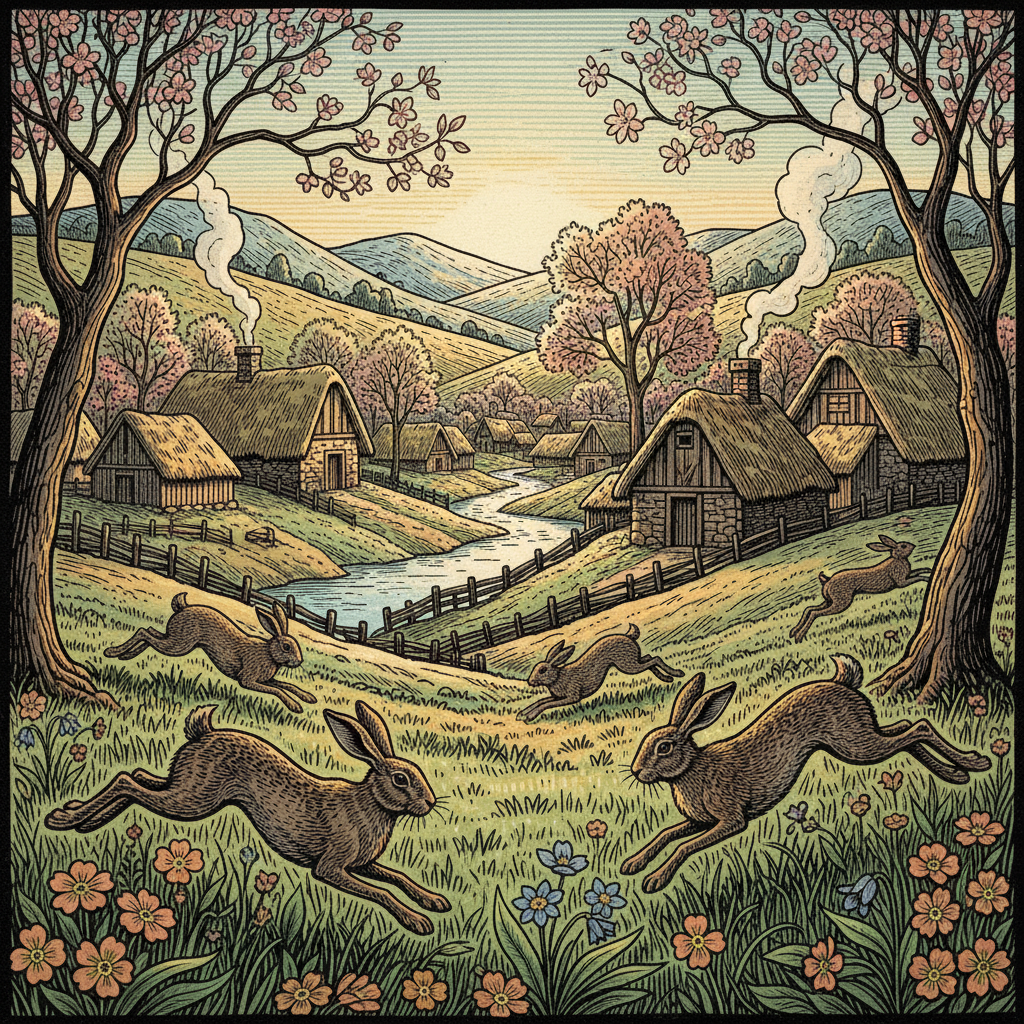
The association of Eostre with hares and eggs is widely repeated in modern popular sources, but it deserves careful handling. Bede does not mention hares. The earliest written association of hares with Eostre comes from Jacob Grimm in the 19th century, who connected the goddess to widespread European folk customs around the Easter Hare. Some of those customs are genuinely old, but their connection to Eostre specifically is reconstruction, not direct evidence.
The same is true of the egg. Eggs as symbols of spring renewal appear across many ancient cultures, from Persian Nowruz to Greek and Roman traditions. The Christian association of eggs with the resurrection has its own deep roots. Whether the Anglo-Saxons specifically associated eggs with Eostre is unknown.
What is true is that the season Eostre named was always associated with the renewal of life. The hare, born in early spring litters, the egg, opening into new life, the lengthening days, the warming earth, all of these belonged to her month whether or not they belonged formally to her cult. The folk imagination that gathered around her name was not random. It was rooted in what northern Europeans actually saw when their winters finally broke.
Eostre and the Christian Easter
The Christian feast of the resurrection has been celebrated since the earliest centuries of the church. In most European languages, the feast takes its name from Pascha, the Greek and Latin word derived from the Hebrew Pesach (Passover), reflecting the original calendrical and theological connection between the resurrection and the Jewish festival. So the Spanish call it Pascua, the French Paques, the Italian Pasqua, the Russian Paskha.
English and German are the two great exceptions. English calls the feast Easter. German calls it Ostern. Both names preserve the memory of the pagan Germanic goddess of spring whose festival fell at the same time of year. When the Anglo-Saxons converted to Christianity from the 7th century onward, they did not import the Latin name. They kept the old name for the season and applied it to the new feast. The continuity of name from pagan to Christian celebration is unusual and is precisely what made Bede comment on it in the first place.
This is not unique to Eostre. The Christian feast of Christmas absorbed elements of the Roman Saturnalia and the Germanic Yule. Saint Brigid in Ireland inherited features of the older Celtic goddess Brigid. Religious traditions are layered, and their boundaries are porous. Easter is, among other things, the name of an old goddess that survived the conversion of her worshippers.
Symbolism and Meaning
Eostre embodies the deep human response to seasonal renewal. In the Anglo-Saxon imagination, she was the dawn after a long darkness, the warmth after a long cold, the green after a long grey. Her name derives from the same root as “east” and “dawn”. She is the goddess of the direction the sun rises from and the time of year the sun begins to win.
The Indo-European family of dawn goddesses she belongs to is one of the most coherent reconstructed mythological families. The Greek Eos rides her chariot across the sky each morning, opening the gates for her brother Helios. The Vedic Ushas is praised in over twenty hymns of the Rigveda as the bringer of light, dispeller of darkness, daughter of the sky. Latin Aurora has the same role. That four widely separated cultures preserved a goddess of the same function with names from the same root suggests that the dawn was personified at the very root of the Indo-European linguistic family, perhaps four or five thousand years ago.
Eostre is the English member of that family. When her name passed into the English word for Easter, it carried with it, however quietly, the memory of every dawn goddess in the long Indo-European inheritance. Cross-cultural connections are also striking with seasonal renewal traditions outside the Indo-European world: Japanese spring festivals like Hanami, Mesoamerican rain rituals to Tlaloc, the Norse celebration of spring associated with the sun goddess Sol. The drive to mark the return of life after winter is a human universal.

Legacy and Modern Influence
Eostre’s most enduring legacy is the word Easter itself. Every English-speaking child who hunts for chocolate eggs is, etymologically, taking part in a festival named for an Anglo-Saxon goddess. Modern Wicca, Neopaganism, and contemporary nature-based spiritual movements have brought her back into active worship, sometimes under her continental name Ostara. The eight festivals of the modern pagan Wheel of the Year include Ostara, celebrated at the spring equinox, drawing on Grimm’s reconstruction and on a creative engagement with the goddess as the spirit of returning warmth.
She also appears in modern fiction, perhaps most prominently in Neil Gaiman’s American Gods, where Easter herself is a major character struggling to reconcile her Christian and pagan associations. The novel captures something true about her position: she is a goddess at the seam between traditions, a name that belongs to two religions at once.
For modern readers, Eostre is a useful figure to think with. She reminds us that the boundary between pagan and Christian is more porous than the polemics of either tradition like to admit. She reminds us that names carry memory across religious change. Most of all, she reminds us that the human response to spring is older than any one religion. Long before there was an Eostre, there was a goddess of the dawn somewhere on the steppes of Eurasia. Long after the formal worship of Eostre had ended, her name was still being spoken every spring, by people who did not even know they were doing it.
Mythology Delivered to Your Inbox
Join 25,000 readers exploring world myth, ancient legends, and the cosmic questions that have shaped human storytelling. New encyclopedia entries delivered every week.
SubscribeFrequently Asked Questions
Who is Eostre?
Eostre is an Anglo-Saxon goddess of spring and dawn, mentioned by the Venerable Bede in 725 CE as the deity for whom the month of Eostur-monath (roughly April) was named. The pagan English celebrated her festival in that month before their Christian conversion. Her name became the English word Easter.
Did Eostre really exist as a goddess?
The historical evidence for Eostre is limited to a single sentence in Bede’s De Temporum Ratione, but most scholars accept that this reflects a real Anglo-Saxon goddess. She belongs to the wider Indo-European family of dawn goddesses, including Greek Eos, Latin Aurora, and Vedic Ushas, all of whose names derive from a common root.
Did Easter come from Eostre?
The English word Easter and the German word Ostern both come from the Anglo-Saxon and continental Germanic names for the goddess and her month. Most other European languages call the Christian feast Pascha or a derivative, drawn from the Hebrew Pesach. English and German are the unusual languages that kept the old goddess’s name when their speakers converted to Christianity.
Are the Easter Bunny and eggs really from Eostre?
The direct connection between Eostre and the hare or egg is largely a 19th-century reconstruction by Jacob Grimm, drawing on European folk customs that may or may not preserve genuinely ancient associations. The hare and the egg are widespread spring symbols across many cultures, and their place in modern Easter combines pre-Christian, Christian, and folk traditions.
Is Ostara the same goddess as Eostre?
Ostara is the continental Germanic counterpart to the Anglo-Saxon Eostre, reconstructed from month names like Old High German ostarmanoth. Both names derive from the same Proto-Germanic root meaning “dawn” or “east”, and most scholars treat them as the same deity in different regional forms.
How does Eostre fit into the Indo-European dawn goddesses?
The Greek Eos, Latin Aurora, Vedic Ushas, Lithuanian Ausrine, and Anglo-Saxon Eostre all share a common Proto-Indo-European root meaning “dawn”. The fact that so many widely separated cultures preserved a goddess of the same function with names from the same root suggests that the dawn was personified at the very root of the Indo-European linguistic family.