Quick Summary
- Iris is the Greek goddess of the rainbow and the personal messenger of the Olympian gods, especially Hera.
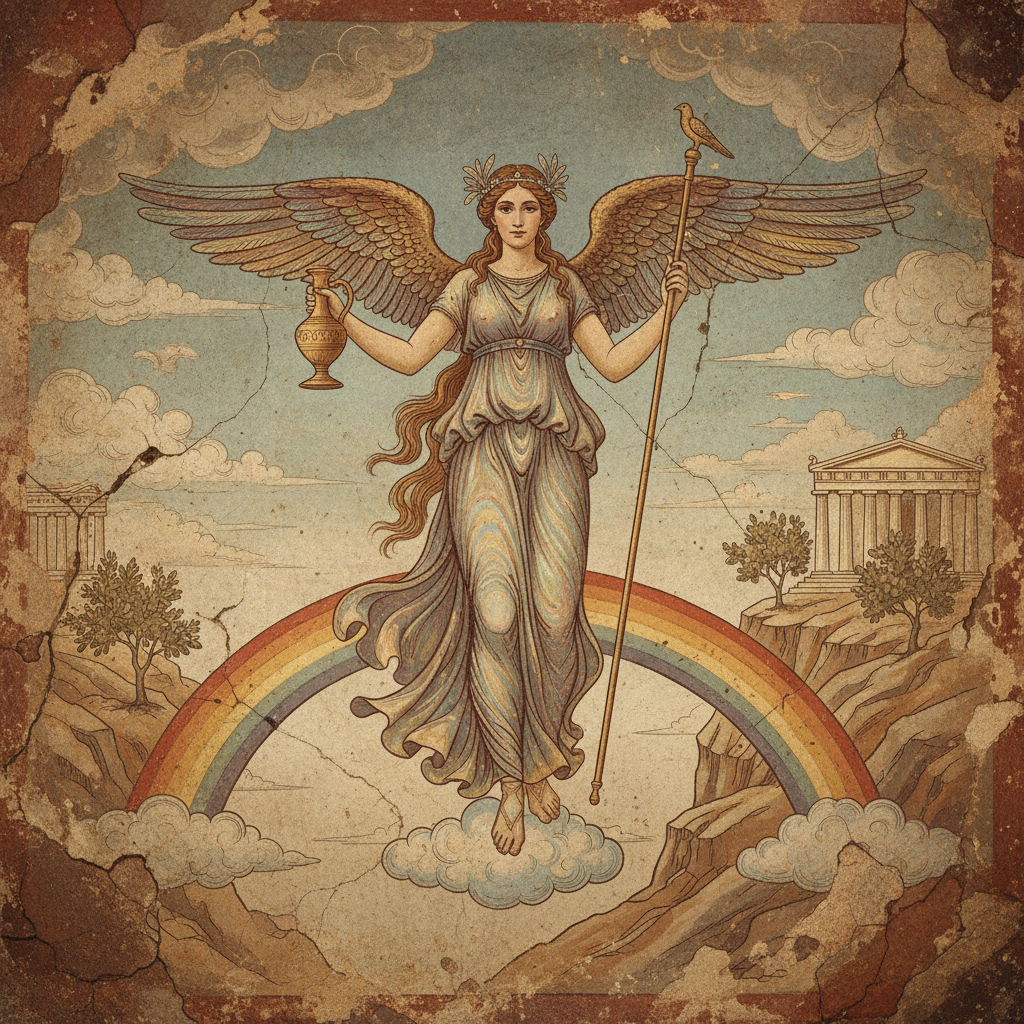
- She travels between heaven, earth, and the underworld on the arc of the rainbow, carrying messages and water in her golden ewer.
- Her name gives English the word iris for the coloured part of the eye and for the genus of flowers, both for their range of colours.
- She appears throughout Homer’s Iliad as the gods’ principal messenger, a role that later poets shared between her and Hermes.
- Her parallel in many cultures is the rainbow as a path or messenger, including the Norse Bifrost and the Aboriginal Rainbow Serpent.
The rain stops. The sun returns. The arc of the rainbow lifts itself out of the wet horizon and bends across the sky. To a Greek shepherd watching from a hillside, the rainbow was not light refracted through droplets. It was a path, and somewhere along that path moved a goddess on errands for the gods. Her name was Iris, and her name has become so common in English that we have nearly forgotten she is a god.
Iris is one of the gentlest and most useful figures in Greek mythology. She does not have great cycles of myth attached to her name. She does not seduce, scheme, or rage. She runs errands. She carries messages. She fetches water from the river Styx. She links the worlds. To call her a minor goddess is technically accurate but misses the point. Without messengers, the Olympian system does not work.
Origins and Cultural Roots
Iris (Ἶρις) is the daughter of the sea god Thaumas and the cloud nymph Electra in Hesiod’s Theogony. Her sisters are the Harpies, the wind-borne snatchers who carry off the dead and the cursed. The pairing seems strange at first: the gentle messenger of the gods and the savage Harpies share a mother and father. But the Greeks saw a connection. All four are creatures of air. All four cross between the divine and the mortal realms in different ways. Iris carries words. The Harpies carry souls.
Her name simply means “rainbow”, and the Greeks used the same word for both the goddess and the meteorological phenomenon. To say iris in classical Greek was to mean either the arc in the sky or the woman who walked it. The slippage is meaningful. Greek thought did not always draw a hard line between a natural phenomenon and the deity who embodied it.
In art she is shown as a young woman with golden wings, often holding the staff of a herald and a pitcher in her hand. Her robes are sometimes shown as dappled or shimmering, a visual echo of the rainbow. She is one of the few Greek goddesses consistently depicted with wings, a sign of her function rather than her status.

The Messenger of the Gods
In Homer’s Iliad, Iris is the principal messenger of the gods. When Zeus needs to summon a god, dispatch a warning to a mortal, or carry a command across the battlefield at Troy, he sends Iris. She moves between Olympus and the world of men with extraordinary speed. She does not negotiate. She delivers, accurately and without delay, exactly what she is told to say.
One of her most striking appearances is in Iliad Book 2, where Zeus sends her to deceive King Agamemnon with a false dream. Another comes in Book 24, when she descends to the home of Achilles and persuades him to release the body of Hector to the grieving King Priam. The scene is one of the great moments of human dignity in the poem, and Iris is the one who facilitates it. The gods speak. She carries the words.
By the time of Hesiod and the later poets, Iris’s role becomes more closely associated with Hera, queen of the gods. She is Hera’s personal messenger, sometimes treated almost as a handmaid. The shift from Zeus’s messenger to Hera’s messenger reflects something about how the role of the messenger evolved in Greek myth as Hermes took over more and more of the courier duties from Olympus.
The Water of the Styx
Iris had one duty no other god would perform. When the gods swore an oath, the most binding form of the oath was sworn on the river Styx, the great river of the underworld whose waters could compel even immortals to keep their word. To swear by the Styx, a god needed water from the Styx. Iris was the one who fetched it.
She would descend to the underworld carrying a golden ewer, fill it from the dark river, and bring it back up to Olympus. The image of Iris moving between the world of the dead and the world of the living, carrying a vessel of water, is one of the most evocative in Greek myth. She links not only heaven and earth but also the world of the living and the world of the dead. The rainbow, in her, becomes a road that touches all three.

Iris and Hermes
The relationship between Iris and Hermes, the more famous Greek messenger god, deserves attention. In the earliest layer of Greek myth, especially in Homer, Iris is the principal messenger. As Hermes’s reputation grew, partly through his expanded role in the Hellenistic period as a god of merchants, travellers, and scholars, he took over many of the courier duties.
The two are not exact equivalents. Iris travels by rainbow. Hermes travels by his winged sandals and his speed. Iris carries simple messages. Hermes carries souls to the underworld and engages in elaborate trickery. Iris is feminine, gentle, faithful. Hermes is shifty, eloquent, sometimes a thief. The Greeks found use for both. The world of divine errands needed more than one runner.
Symbolism and Meaning
Iris embodies the idea that connection between worlds requires a being to carry the connection. The Olympian gods are powerful, but they cannot speak directly to mortals from their distant home without a medium. The rainbow, with its bridge-like form, is the natural symbol of that medium. To make the rainbow a goddess is to make connection itself divine.
Her quiet faithfulness is also worth noticing. In a pantheon famous for its melodrama, Iris does not betray, scheme, or take sides. She does what she is asked. The Greeks valued this quality in mortals too: aidos, a kind of decent loyalty, was a virtue celebrated in Homer. Iris models it on the divine plane.
Cross-cultural connections are striking. The Norse Bifrost is a rainbow bridge connecting realms, walked by gods rather than by a single goddess but expressing the same intuition: the rainbow is a road. Aboriginal Australian traditions personify the rainbow as a great serpent who shaped the rivers and the land. Japanese mythology has the Floating Bridge of Heaven. Wherever a culture has lived under a rainbow-producing sky, the rainbow has invited stories of beings who walk it.

Legacy and Modern Influence
Iris’s name has travelled further than perhaps any other Greek goddess’s. The flower called the iris, with its many vivid colours, takes its name from her, an etymology preserved by Theophrastus in the 4th century BCE. The coloured ring of the human eye is also called the iris, named for the same reason. The phenomenon of iridescence, the play of colour across an oily film or a bird’s feather, comes from her name. So does iridium, the chemical element discovered in 1803, named for the rainbow appearance of its salts.
In modern fiction, Iris has had a quieter career than some of her Olympian colleagues. She appears in Rick Riordan’s series, in modern poetry from H.D. and others, and as an occasional figure in opera and ballet. The role she plays in those modern works is often the same one she played in Homer: the gentle messenger, the one whose path is the rainbow, the goddess of connection rather than conflict.
Her quietness is, in a strange way, her durability. Loud gods get overthrown. Loud myths get parodied. Iris just keeps walking the rainbow, as she has for three thousand years.
Mythology Delivered to Your Inbox
Join 25,000 readers exploring world myth, ancient legends, and the cosmic questions that have shaped human storytelling. New encyclopedia entries delivered every week.
SubscribeFrequently Asked Questions
Who is Iris in Greek mythology?
Iris is the Greek goddess of the rainbow and the personal messenger of the Olympian gods, especially Hera. She travels between heaven, earth, and the underworld on the arc of the rainbow, carrying divine messages and the water of the Styx for binding oaths.
What does the name Iris mean?
The name simply means “rainbow” in classical Greek. The same word served for both the goddess and the meteorological phenomenon. The flower iris, the iris of the eye, the chemical element iridium, and the word iridescence all derive from her name.
What does Iris do in the Iliad?
Iris is the principal messenger of the gods in Homer’s Iliad. She carries Zeus’s commands across the battlefield at Troy, persuades Achilles to release the body of Hector to King Priam, and delivers a false dream to Agamemnon. Her role is to communicate, never to act on her own.
How is Iris related to the Harpies?
According to Hesiod’s Theogony, Iris and the Harpies share parents: the sea god Thaumas and the cloud nymph Electra. The Greeks saw a connection between the gentle rainbow messenger and the savage wind-borne Harpies because both are creatures of the air who travel between divine and mortal realms.
Why does Iris fetch water from the Styx?
The most binding oath a god could swear was sworn on the river Styx, the great river of the underworld. To swear that oath, a god needed water from the Styx. Iris was the only god willing or able to descend to the underworld to fetch it, carrying it back to Olympus in a golden ewer.
How does Iris compare to rainbow figures in other cultures?
The Norse Bifrost is a rainbow bridge walked by the gods. The Aboriginal Australian traditions feature a great Rainbow Serpent. The Japanese have the Floating Bridge of Heaven. Wherever a culture has lived under a rainbow-producing sky, the rainbow has invited stories of beings or paths that connect realms.