Quick Summary
- Stingy Jack is the central figure of an Irish folk tale who tricks the Devil twice and is condemned to wander the world after death with only a hollowed-out turnip and a coal of hellfire.
- His story is the origin of the Jack-o-Lantern tradition, originally carved from turnips or rutabagas in Ireland and Scotland.
- When Irish immigrants brought the tradition to America in the 19th century, they discovered that pumpkins were easier to carve, and the modern Halloween pumpkin was born.
- The tale survives in many regional Irish, Scottish, and Welsh variants, all sharing the core motif of the wily man who outwits the Devil but cannot escape his own afterlife.
- Stingy Jack belongs to a wider folk tradition of “ghost lights” and will-o-the-wisps, mysterious lanterns seen in the bogs and moors of northern Europe.
A man crosses a bog at night. The fog is heavy. The path is uncertain. Ahead, a small light bobs and flickers, just at the edge of vision. He calls out. There is no answer. He follows the light, hoping for shelter. The light leads him deeper into the marsh, away from the path, until he is lost. The light belongs to a man without a soul, condemned to walk the wild places of the earth with only a coal of hellfire to see by.
His name is Jack. Stingy Jack. The Irish have told stories about him for centuries. He cheated the Devil twice and paid the price. He cannot enter heaven, because he was a wicked man. He cannot enter hell, because the Devil swore not to take him. He wanders. The lantern he carries was carved from a turnip. The light inside it is a coal pulled from hell. Across the world, in countries Jack never visited, his lantern still burns at the end of October every year.

Origins and Cultural Roots
The legend of Stingy Jack is part of the long oral tradition of Irish folk tales, the body of stories that survived from pre-Christian Celtic religion through the centuries of Catholic Ireland, often picking up new theological furniture along the way. The Jack story is post-Christian in its setting, with God and the Devil as named characters, but the underlying pattern of the trickster who outwits supernatural opponents goes back much further. It connects to Celtic stories of heroes who deal with otherworldly beings on their own terms, and to the universal folk type of the wily peasant who beats the powerful at their own game.
The earliest written versions of recognisable Stingy Jack tales appear in the 19th century, but folklorists generally agree that the oral tradition is much older. Versions of the tale exist in Scottish Highland, Welsh, and Manx traditions as well as Irish, with variations in the details but the same general arc.
Jack himself is variously called Stingy Jack, Drunk Jack, Jack of the Lantern, Jack-o-Lantern, or simply Jack. He is depicted as a clever, drunken, miserly Irishman who lives by his wits and his cleverness, never quite working an honest day. He is exactly the kind of person Irish folk tradition delights in: not virtuous, not sympathetic in any obvious way, but undeniably cunning.

The Twice-Tricked Devil
In the most common version of the tale, Jack is drinking in a tavern when the Devil appears, having come to claim his soul. Jack persuades the Devil to allow him one last drink and asks the Devil to pay for it. The Devil agrees and transforms himself into a coin to settle the bill. Jack pockets the coin and places it in his purse next to a silver cross. The Devil, trapped by the proximity to the holy symbol, cannot return to his original form. Jack agrees to release the Devil only if the Devil promises not to claim Jack’s soul for ten years.
Ten years later, the Devil returns. This time, Jack is walking down a country road. The Devil announces that the time is up. Jack asks if the Devil would mind first climbing a nearby apple tree to fetch him an apple, since this is to be his last meal. The Devil obliges. The moment the Devil is up the tree, Jack carves a cross into the bark, trapping the Devil among the branches. The Devil rages. Jack sets his terms: he will release the Devil only if the Devil swears never to claim his soul. The Devil swears.
Years pass. Jack dies. He arrives at the gates of heaven. Saint Peter takes one look at the record of his life and sends him away. Jack descends to the gates of hell. The Devil, holding to his oath, refuses to take him. Jack is left in the dark on the boundary between the two worlds. He asks the Devil how he is supposed to find his way. The Devil, in mockery, throws him a single coal of hellfire. Jack puts it inside a hollowed-out turnip he has been eating, and uses the lantern to light his way as he walks the earth, condemned to wander forever.
From Turnip to Pumpkin
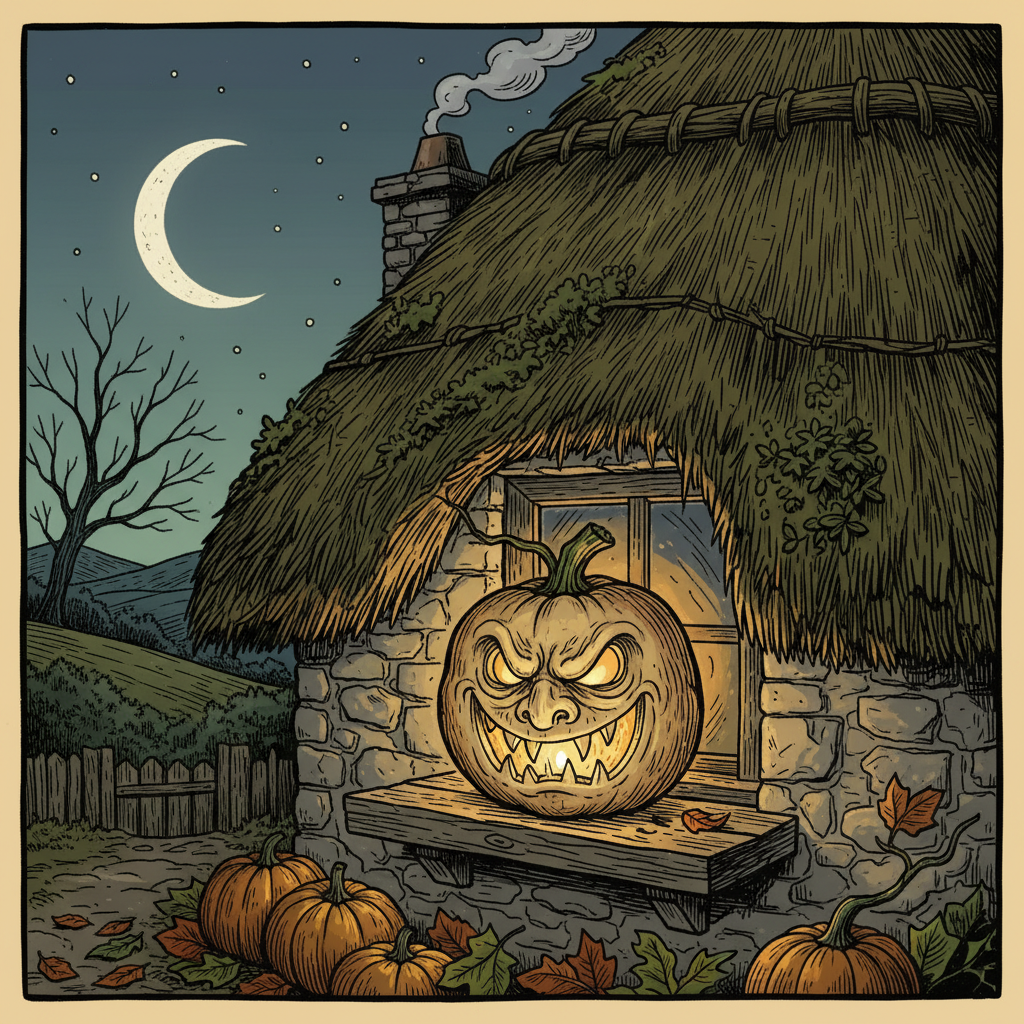
The original Jack-o-Lantern was a turnip. In Ireland and Scotland, where turnips, swedes, and rutabagas were common autumn crops, people carved frightening faces into them, set candles inside, and placed them in windows on the night of Samhain (1 November). The carved faces were said to represent souls of the dead, or to ward off evil spirits, or to memorialise the wandering Jack. The same tradition existed in parts of Wales, Brittany, and Manx culture.
When Irish and Scottish immigrants began arriving in North America in significant numbers, especially after the Great Famine of 1845-1852, they brought the tradition with them. They discovered that the native pumpkin, larger and softer than a turnip, was much easier to carve. The pumpkin Jack-o-Lantern is a transatlantic invention: an Irish folk practice meeting an American crop. By the late 19th century, the carved pumpkin was an established part of American Halloween, and from there it spread back to Europe and around the world.
The Museum of Country Life in Castlebar, County Mayo, holds one of the oldest known surviving Irish carved turnip Jack-o-Lanterns, dating from the early 20th century. The face is grotesque and fierce. To stand before it now, hardened and dark with age, is to see directly what generations of Irish children saw in their own kitchens: a lantern made from a vegetable, lit against the dark of late October.
Ghost Lights and Will-o-the-Wisps
Stingy Jack belongs to a wider tradition of mysterious lights seen in wild places at night. Across Britain, Ireland, and continental Europe, the will-o-the-wisp, the friar’s lantern, the corpse candle, the spunkie, and many regional variants are all stories of small lights that appear in marshes and bogs, often leading travellers astray. The natural phenomenon behind some of these stories is probably bioluminescent fungi or methane combustion in marsh gas, but the folkloric explanations vary.
In some traditions, the lights are the souls of the unbaptised dead. In others, they are fairies leading mortals into the otherworld. In the Stingy Jack tradition, the light is Jack himself, walking with his lantern, sometimes as a benign figure, sometimes as a malicious one who deliberately leads travellers off the path. The image of the bog-light, flickering in the distance over water, is one of the great atmospheric staples of folk horror.
Symbolism and Meaning
Stingy Jack embodies a particular Irish folk attitude toward virtue and damnation. He is not a saint. He cheats. He drinks. He is hard with his money. He outwits the Devil not because he is good but because he is clever. Yet his fate is grim. The story does not reward his cunning with salvation. It punishes him with the loneliest possible afterlife: walking the earth forever, with only a coal of hellfire and a vegetable lantern.
This grimness is part of the appeal. Irish folk tradition is unsentimental about its tricksters. It enjoys their wit. It does not pretend that wit alone is enough to save them. Jack is fun to listen to. He is also, in the end, a warning. The same tradition that celebrates his cleverness places his lantern at the edge of the marsh, where it can lure others to the same fate.
The connection to Samhain, the Celtic festival from which Halloween descends, is also significant. Samhain marked the night when the boundary between the world of the living and the world of the dead grew thin. Spirits walked. The dead returned. A figure like Jack, neither alive nor dead, fits naturally into that night. He is exactly the kind of being you would not want to meet at a crossroads in late October. The lantern in your window is a way of warding him off, or of joining him.

Legacy and Modern Influence
Stingy Jack’s lantern is now one of the most recognisable cultural symbols in the world. The carved pumpkin appears every October in shop windows from Tokyo to Buenos Aires. The phrase “Jack-o-Lantern” is in dictionaries in dozens of languages. Children who could not place Ireland on a map carve faces into pumpkins and never know whose lantern they are lighting.
The Stingy Jack story itself has been retold in modern children’s books, animated specials, horror films, and graphic novels. Tim Burton’s The Nightmare Before Christmas and the cult anthology film Trick ‘r Treat are loose modern adaptations of the wandering Jack figure. The character of Jack appears in countless paranormal investigation shows and Halloween specials.
For modern readers, Stingy Jack offers something useful: a reminder that Halloween’s most familiar object has a story behind it. The pumpkin on the porch is a hollowed-out turnip. The candle inside is a coal from hell. The grinning face is a man who tricked the Devil and lost anyway. Every October, a small Irish folk tale lights up the world.
More From European Folklore
Continue exploring the legends, fairy tales, and folk traditions of Europe. New encyclopedia entries published every week.
Explore MoreFrequently Asked Questions
Who is Stingy Jack?
Stingy Jack is the central figure of an Irish folk tale, a wily, drunken, miserly man who tricks the Devil twice and is condemned to wander the earth after death with only a coal of hellfire and a hollowed-out turnip for a lantern. His story is the origin of the Jack-o-Lantern tradition.
How did Jack trick the Devil?
In the most common version, Jack first persuaded the Devil to turn himself into a coin to pay for a drink, then trapped the coin in his pocket beside a silver cross. He later persuaded the Devil to climb an apple tree to pick a fruit, then carved a cross into the trunk to trap him. In each case he extracted a promise from the Devil before letting him go.
Why is Jack carrying a lantern?
When Jack died, neither heaven nor hell would take him. Heaven rejected him because he had been wicked. The Devil, bound by his oath not to claim Jack’s soul, also refused him. Left in the dark, Jack received a single coal of hellfire from the mocking Devil and placed it inside a hollowed-out turnip to light his way as he wandered the earth forever.
Why is the modern Jack-o-Lantern a pumpkin?
The original Irish and Scottish Jack-o-Lanterns were carved from turnips, swedes, or rutabagas. When Irish and Scottish immigrants brought the tradition to North America in the 19th century, especially after the Great Famine, they discovered that pumpkins were larger and easier to carve. The pumpkin Jack-o-Lantern is a transatlantic adaptation of the older European tradition.
Is Stingy Jack the same as a will-o-the-wisp?
The two traditions overlap. Both involve mysterious lights seen at night in wild places, often associated with restless spirits and the unbaptised dead. Stingy Jack is one specific Irish version of the wider European tradition of bog-lights and corpse candles. In some tellings, every distant marsh light is a sighting of Jack himself.
How is Jack connected to Halloween?
The Stingy Jack story is set in the context of Samhain, the Celtic festival from which Halloween descends. On Samhain, the boundary between the living and the dead was thought to be thin, and a figure like Jack, neither in heaven nor in hell, fits naturally into that night. The Jack-o-Lantern carved from a turnip or pumpkin is the traditional way of marking the night.