Quick Summary
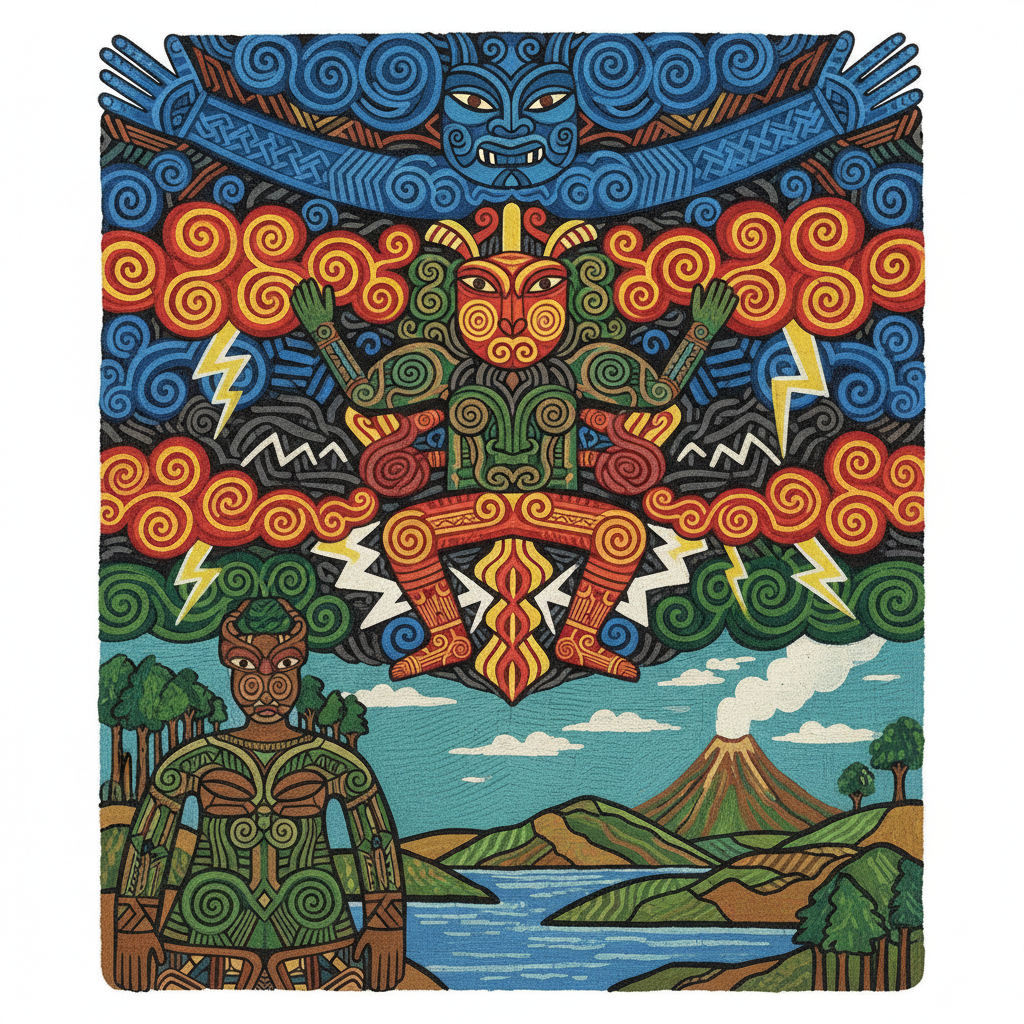
- Tawhirimatea is the Maori atua (god) of weather, storms, lightning, thunder, and the wild winds, son of Ranginui the sky father and Papatuanuku the earth mother.
- When his brothers separated their parents to bring light into the world, Tawhirimatea opposed the act and waged war on them, becoming the storm that has raged ever since.
- His four winds, sometimes called his children, blow from the four directions and bring weather to the islands of Aotearoa (New Zealand).
- Tawhirimatea is honoured in karakia (chants) and acknowledged in Maori navigation, agriculture, and seasonal observances.
- His story belongs to a wider Polynesian tradition of storm and wind atua, paralleled by Hawaiian, Samoan, and Tongan traditions.
Before there was a world, there was an embrace. Ranginui the sky father held Papatuanuku the earth mother in such close darkness that nothing could grow between them. Their children, the great atua, lived in that darkness, pressed flat against their parents’ bodies, longing for light. One by one the children debated what to do. Most wanted to push the parents apart. One refused.
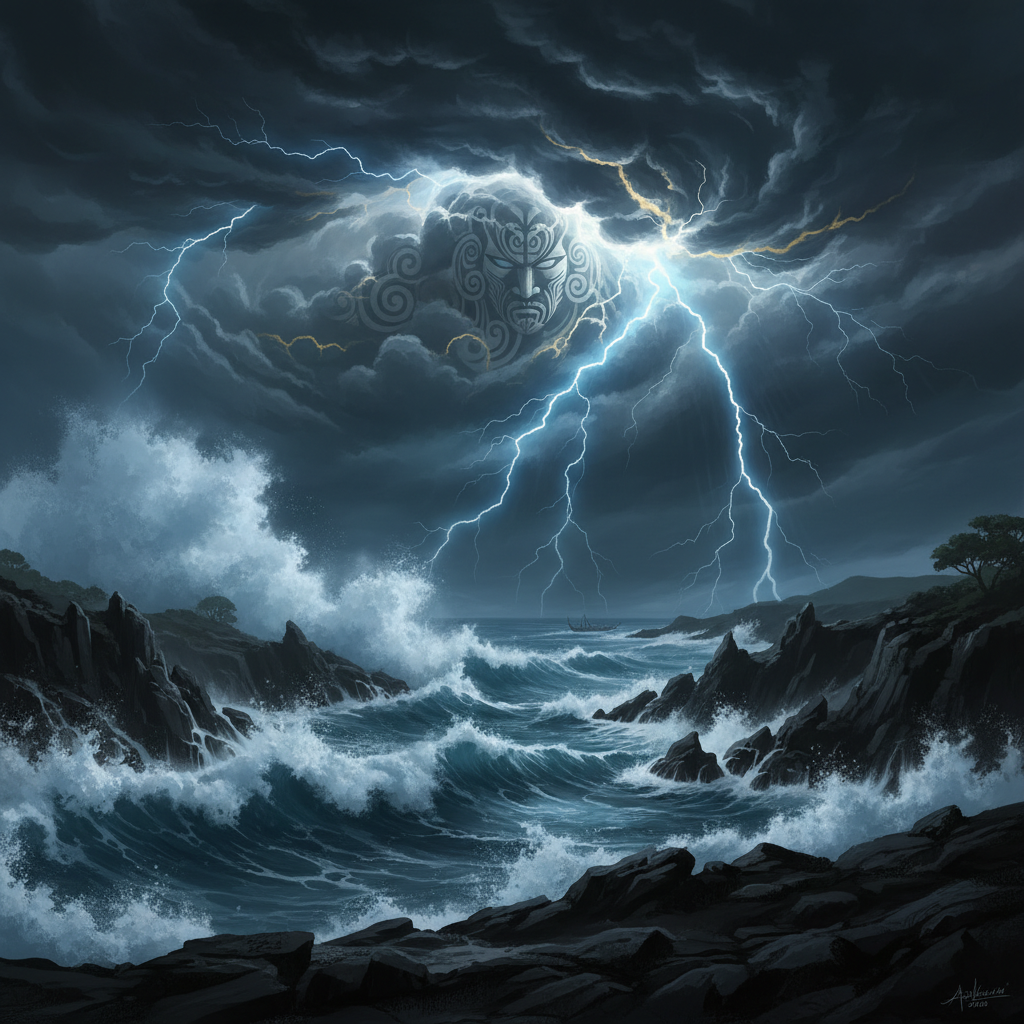
That refusal belongs to Tawhirimatea, the god of winds. When his brothers managed to separate Ranginui and Papatuanuku, when light flooded the world for the first time, Tawhirimatea was furious. He climbed into the sky with his father and from there waged war on his siblings. The storm has not stopped since. Every gust of wind, every flash of lightning, every crashing wave on the coast of Aotearoa carries his anger.
Origins and Cultural Roots
Tawhirimatea (sometimes Tawhiri, Tawhirimaatea) belongs to the cosmology of the Maori people of Aotearoa, the Polynesian voyagers who arrived in New Zealand around the 13th century CE bringing with them a rich oral tradition rooted in the wider Polynesian world. The Maori atua share names and roles with deities across Polynesia: Tawhiri’s distant cousins include the Hawaiian La’amaomao and the Samoan Tagaloa winds.
The principal sources for Maori myth are the karakia (ritual chants), waiata (songs), and whakapapa (genealogies) preserved by tohunga (experts) and recorded in writing from the 19th century onward. Important early ethnographers including Sir George Grey and Te Rangikaheke recorded versions of the creation cycle that includes Tawhirimatea’s war on his brothers. Other lineages preserved different details. The story is not a single fixed text. It is a living tradition with regional variation.
His name combines tawhiri (to summon, or wind) with matea (a name element of varied meaning). The name marks him as the summoner of weather, the calling of the wind. Some tribal traditions use slightly different forms. All recognise him as the great atua of storms.

The Separation of the Parents
Tawhirimatea is one of the principal sons of Ranginui and Papatuanuku. His brothers include Tane Mahuta, the god of forests; Tangaroa, the god of the sea; Rongo, the god of cultivated food; Haumia-tiketike, the god of wild food; Tu-matauenga, the god of war; and several others depending on the tradition. The children grow restless in the darkness between their parents and debate what to do.
Tu-matauenga argues for killing the parents. Tane proposes a gentler solution: pushing them apart to make space between earth and sky. The brothers agree to Tane’s plan, except for Tawhirimatea. He alone refuses to harm his parents. He alone wishes to keep them in their embrace.
The other brothers try in turn to push their parents apart and fail. Finally Tane Mahuta, lying on his back, sets his shoulders against his mother and his feet against his father, and slowly forces them apart. Light enters the world for the first time. The brothers see each other clearly for the first time. The sky grieves. The earth grieves. Tawhirimatea, watching, is consumed with rage.
The War of the Winds
Tawhirimatea ascends into the sky with his father Ranginui. There, in the high air, he gathers his strength and begets his children. These children are the winds: the four directional winds, the squalls, the hurricanes, the rain, the mist, the cloud, the lightning, and the thunder. With his children at his back, Tawhirimatea sweeps down on his brothers.
He attacks Tane Mahuta first, because Tane is the brother who pushed the parents apart. The winds break the great trees of Tane’s forests, and to this day the tallest tree falling in a storm is sometimes said to be Tane being beaten by his angry brother. He attacks Tangaroa, god of the sea, and the waves rise into mountains under his fury. Tangaroa flees deep into the ocean, but his children, the fishes, scatter. Some flee into the rivers, becoming the freshwater fish. Others remain at sea. The split between Tangaroa and Tane is laid down here: the trees of the forest and the fish of the sea become enemies, because Tangaroa cannot forgive his brother for sheltering his runaway children.
Tawhirimatea attacks Rongo and Haumia-tiketike, gods of cultivated and wild foods. Their mother Papatuanuku hides them in her body. To this day, kumara and fern root grow underground, sheltered by the earth from the storms above. Finally Tawhirimatea attacks Tu-matauenga, the god of war and ancestor of humanity. Tu fights back. He alone of the brothers stands his ground. Tawhirimatea cannot defeat him, and the war between the storm and humanity continues, with no clear victor, to this day.
Tawhirimatea and Ranginui
Tawhirimatea is the only son who chose to remain with his father in the sky. Ranginui’s grief at being separated from Papatuanuku is felt as the rain. Tawhirimatea’s anger is felt as the storm. Together, sky father and storm son, they hold the upper world. The rain that falls is sometimes called the tears of Ranginui, mourning his lost embrace. The wind that drives the rain is Tawhirimatea, refusing to forget what was lost.
This image of weather as grief is one of the most striking in Polynesian cosmology. Storms are not random violence. They are an ongoing family quarrel, a refusal to accept the separation that was the price of light. The Maori world is a world that came into being through a wound, and the wound is still open. To live under the New Zealand sky is to live under the weather of unfinished grief.
Symbolism and Meaning
Tawhirimatea embodies a worldview different from many of the great wind gods of other traditions. Where the Greek Anemoi sort the winds into rational compass directions, where the Japanese Fujin carries his bag with controlled menace, Tawhirimatea is grief turned outward. He is the one who said no when the others said yes. His winds are not seasonal cycles. They are the storm of a refused separation.
The story also organises the natural world. The split between the trees and the fishes, the hiding of food crops underground, the standing of humanity against the sky, all of this is mapped onto the war of Tawhirimatea. To know the cosmology is to understand why the world looks the way it does. This is not just a creation myth. It is an explanation of ecology, of weather, of the wounds and accommodations that hold the natural order in place.
Tawhirimatea’s place among Polynesian wind atua is also worth noting. The Hawaiian tradition of La’amaomao, the goddess who keeps the winds in a calabash, parallels the wind-bag motif of Greek and Japanese myth. The Samoan and Tongan traditions personify the winds in their own ways. Across the islands of the Pacific, the wind has many faces. Tawhirimatea is the grieving brother. He is the one whose storm is also a memory.

Legacy and Modern Influence
Tawhirimatea remains a living figure in Maori culture. His name is invoked in karakia for safe travel, in fishing rituals, in the opening of meetings on marae. He appears in modern Maori art, sculpture, and literature, where his image is often abstract: spirals of wind, lightning rendered as moko (traditional tattoo) lines, the colours of storm. The flags of some Maori iwi (tribes) include references to him.
In the wider New Zealand culture, his name appears in weather forecasting traditions, in school curricula, in the names of buildings and ships. The 2010 Maori-language film Whetu Marama: Bright Star draws on the cycle in which he appears. The Hayao Miyazaki-adjacent traditions of Pacific wind imagery owe something, however indirectly, to the same cosmology of the storm as a being with feelings.
For modern readers approaching Maori myth respectfully, Tawhirimatea offers a reminder that mythology is not a relic. The atua are honoured today by Maori communities who carry the tradition. The story is theirs. Outside readers come to it as guests, with curiosity and care. The storm rolling in from the Tasman Sea this winter is, in this telling, an old anger that has not yet been laid down. The wind is still arguing with its brothers.
Mythology Delivered to Your Inbox
Join 25,000 readers exploring world myth, ancient legends, and the cosmic questions that have shaped human storytelling. New encyclopedia entries delivered every week.
SubscribeFrequently Asked Questions
Who is Tawhirimatea in Maori mythology?
Tawhirimatea is the Maori atua (god) of weather, storms, winds, lightning, and thunder. He is a son of Ranginui the sky father and Papatuanuku the earth mother. He alone refused to separate his parents, and in fury at his brothers’ decision he made war on them, a war that continues as every storm.
Why is Tawhirimatea angry?
Tawhirimatea was the only son who refused to separate his parents Ranginui and Papatuanuku. When his brothers, led by Tane Mahuta, forced the sky and earth apart to bring light into the world, Tawhirimatea took his father’s side and waged war on his siblings. His anger is the storm.
Who are Tawhirimatea’s brothers?
His brothers include Tane Mahuta the forest god, Tangaroa the sea god, Rongo the god of cultivated food, Haumia-tiketike the god of wild food, and Tu-matauenga the god of war and ancestor of humanity. Different tribal traditions list other brothers as well.
Why did the fishes flee from the trees?
When Tawhirimatea attacked Tangaroa the sea god, the children of Tangaroa scattered. Some, the freshwater fish, fled inland and were sheltered by Tane Mahuta in his rivers. Tangaroa was angry that his brother sheltered his runaway children, and to this day the trees of the forest and the fish of the sea remain at odds.
Who are Tawhirimatea’s children?
Tawhirimatea begot the four directional winds, the squalls, the hurricanes, the rain, the mist, the cloud, the lightning, and the thunder. These are sometimes called his children, sometimes his weapons. With them he wages war on his brothers across the surface of the world.
Is Tawhirimatea worshipped today?
Tawhirimatea is honoured in Maori karakia, in fishing and travel rituals, and in the cultural practices of marae life. He is not a relic but a living figure within Maori spiritual practice. The cosmology in which he appears continues to shape how the natural world is understood and addressed.