Quick Summary
- Vayu is the Hindu god of wind, air, and breath, one of the eight Lokpalas (guardians of the directions) and a Vedic deity of great antiquity.
- His name in Sanskrit means simply “wind” or “air”, and he is associated with prana, the life-force that moves through every breathing being.
- He is the father of two of the most beloved heroes in Hindu epic: Hanuman, the monkey god of the Ramayana, and Bhima, the strongest of the Pandava brothers in the Mahabharata.
- Vayu has clear linguistic and functional cognates across the Indo-European world, including the Iranian Vayu, the Slavic wind spirits, and the Greek Anemoi.
- He rides a deer or antelope, carries a banner, and is sometimes shown with a thousand eyes, a sign of his presence in every breath of every living thing.
To breathe is to live. To stop breathing is to die. The breath that moves through your lungs as you read this is, in the Hindu understanding, a small piece of a much larger movement. The same wind that drives the monsoon clouds across the subcontinent each summer is the same substance, in different scale, as the breath of every cow, every child, every saint. It has a god. The god is Vayu, the lord of the air.
Vayu is one of the most ancient deities of Hindu religion. He is named in the Rigveda, the oldest Sanskrit scripture, with hymns dedicated to him alongside the great Vedic gods Indra, Agni, and Varuna. He has had an unbroken cult for over three thousand years. He is the father of two of the most loved heroes in all of Indian literature. He is the breath that makes life possible.

Origins and Cultural Roots
Vayu (वायु in Devanagari) is attested from the earliest layer of Hindu scripture. The Rigveda, composed in Sanskrit between roughly 1500 and 1000 BCE, contains numerous hymns invoking him alongside Indra, the king of the gods, with whom he often shares chariots and offerings. He is one of the eight Lokpalas, the guardian deities of the eight directions of the cosmos, presiding over the northwest in classical Hindu cosmology.
His name is the Sanskrit word for wind or air, identical to the natural phenomenon. Like the Greek anemoi, like the Slavic stri-, the Sanskrit vayu is both god and substance. His cognates across the Indo-European world include the Iranian Vayu (also a wind god, though in Zoroastrian theology he becomes a more morally ambiguous figure), the Lithuanian Vejas, and proto-Slavic root words for breath and air. The shared family of wind deities reaches back to the Proto-Indo-European linguistic and religious community of perhaps four thousand years ago.
In iconography, Vayu is shown as a vigorous male figure, often with antelope or deer as his vehicle (vahana), carrying a banner or flag. In some images he has a thousand eyes, a reference to the omnipresence of breath in every living being. He is youthful, strong, and visibly in motion.
Vayu and Prana
The connection between Vayu and prana (life-force, breath) is one of the most theologically important in Hindu thought. Prana is not just oxygen. It is the vital energy that animates living beings. Yogic and Ayurvedic traditions developed elaborate practices of pranayama, breath control, designed to direct and refine the flow of prana through the body. Each of these practices is, in some sense, a transaction with Vayu.
The Upanishads, the philosophical texts that follow the Vedas, develop the idea that prana is the unifying principle of life, comparable to atman (the self) and brahman (ultimate reality) in their respective philosophical contexts. Vayu, as the macrocosmic form of prana, becomes the cosmic principle of life. The wind in the world and the breath in the body are the same divine substance.
This identification is unusual among the world’s wind gods. The Greek Anemoi control weather. The Japanese Fujin carries a bag of winds. The Aztec Ehecatl shares the breath-of-life motif with Vayu, but Hindu theology takes the connection further than most, embedding it in the formal philosophy of yoga and Vedanta.
Father of Hanuman and Bhima
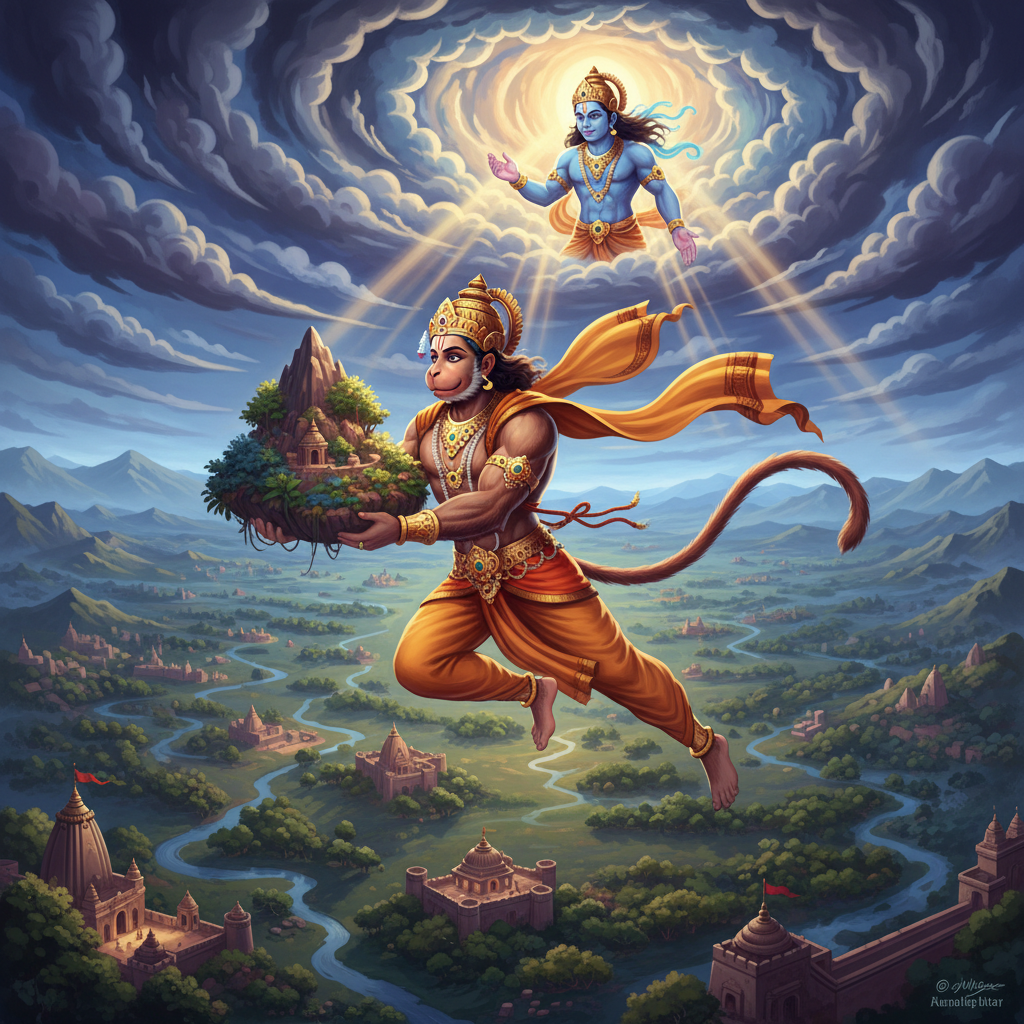
Vayu’s most famous role in Hindu mythology is as the father of Hanuman, the monkey god of the Ramayana. Hanuman is one of the most beloved figures in all of Hindu religion: the loyal devotee of Rama, the leaper across the sea between India and Lanka, the bringer of healing herbs from the Himalayas, the protector of all who pray to him. His strength, his speed, and his ability to fly are all gifts from his father Vayu.
Vayu is also the father of Bhima, the second of the five Pandava brothers in the Mahabharata. Bhima is the strongest of the brothers, a giant of a man who eats more than the other four combined and who slays the demon Hidimba and the unjust king Duryodhana. Like Hanuman, Bhima inherits his father’s power, his physical force, and his close connection to the breath of life.
The pattern of the wind god fathering powerful heroic sons is significant. Vayu’s children are not subtle. They are massive, strong, fast, mobile. The wind, in the Hindu imagination, is fertile of heroes. Each gust carries the potential of a Hanuman or a Bhima.

Symbolism and Meaning
Vayu embodies the Hindu intuition that the smallest and the largest movements are the same thing. The breath in your chest is the same substance as the wind that moves the clouds. The wind that moves the clouds is the same substance as the breath of the cosmos. To meditate on the breath is to commune with the god of the wind. To honour the wind is to recognise the source of one’s own life.
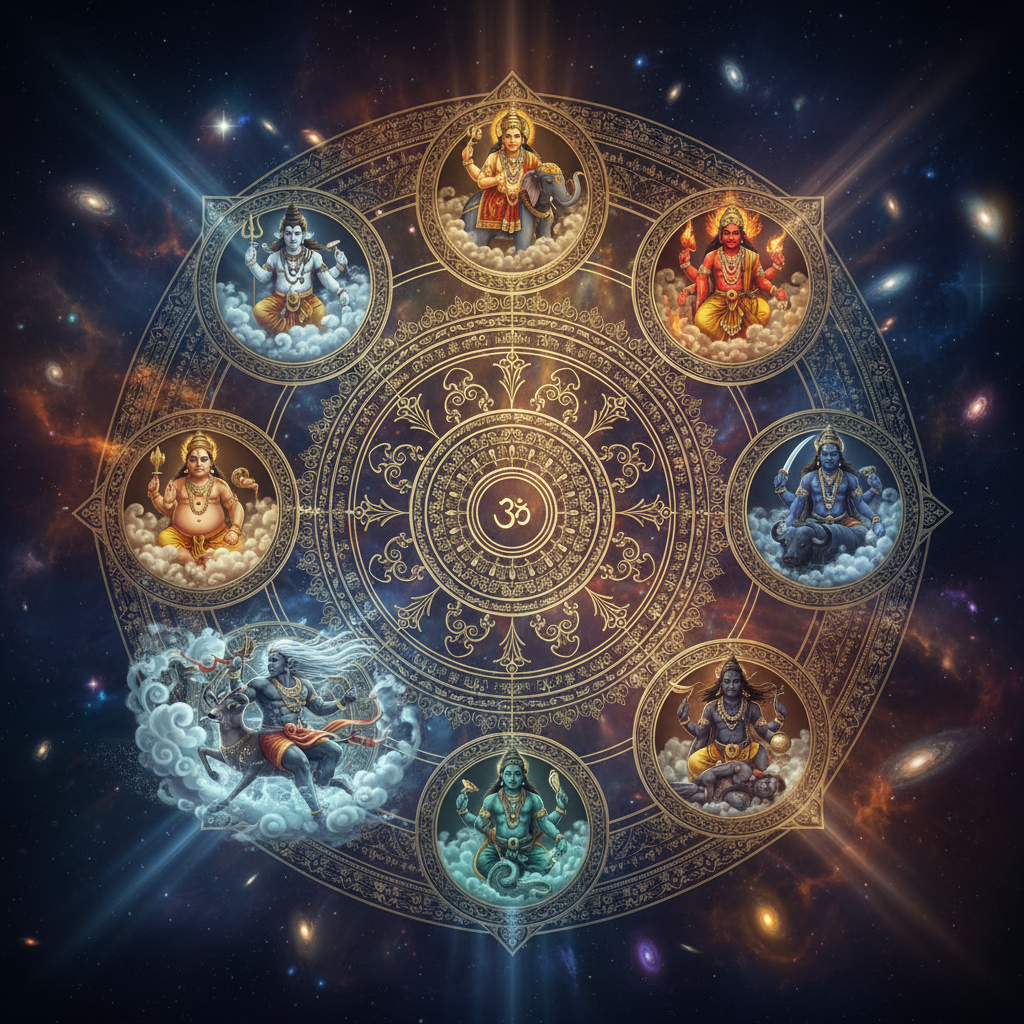
His role as a Lokpala, a guardian of the directions, places him within the formal cosmological structure of Hindu thought. The eight Lokpalas guard the eight directions, with major gods (Indra, Yama, Varuna, Kubera) at the cardinal points and others (including Vayu, Agni, Soma, and Ishana) at the intermediate points. The cosmos is structured. The directions are watched. Each direction has a divine custodian.
The Indo-European cognates make Vayu particularly interesting for comparative mythology. The Sanskrit vayu and the Avestan vayu derive from the same Proto-Indo-Iranian root. The Iranian Vayu in the Avesta is a more morally complex figure, sometimes a benevolent wind, sometimes a devourer. The reconstructed pre-Vedic wind god probably had elements of both, which Hindu and Zoroastrian traditions then specialised differently. Vayu is one of our clearest windows into Indo-Iranian religion before the split.
Legacy and Modern Influence
Vayu remains an active deity in Hindu practice today. Vedic rituals continue to invoke him. Yogic and Ayurvedic systems treat his name as functionally synonymous with the principle of breath and air. Hanuman temples across India and the wider Hindu world honour Vayu as the father of the monkey god. Daily prayers in many Hindu households thank Vayu for the breath that makes the day possible.
His name appears in Indian science and engineering: the Indian Air Force is sometimes called Vayu Sena, and aviation projects regularly use his name. The Vayu Purana, one of the eighteen great Puranas, is dedicated to him and contains some of the most detailed accounts of his theology. The text, dating in its current form from around the early centuries CE, is still studied in modern Sanskrit programmes around the world.
For modern readers, Vayu offers a model of theological depth that the more anthropomorphised wind gods of other traditions sometimes lack. He is wind, breath, life-force, and Lokpala all at once. He is named in scripture three thousand years old and prayed to today. He is the father of two of the most loved heroes in world literature. He is the breath you are taking right now as you finish this sentence.
More From Hindu Mythology
Continue exploring the gods, sages, and epics of Hindu tradition. New encyclopedia entries published every week.
Explore MoreFrequently Asked Questions
Who is Vayu in Hindu mythology?
Vayu is the Hindu god of wind, air, and breath, one of the eight Lokpalas (guardians of the directions) and a Vedic deity of great antiquity. His name in Sanskrit means simply “wind” or “air”, and he is associated with prana, the life-force that moves through every breathing being.
Who are Vayu’s famous sons?
Vayu is the father of Hanuman, the monkey god of the Ramayana, and of Bhima, the strongest of the Pandava brothers in the Mahabharata. Both sons inherit Vayu’s strength, speed, and power, and both are among the most beloved heroes in Hindu literature.
What is the connection between Vayu and prana?
Prana is the Hindu concept of life-force or vital energy, and is identified with the breath. Vayu, as the god of wind and air, is the macrocosmic form of prana. Yogic practices of pranayama (breath control) are in this sense practices oriented toward Vayu. The wind in the world and the breath in the body are the same divine substance.
What is a Lokpala?
The Lokpalas are the eight guardian deities of the directions in Hindu cosmology. They include Indra (east), Yama (south), Varuna (west), Kubera (north), and the four intermediate guardians Agni (southeast), Vayu (northwest), Soma or Ishana (northeast), and Nirriti (southwest). Vayu’s domain is the northwest.
Is Vayu related to other Indo-European wind gods?
Yes. The Sanskrit Vayu and the Avestan Vayu (Iranian) descend from a shared Proto-Indo-Iranian root, and the wider family includes the Lithuanian Vejas and proto-Slavic root words for breath. The Iranian Vayu in the Avesta is a more morally ambiguous figure than the Vedic Vayu. Comparative mythology treats them as two specialisations of a shared ancestor.
Is Vayu still worshipped today?
Yes. Vayu is invoked in Vedic ritual, in daily Hindu prayer, in yogic and Ayurvedic practice, and at Hanuman temples across India and the wider Hindu world. His name appears in modern Indian institutions including the air force (Vayu Sena) and many engineering projects.