Quick Summary
- Chione is the Greek nymph or goddess of snow, daughter of Boreas the north wind and Oreithyia the Athenian princess he abducted.
- Her name comes directly from the Greek word for snow (chion), and she is the personification of falling snow itself.
- She belongs to the broader family of nymphs and minor goddesses tied to specific natural phenomena, alongside her sister Cleopatra and brothers Zetes and Calais.
- Greek mythology contains several women named Chione, but the snow nymph daughter of Boreas is the most consistent figure across the sources.
- She represents one of the most direct personifications of weather in the Greek pantheon, simpler in concept than her storm-fathered cousins but powerful in image.
The first snow of winter falls on the high mountains of Thrace. The white powder settles on the pine trees, on the rocks, on the streams already going to ice. The Greeks watching from the warmer lands to the south knew where the snow came from. The cold wind that brought it had a name: Boreas, the north wind. The snow itself had a name too. The snow was his daughter, and her name was Chione.
Chione is one of the smaller figures in Greek mythology, mentioned in passing rather than starring in great cycles, but her presence in the Greek imagination is steady and clear. The Greeks saw the natural world as populated by minor deities tied to specific phenomena. The springs had nymphs. The trees had dryads. The mountains had oreads. The snow had Chione. Each natural force was, to some extent, alive.
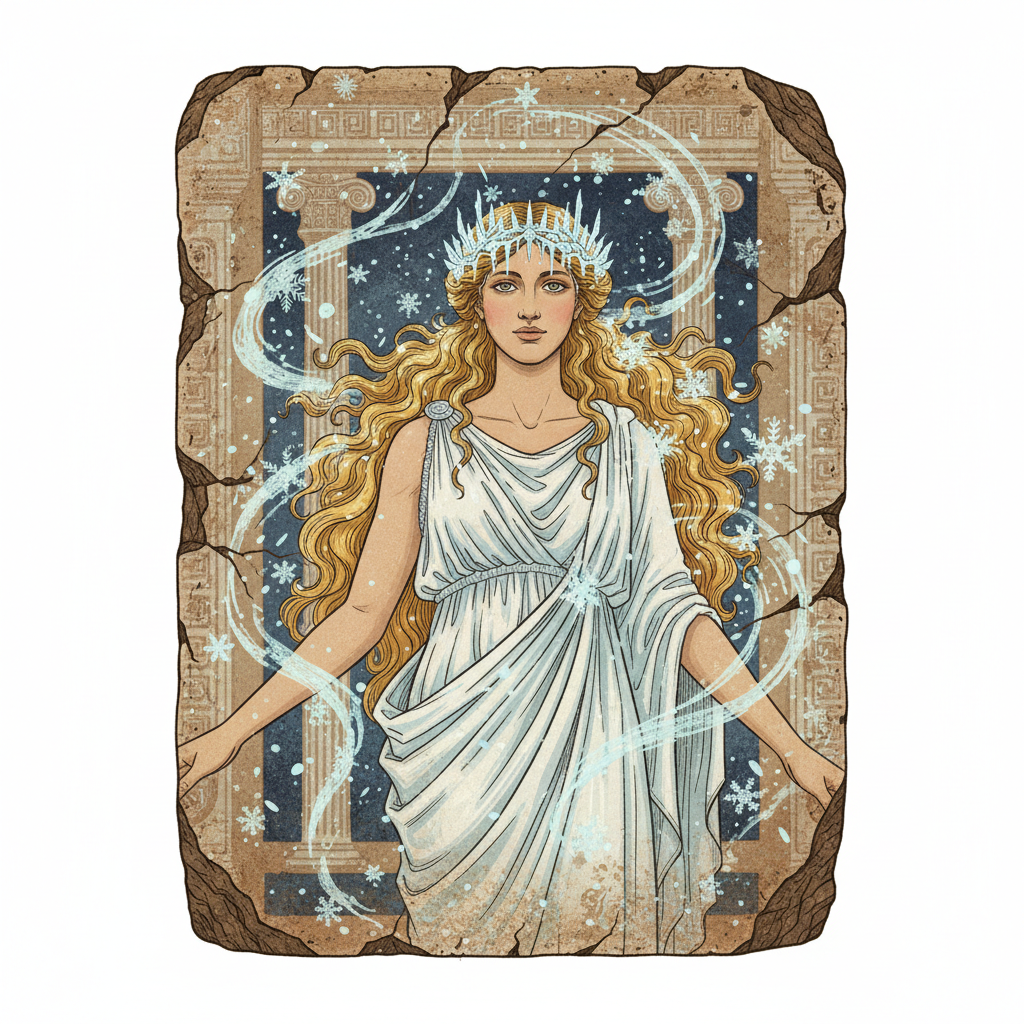
Origins and Cultural Roots
Chione (Χιόνη) is the daughter of Boreas, one of the four Anemoi wind gods, and Oreithyia, an Athenian princess whom Boreas abducted from a meadow on the banks of the Ilissos river. The story of her parents’ meeting is one of the most famous Boreas myths and is preserved in many sources, including Plato’s Phaedrus, Ovid’s Metamorphoses, and the lyric poets. Chione is the daughter of that union.
Her name comes directly from chion (χιών), the ordinary Greek word for snow. Like her father’s siblings whose names mean “north wind”, “south wind”, “east wind”, and “west wind”, Chione’s name and her function are the same word. She is snow personified.
Her siblings are also figures of weather and motion. Her sister Cleopatra (not the Egyptian queen, an entirely different figure) was queen of Thrace. Her brothers, the Boreads, were Zetes and Calais, winged warriors who flew with Jason and the Argonauts on the quest for the Golden Fleece. The Boread family is the family of the cold north wind given many faces.

Chione in Greek Sources
The fullest mention of the snow Chione comes from the Roman poet Hyginus, who in his Fabulae (1st century CE) names her as a daughter of Boreas and Oreithyia. Greek sources mostly mention her in genealogies and family trees rather than in narratives of her own. There are no major Chione myths the way there are major Persephone or Demeter myths. She is part of the cold wind’s household.
This relative narrative quietness is not unusual for Greek nature deities. The Anemoi themselves have far fewer detailed myths than the Olympians, and the children of the Anemoi have fewer still. They are present, named, honoured, but not narratively foregrounded. Their presence is structural rather than dramatic. The world has snow because Chione exists. That is enough for the mythological economy.
Several other Greek mythological figures share the name Chione, including a daughter of Daedalion and a daughter of Callirhoe. The genealogical confusion is typical of Greek myth, where names recur and characters with the same name in different genealogies are sometimes conflated and sometimes carefully kept separate by ancient commentators. The snow nymph daughter of Boreas is the figure most often meant when Chione appears in connection with weather.
The Cold Mountains of Thrace
The home of Boreas, in Greek tradition, was Thrace, the land north of the Aegean now divided between Greece, Bulgaria, and Turkey. The Thracian mountains were the source of the cold winds that swept south into the Greek world each winter. Greek poets imagined Chione as living in these mountains with her father and her sisters, descending to the lowlands when the cold months came.
The geography is significant. Greece itself has snow only in the high mountains and only in the deep winter. The Greek sense of snow as something brought from the north, as a foreign element imported by Boreas, reflects the climate of the southern Aegean. Cold and snow were associated with somewhere else, a place beyond the everyday. Chione, daughter of the cold wind, was a figure from a colder country.

Symbolism and Meaning
Chione embodies one of the cleanest examples of Greek nature personification. She is not a complex deity. She has no consort drama, no underworld journey, no rivalry with another goddess. She is what her name says she is. Snow, given a body. The Greek pantheon often works this way for the smaller forces of nature: the spring nymph is the spring, the snow nymph is the snow.
This kind of clean personification has its own theological power. To name the snow Chione is to acknowledge that the falling of snow is a presence in the world, not a phenomenon. Something is happening. A being is acting. The cold wind has a daughter, and her descent is what we feel on our skin in February.
Cross-cultural parallels are striking. The Norse Skadi is the giantess of winter mountains and snow, paired with skiing and hunting. The Slavic Marzanna is the goddess of winter killed in effigy each spring. The Inuit Sedna is associated with cold seas. Wherever cold and snow have been a serious presence in human life, deities of cold have appeared. Chione is the Greek version, lightly drawn but unmistakably part of the family.

Legacy and Modern Influence
Chione’s name has had a quiet but persistent afterlife. In modern Greek, chioni is still the word for snow. The element chion- appears in scientific names of snow-related plants and animals: the chionophore (snow-bearer) plants of the Mediterranean and central Asian mountains, the chionophiles (snow-lovers) of cold-climate biology. The naming of snow leopards as Panthera uncia rather than something Chione-derived is a slight oversight in this tradition.
In modern fiction, Chione appears occasionally in Rick Riordan’s series, in fantasy novels, in role-playing games, and in poetry that reaches for the snow-personification image. She is rarely a central figure. The same understated presence that made her a minor Greek deity makes her a minor character in modern adaptation, although her name is so beautiful and so specific that writers often reach for it when they need a goddess of snow.
For modern readers, Chione is a useful entry point into Greek nature mythology. The Anemoi are a family. The family has children. Each child carries some element of the parents’ domain. The snow that falls on a Thessalian peak in February has a name. The Greeks gave it. We can still pronounce it.
More From Greek Mythology
Continue exploring the gods, monsters, and heroes of ancient Greece. New encyclopedia entries published every week.
Explore MoreFrequently Asked Questions
Who is Chione in Greek mythology?
Chione is the Greek nymph or goddess of snow, daughter of Boreas the north wind and Oreithyia the Athenian princess he abducted. Her name comes from the Greek word for snow, and she personifies the falling snow itself. Her siblings include Cleopatra of Thrace and the winged Boreads Zetes and Calais.
What does the name Chione mean?
Chione comes directly from chion (χιών), the ordinary Greek word for snow. Like her uncles the Anemoi whose names mean “north wind”, “south wind”, and so on, her name is identical with the natural phenomenon she personifies.
Is Chione related to the Anemoi?
Yes. Her father Boreas is the north wind, one of the four Anemoi wind gods of Greek mythology. As his daughter, Chione belongs to the household of the cold north wind, descending from the mountains of Thrace each winter to bring snow to the Greek world.
Are there other Chiones in Greek myth?
Yes. Several Greek mythological figures share the name, including a daughter of Daedalion who was beloved by both Apollo and Hermes, and a daughter of Callirhoe. The snow nymph daughter of Boreas is the figure most often meant when Chione appears in connection with weather and the cold mountains of Thrace.
Why was Boreas associated with Thrace?
Thrace, the land north of the Aegean, was where the cold winds came from in the Greek imagination. Greek poets located the home of Boreas, and therefore of his daughter Chione, in the Thracian mountains. Cold and snow were associated with somewhere beyond the warm Aegean lands.
How does Chione fit into other snow goddess traditions?
She belongs to a wider European family of cold-and-snow deities, alongside the Norse Skadi, the Slavic Marzanna, and the Germanic Holda. Each tradition gives the cold a face. Chione is the Greek version, simpler than some of her cousins but unmistakably part of the family.